For high-earning technology executives, corporate promoters, and affluent Indian families, spending decades constructing an exceptional capital base is a common achievement. Yet, securing how that accumulated capital transitions across generations often remains a fragmented afterthought. It is a dangerous structural paradox: a family may spend years optimizing equity asset location or minimizing mutual fund fee drag, while completely ignoring the legal architecture required to transfer those assets seamlessly. Wealth creation is only half the journey; wealth transmission is the other.
A pervasive reductionism dominates the personal finance landscape, leading many to believe that estate planning is either an exclusive tool reserved for ultra-wealthy dynasties or a simple task solved by filling out standard bank nominations. In reality, a nominee is frequently nothing more than an administrative trustee, not the ultimate beneficiary. True estate planning is a comprehensive engineering discipline. It demands a unified framework that balances active wealth preservation with structural legal insulation, private family governance, digital asset mapping, and the absolute verification of clean generational transmission across full market cycles.
The Estate Planning Myth: Defining the Fiduciary Perimeter
Estate planning is not about death; it is about protecting family harmony, securing lifestyle continuity for vulnerable dependents, maintaining absolute balance sheet privacy, and eliminating unnecessary litigation drag. If you ask a successful professional whether they hold diversified investments and robust insurance shields, they will confidently present a clean spreadsheet. But if you ask whether they possess a legally valid, updated Will, the answer is routinely negative. Estate planning establishes a defensive perimeter around your household balance sheet, ensuring your assets obey your precise intentions when you are no longer around to manage them.
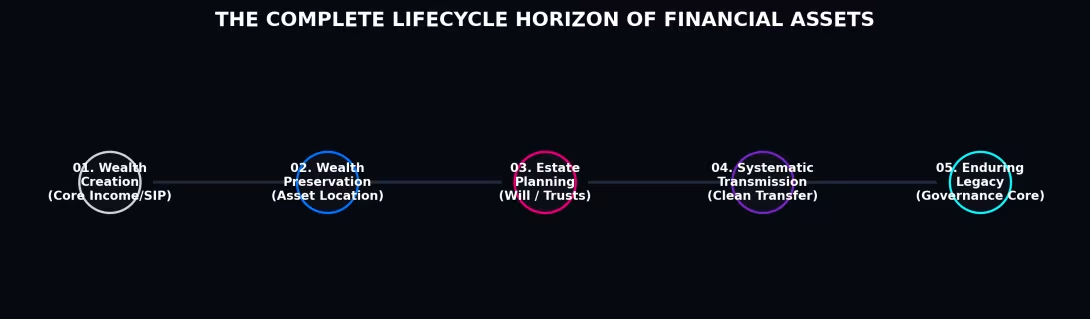
Deconstructing the Real Asset Perimeter: What Is Your True Estate?
An institutional legacy plan begins by auditing and organizing every component of your net worth into a single, centralized wealth inventory. Affluent families accumulate diverse asset tranches that cut across multiple distinct operational perimeters:
- Financial Assets: Direct blue-chip equities, direct-plan mutual funds, corporate debt bonds, bank fixed deposits, Public Provident Fund (PPF) lifecycles, and Employee Provident Fund (EPF) cashways.
- Physical Assets: Premium residential properties, commercial real estate parcels, agricultural land rights, ancestral gold, and high-value physical collections.
- Business Assets: Partnership firm interests, founder equity shares in closely held private enterprises, startup venture allocations, and commercial practice billings.
- Digital Assets: Sovereign crypto-asset tranches, primary email domains, commercial websites, cloud-storage code repositories, and high-value digital media channels.
Failing to build a clear, easily accessible directory of these components ensures that your legal heirs can spend years executing stressful administrative searches across disconnected financial institutions just to identify the family's assets.
The Intestate Vulnerability Vector: The Reality of Dying Without a Will
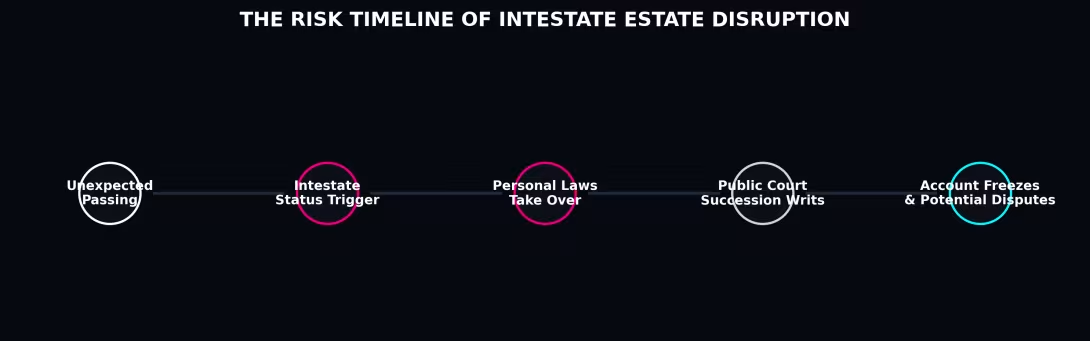
Dying without leaving a legally valid, uncompromised Will is known as dying intestate. When this operational failure occurs, your personal choices and intentions regarding your wealth are completely erased from the legal system. Your estate is thrust into a rigid distribution framework governed strictly by statutory personal succession laws, such as the Hindu Succession Act, 1956, or the Indian Succession Act, 1925.
The consequences of intestate succession introduce immense stress and heavy financial costs into an affluent household. Rather than experiencing a smooth asset shift, your surviving spouse, children, and parents are forced to navigate the public court system to secure legal titles. This path demands filing for expensive Succession Certificates for financial liquidities or Letters of Administration for real estate, exposing your family's personal wealth records to the public, triggering prolonged account freezes, and creating fertile ground for multi-generational legal battles.
The Custodian Paradox: Nominee vs. Legitimate Legal Heir
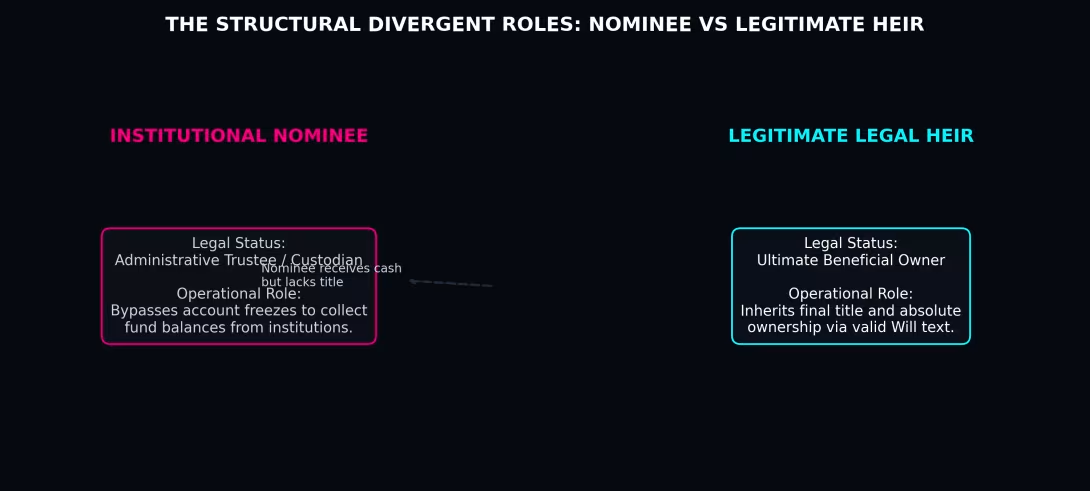
The single most expensive misconception across the Indian personal finance landscape is the widespread belief that setting up an asset nomination automatically transfers permanent legal ownership to that nominee. This is flatly incorrect. Under established Indian jurisprudence, a nominee is merely an administrative custodian or trustee—a legal placeholder authorized by institutions to collect funds or units to prevent immediate account abandonment.
The nominee holds the assets in a fiduciary capacity for the legitimate legal heirs, who are determined either by a valid Will or by the laws of intestate succession. Consider how this operational boundary handles your primary financial instruments:
| Financial Instrument Wrapper | Nomination Legal Status | Ultimate Title Ownership Boundary | Strategic Purview for Legacy Plans |
|---|---|---|---|
| Bank Savings & Fixed Deposits | Pure administrative custodian tracking | Governed strictly by Will or Succession Acts | Nominee can withdraw funds but must distribute them to legal heirs. |
| Mutual Fund Schemes | Custodian receiver mechanism | Governed strictly by Will or Succession Acts | Units transfer to the nominee's folio purely as a trustee holder. |
| Corporate Demat Shares | Subject to specific Companies Act rules | Will overrides unless explicitly contested | Requires careful alignment between your Will text and demat nomination tags. |
| Life Insurance Proceeds | Beneficial Nominee framework rules | Nominated immediate family owns the funds | Spouse, children, or parents named serve as the definitive beneficiaries. |
To guarantee an uninterrupted, smooth transfer of wealth, your estate strategy must combine nominations with a valid Will. This dual configuration ensures your nominee can access accounts immediately without triggering asset lockups, while your Will provides the legal title required to pass ownership permanently without court intervention.
Will Execution Mechanics: Eliminating Structural Drafting Errors
A Will is a versatile legal document that allows you to direct the transmission of your wealth. However, it must adhere to strict statutory execution standards to ensure it cannot be easily contested or declared invalid during probate. A legally sound Will requires meeting basic compliance conditions: the testator must possess absolute sound mental capacity, the asset descriptions must use clear language that avoids ambiguity, and the document must be signed in the physical presence of at least two independent witnesses who are not beneficiaries under the Will.
While registering a Will under the Indian Registration Act, 1908, is generally not mandatory, doing so significantly increases the document's legal weight. Registering your Will means the testator and the witnesses appear personally before a government Sub-Registrar, who records and stores the final document in the official state registry. This validation process provides strong evidence of authenticity, making it incredibly difficult for disgruntled parties to contest the Will later by claiming forgery or undue influence.
Private Family Trusts: Strategic Controls and Protection for Dependents
As your family net worth scales past basic liquidity milestones, relying solely on a standard Will can introduce structural limitations. A Will can only execute a one-time transfer of wealth upon your death, passing assets directly to your heirs regardless of their age, financial literacy, or emotional readiness. To build long-term control, affluent families utilize Private Family Trusts to manage their generational legacy.
A Private Trust operates as an independent, tax-aware fiduciary layer. By separating asset ownership into three distinct roles—the Settlor (who transfers the capital), the Trustee (who manages the assets under strict fiduciary guidelines), and the Beneficiaries (who receive the financial distributions)—you can implement precise, multi-generational wealth controls:
- Revocable Trust Layouts: Allows the Settlor to maintain complete control over the trust assets during their lifetime, retaining the power to amend, restructure, or revoke the entire framework at any moment.
- Irrevocable Trust Structures: Involves a permanent transfer of capital out of your personal name, creating an independent asset shield that insulates family wealth from business liabilities, commercial bankruptcies, or high-risk legal claims.
- Protection for Vulnerable Dependents: Enables structured, incremental distributions to support minor children, elderly parents, a dependent spouse, or special-needs family members. This setup ensures that large inheritances are never mismanaged or exposed to predatory financial actors.
Digital and Cross-Border Estate Frontiers: Navigating Modern Capital Loops
Modern estate planning must also look beyond traditional physical assets to secure your digital and global footprint. A modern digital estate plan demands building an independent inventory that documents access instructions for cloud architecture repositories, domain registries, and digital portfolios, ensuring your executors can manage your digital presence without facing immediate security lockouts.
This digital planning must be paired with cross-border legal coordination if you hold international assets. Families navigating cross-border horizons—such as holding US brokerage accounts, UK investment properties, or global RSUs—cannot rely on a single domestic Will to transfer their wealth. Foreign courts routinely refuse to execute localized Indian estate orders, leaving international assets stuck in costly jurisdictional deadlocks. Securing a global legacy requires establishing concurrent jurisdictional Wills, ensuring your Indian Will manages your domestic assets cleanly while separate, host-country testamentary documents govern your offshore capital loops according to local estate tax rules.
Tax Location Multipliers: The Post-Inheritance Fiscal Landscape
Evaluating wealth preservation metrics requires analyzing the exact tax environment governing your estate transfer. Under current Indian tax compliance guidelines, there is no inheritance tax or estate duty levied on the transfer of wealth via a valid Will or intestate succession rules. The receipt of inherited assets is also fully exempt from income tax under the Section 56(2)(x) gift tax exemptions for specified relative tracks.
However, significant tax events occur later when your beneficiaries decide to liquidate those inherited assets. To optimize these future liabilities, your heirs must trace and reset their cost basis using clear tax-location rules:
| Inherited Asset Class | Cost of Acquisition Basis | Holding Period Tracking Rule | Long-Term Capital Gains Tax (LTCG) |
|---|---|---|---|
| Listed Equity Shares & Mutual Funds | Original cost paid by the previous owner | Calculated from the original date of purchase | Taxed at flat long-term rates after adjusting for step-up milestones. |
| Residential & Commercial Real Estate | Original cost paid by the previous owner | Calculated from the original date of purchase | Entitled to full indexed cost updates using the Cost Inflation Index (CII). |
Ensuring your wealth inventory contains the original purchase bills and tax documentation allows your heirs to accurately claim these indexation benefits, completely shielding their inherited legacy from unnecessary tax erosion.
Family Governance and the Intergenerational Conversation
Empirical wealth data reveals a sobering statistic: the vast majority of multi-generational family fortunes disappear within three generations. This loss rarely stems from poor investment performance or market volatility; it is driven primarily by a breakdown in family communication, misaligned expectations, and a total absence of Family Governance.
True estate protection requires moving past simple legal documentation to host open financial conversations within the household. The core value of estate planning lies in transferring clarity long before the files are needed—ensuring your family knows where assets are located, who is designated to act as the executor, how minor dependents will be protected, and what shared financial values accompany the capital. Establishing a formal Family Constitution and hosting structured family meetings creates an enduring decision-making framework, transforming your wealth into an uncompromised legacy of purpose-driven contribution.
The Actionable Strategic Estate Checklist Matrix
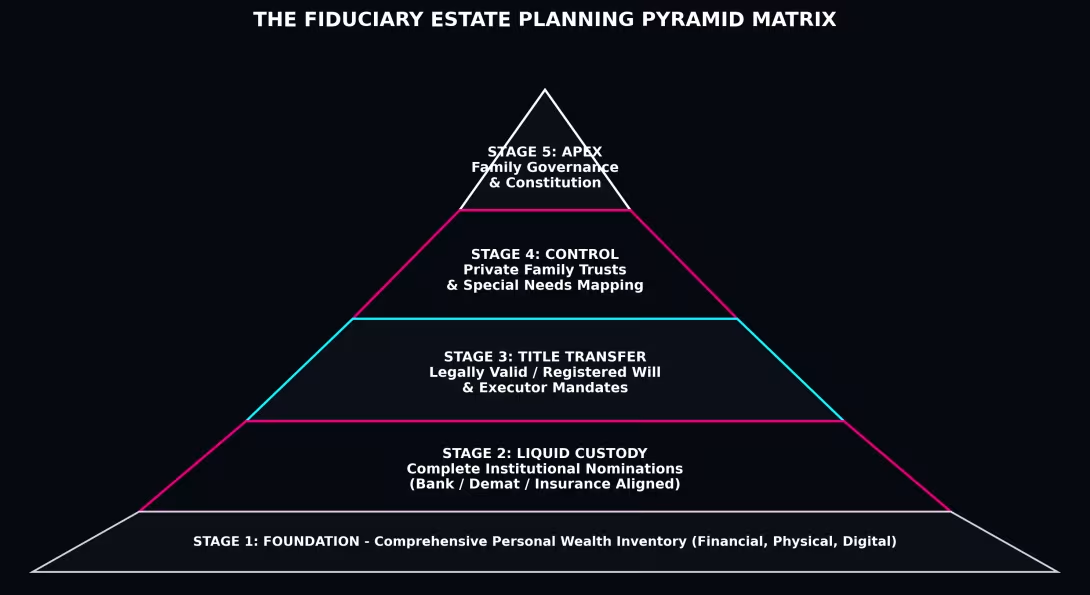
An unexecuted strategy introduces silent, ongoing risks to your family legacy. To transition from basic wealth accumulation to an active preservation framework, affluent households must systematically complete six core milestones. Use this structural checklist to audit, verify, and track your balance sheet's generational readiness:
| Audit Track | Strategic Milestone Action | Core Operational Purview | Execution Priority Status |
|---|---|---|---|
| [ ] | 01. Asset Directory Compilation | Aggregate all financial folios, physical real estate deeds, private business shares, and digital assets into a single wealth directory. | Phase 1 Foundation |
| [ ] | 02. Institutional Nomination Alignment | Update and align all nomination files across insurance, bank accounts, and demat ledgers to prevent custodian freezes. | Phase 1 Foundation |
| [ ] | 03. Legal Will Drafting | Execute a clear, uncompromised Will in the presence of two independent witnesses, and complete registration for legal protection. | Critical Perimeter |
| [ ] | 04. Digital Estate Infrastructure | Document private encrypted entry credentials, email control configurations, and software repository keys for the executor. | Operational Shield |
| [ ] | 05. Private Family Trust Setup | Establish revocable or irrevocable trust layers to protect minor children, handle estate taxes, and shield against liabilities. | Advanced Control |
| [ ] | 06. Unified Family Governance | Formulate a formal Family Constitution and lead regular financial meetings to align your values with capital transmission. | Generational Continuity |
Reviewing this structural checklist at least once every two to three years—or immediately following major life events such as corporate transitions, changes in family structure, or overseas asset acquisitions—guarantees that your wealth transmission lines remain structurally sound and completely aligned with your long-term intentions.
Financial Planning Mistakes That Cannot Be Fixed by Higher Returns
The single most dangerous misconception across the affluent market is the belief that superior fund selection or high portfolio returns can compensate for a broken, uncoordinated estate foundation. Investors frequently spend decades optimizing their equity yields from 12% to 15%, while leaving critical, systemic gaps across their broader wealth plan.
In the real world, an unexpected life event will easily overwhelm market outperformance. Consider the critical structural mistakes that no level of portfolio returns can ever fix:
- Relying Solely on Asset Nominations Without a Legally Valid Will: Leaving multi-crore accounts backed only by nominal bank nominations ensures your family faces immediate asset freezes, public probate delays, and complex succession challenges right when they need liquidity most.
- Failing to Adapt Your Estate Plan to Global Jurisdictions: Accumulating cross-border brokerage balances or international stock blocks without drafting concurrent, jurisdiction-specific Wills ensures that foreign estate taxes (up to 40%) can aggressively erode your wealth, unhindered by your domestic investment performance.
- Allowing Your Will to Become Outdated or Contradictory: Maintaining an old Will that fails to reflect your current asset inventory, changes in family structure, or new business partnerships creates fertile ground for multi-generational legal disputes that can drain your capital through prolonged litigation.
- Operating Without an Independent Health and Disability Shield: Relying exclusively on corporate group cover means that if a sudden health crisis forces a career transition, your protection disappears instantly, exposing your core compounding equity folios to forced, premature liquidations to fund private medical inflation.
- Keeping Your Spouse and Adult Children Isolated from Wealth Awareness: Failing to maintain an open dialogue regarding asset locations, account passwords, and executor designations means that if an unexpected crisis occurs, your family lacks the operational knowledge required to access and manage the wealth you worked to build.
"A 15% return portfolio cannot compensate for a broken financial plan. True global financial independence is achieved by establishing clear, regulatory guardrails around your capital, ensuring your assets can withstand international compliance shocks across full economic cycles."
The True Role of a SEBI Registered Investment Adviser
Navigating the intersections of structural asset allocation, multi-jurisdictional compliance, tax location mapping, and estate continuity completely on your own can quickly turn into an exhausting second job. That is precisely why partnering with a fee-only, SEBI Registered Investment Adviser (RIA) is so vital. A true fiduciary adviser looks past short-term transaction volumes or sales pitches. Their focus is completely on your long-term success.
At Wealth Together, our relationship model is completely decoupled from conflict-laden sales commissions or hidden distribution networks. Having successfully navigated this exact corporate transition ourselves, we understand the unique pressures facing high-end technology professionals and modern families. Our mission is to serve as an objective, trusted sounding board—helping you organize your financial assets, compile a robust wealth inventory, align your investment accounts with proper nominations, and coordinate seamlessly with specialized legal professionals to ensure your financial blueprints survive every life transition with absolute peace of mind.
We invite you to explore our custom Get Started Roadmap to understand our transparent, fee-only advisory onboarding process, or seamlessly utilize our floating portal block to secure your personalized, zero-obligation portfolio discovery session today.
Skip commission-driven sales pitches and align your capital with a pure fee-only fiduciary adviser.