For high-earning technology professionals, corporate promoters, and affluent families in India, building a significant capital base is a testament to decade-long career discipline. However, maintaining that capital across extended economic horizons introduces a completely separate challenge. In mature portfolios, the primary threat to your financial security is rarely poor investment performance. The true risk is systemic behavioral failure—the tendency to let emotional reactions during market drops disrupt a well-designed financial strategy.
Most mainstream financial platforms analyze market volatility by focusing exclusively on product selection or shifting short-term past performance metrics. This narrow view completely ignores the psychological pressures that dictate real-world investor behavior. A professional fiduciary framework treats behavioral management as a core return enhancer. Protecting your family estate requires understanding how your natural instincts react to market drops, recognizing the commercial incentives behind sensationalized headlines, and establishing structured, rule-based frameworks to keep your execution aligned with your long-term goals.
The Risk Manager Paradigm: Behavioral Discipline vs. Forecasting Illusion
The defining error across affluent portfolios is assuming that wealth preservation requires predicting the exact bottom or top of an economic cycle. This search for absolute certainty often leads investors to follow unverified online forecasts, adjust their long-term allocations based on short-term news, or exit the market entirely during global panics. In reality, a great investment choice cannot compensate for a broken financial plan. True portfolio insulation relies on rule-based asset allocation, clear liquidity guardrails, and the discipline to stay invested when uncertainty peaks.
Why Every Crisis Feels Like the End
The primary psychological barrier during an economic downturn is the illusion that the current crisis is completely unprecedented. When looking back at historical market pullbacks—including the global financial crisis, regional conflicts, sudden inflation spikes, and unexpected health panics—the subsequent recoveries look obvious on a chart. However, while navigating those phases in real time, sensationalized headlines continuously suggest that corporate earnings will never recover and that a total collapse is inevitable.
This pattern reveals a core truth about financial history: the specific triggers that spark a market correction change every cycle, but how human emotions react to those triggers remains remarkably consistent. Treating every macro adjustment as a sign of permanent structural failure leads to rushed, emotional decisions, making it vital to evaluate short-term volatility through a long-term historical lens.
The Script Changes, Human Behaviour Doesn't
To understand how emotional patterns repeat across separate market cycles, consider how the specific narrative changes while the underlying behavioral sequence remains exactly the same:
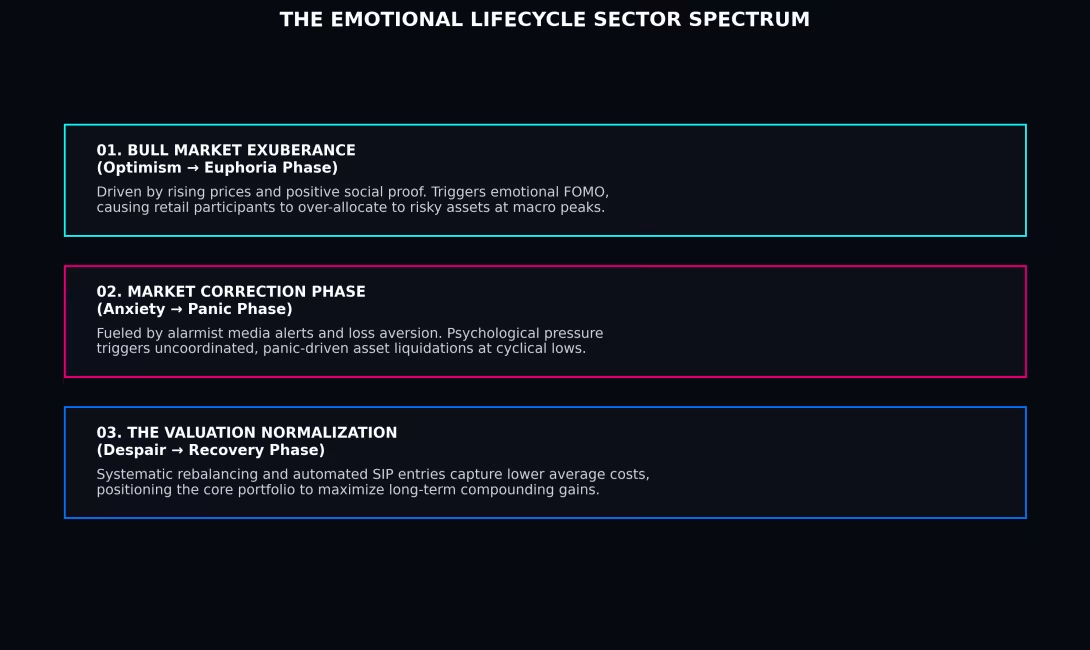
- The Global Financial Crisis (2008): Driven by a structural credit collapse, leading retail investors to assume the modern banking system was permanently broken.
- The Pandemic Shock (2020): Fueled by global health lockdowns, causing widespread assumptions that international trade and commerce would never resume normal operations.
- The Macro Rate Tightening (2022): Triggered by sudden inflation spikes and rapid central bank rate hikes, sparking widespread panic regarding prolonged stagflation.
- Emerging Structural Shifts: Driven by rapid artificial intelligence developments, automation trends, and changing global employment landscapes.
The underlying catalyst shifts every decade, but the emotional trap follows a predictable path: initial anxiety gives way to panic, leading to uncoordinated asset liquidations at cyclical lows. Once the market stabilizes and begins to recover, these same investors experience regret, fall into emotional trend-chasing, and eventually buy back into the exact same asset classes at significantly higher valuations, permanently breaking their compounding momentum.
The Psychology of Investor Panic
Behavioral finance proves that human instincts are naturally mismatched for long-term financial management. Over thousands of years, humans evolved to survive immediate threats by reacting instantly to danger—a primal survival mechanism that triggers rapid flight responses during times of crisis.
Financial markets exploit these deep-seated survival instincts. When portfolio screens turn red during a correction, a natural cognitive bias called Loss Aversion takes over, making the psychological pain of a financial loss feel twice as intense as the pleasure of an equivalent gain. This emotional pressure is amplified by Herd Mentality and Recency Bias—the tendency to assume that current downward price trends will continue indefinitely. This dynamic causes individual market participants to prioritize immediate comfort over disciplined, long-term risk planning.
The Business Model of Fear
To maintain complete emotional objectivity during a market correction, you must recognize that fear functions as a highly profitable commercial business model across modern digital platforms. Sensationalized financial predictions, alarming media alerts, and warnings of imminent economic collapse are deliberately designed to capture consumer attention. Because human psychology is naturally wired to respond to negative triggers, high-stress commentary drives massive online engagement, views, and ad revenue.
Recognizing that sensationalized market warnings are often driven by simple platform monetization changes your perspective. Alarmist soundbites spread significantly faster than balanced, objective data. True balance sheet protection requires building a defensive perimeter around your attention span, tuning out loud online commentary, and basing your financial execution strictly on audited corporate fundamentals.
Finfluencers, Crash Predictions, and Market Astrologers
During periods of high market uncertainty, investors frequently look for absolute certainty, making them vulnerable to unverified online forecasts and speculative stock tips. This demand is met by a wide array of unregistered commentators, messaging group tip lines, and financial astrologers who claim to predict exact market tops, bottoms, and macroeconomic shifts.
A simple historical review reveals that no individual or algorithm consistently forecasts complex international economic developments. Unregistered commentators focus on generating clicks and views; they do not conduct proper risk profiling or hold any legal accountability for your personal outcomes. A professional strategy relies on structured wealth planning rather than speculative predictions, ensuring your portfolio is built to handle multiple future scenarios safely.
What History Teaches Us About Market Corrections
Evaluating the long-term historical performance of public equity markets provides important context that helps counter short-term panic. Over multi-decade cycles, corrections represent a natural, healthy component of the wealth-creation process:
| Historical Market Crisis Event | Average Peak-to-Trough Drawdown | Typical Short-Term Sentiment Boundary | Long-Term Compounding Recovery Outcome |
|---|---|---|---|
| Dot-Com Valuation Crash | Significant Valuation Drops | Assumed technology sectors would never recover | Led to a healthy realignment around profitable, cash-generating business models. |
| Global Financial Crisis | Severe Structural Equity Declines | Widespread panic regarding systemic credit failures | Sovereign central banks reinforced liquidity lines, driving a decade-long economic expansion. |
| Pandemic Liquidity Shock | Rapid, High-Velocity Correction | Lockdown fears suggested global trade was broken | Triggered a swift, massive corporate earnings recovery across all global indices. |
| Geopolitical Rate Tightening | Prolonged Cyclical Adjustments | Fears of hyper-inflation and prolonged stagflation | Spurred corporate restructuring and solid earnings resilience across major industries. |
This data proves an essential truth: while short-term market drops are uncomfortable, they are temporary adjustments. The long-term path of diversified corporate equity is driven by corporate earnings growth and expanding consumer demand, ensuring that disciplined allocators are consistently rewarded for staying the course.
The Real Cost of Panic Selling
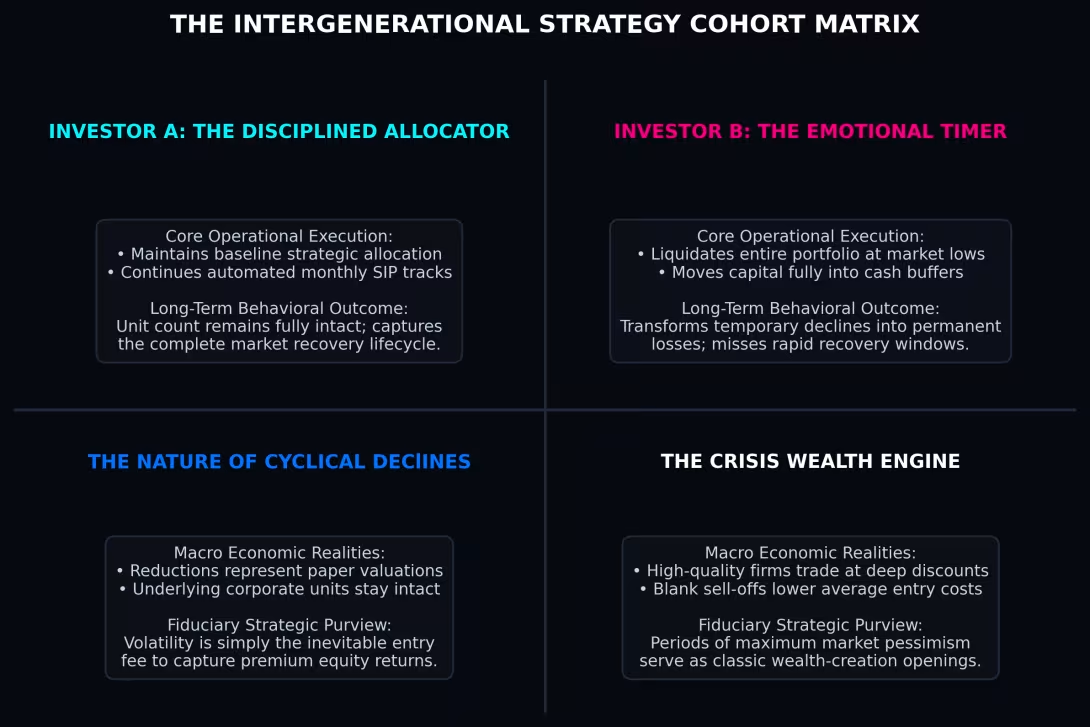
A critical distinction in financial planning is separating a temporary decline in paper valuations from a permanent loss of capital. When a diversified portfolio drops during a correction, your underlying unit ownership across top businesses remains fully intact. The drop represents a temporary shift in market valuation, not a destruction of the underlying assets.
Panic selling transforms these temporary paper declines into permanent capital losses. When an investor panics and exits to cash to "wait for clarity," they disconnect their capital from the market's natural recovery engine. This mistake is illustrated by a simple comparison:
- Investor A (The Disciplined Allocator): Maintains their core asset allocation throughout a 30% drop, keeping their unit count intact, and fully captures the subsequent market recovery as valuations normalize.
- Investor B (The Emotional Timer): Liquidates their entire portfolio at the absolute bottom of a correction to avoid further drops. They remain in cash during the initial phase of the recovery, hesitate as prices rise, and are eventually forced to buy back their original positions at a higher cost, permanently shrinking their capital base.
The Cost of Missing the Best Recovery Days
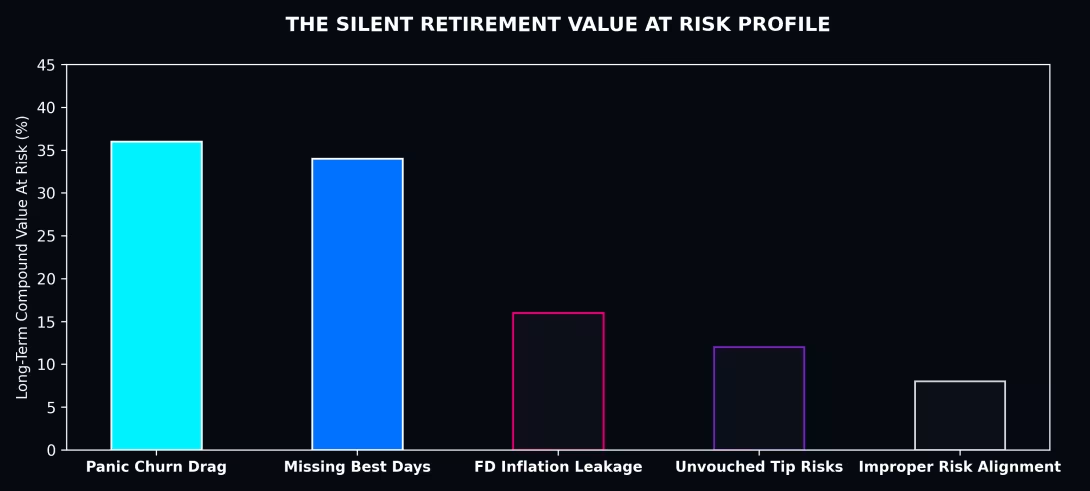
The primary mathematical danger of trying to time the market is that some of the strongest recovery days historically occur immediately following the worst declines. Forcing your capital into cash to escape a drop ensures you miss these high-velocity recovery windows, which can permanently damage your long-term compounding returns.
Data shows that missing just a handful of the market's best performing days over a multi-decade investing timeline can cut your final retirement net worth in half. True wealth preservation relies on understanding that volatility is simply the entry fee required to capture premium equity returns. Protecting your family legacy demands having the operational discipline to remain fully invested when short-term uncertainty peaks.
Why SIP Investors Have an Advantage During Market Falls
For families in their wealth accumulation phase, a down market should be viewed as an advantage rather than a crisis. Operating an automated Systematic Investment Plan (SIP) across low-cost direct plans during a correction allows you to leverage a process called Rupee Cost Averaging.
When prices drop, your fixed monthly SIP contribution automatically purchases a higher number of mutual fund units. As the market eventually stabilizes and moves into its next expansionary phase, this larger pool of accumulated units accelerates your compounding momentum. This dynamic confirms that accumulation phase portfolios should welcome market corrections as valuable opportunities to lower their average cost basis ahead of future growth cycles.
Why Crashes Can Be Wealth Creation Opportunities
An institutional wealth strategy treats market corrections as high-value wealth-creation windows, allowing you to secure equity stakes in top-tier corporations at deeply discounted prices. This process requires separating a temporary drop in stock prices from a permanent decline in underlying business health.
A broad market correction often triggers a blanket sell-off, dropping the share prices of resilient, cash-generating enterprises alongside lower quality assets. For an affluent investor with a long-term perspective, these phases represent the most efficient times to deploy capital, letting you acquire productive business assets at attractive valuations while short-term retail participants exit in a panic.
The Role of Asset Allocation and Proper Risk Profiling
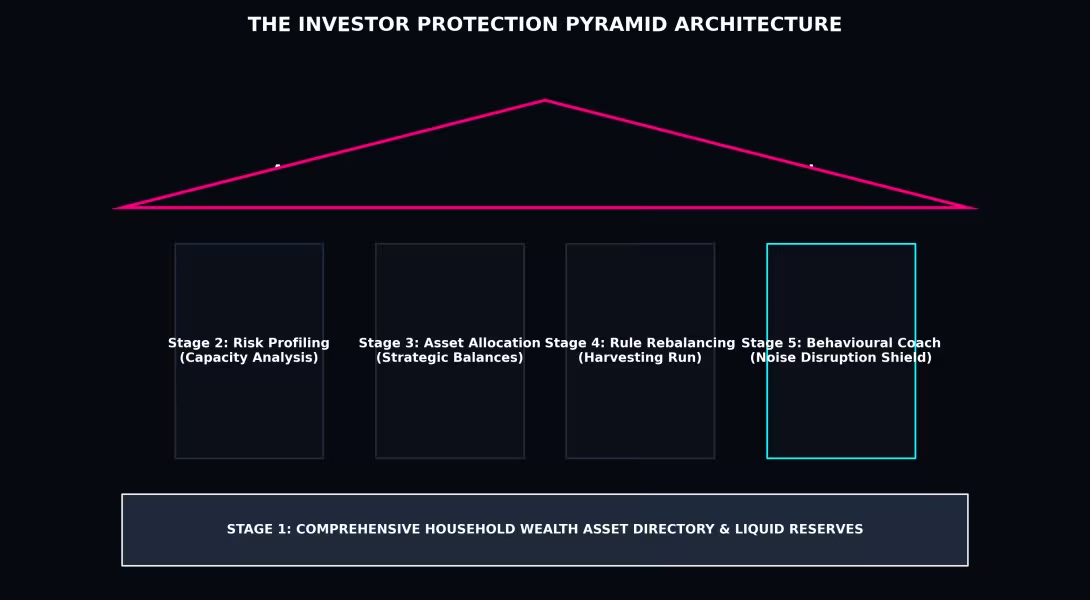
Maintaining absolute emotional discipline during an economic shock is impossible if your portfolio lacks a structured Strategic Asset Allocation. Diversification across non-correlating asset classes—including domestic equities, high-quality fixed income, international indices, and gold—serves a vital purpose: ensuring that your entire balance sheet never drops in unison.
Furthermore, a resilient asset allocation must be supported by accurate, personal risk profiling. Many retail investors label themselves as highly aggressive during prolonged bull markets, only to experience severe anxiety when their portfolio experiences a standard 20% correction. True risk management requires distinguishing between your emotional *risk tolerance* and your actual financial *risk capacity* (your real ability to withstand drawdowns based on your net worth, cash flows, and liability timelines). This analysis ensures your portfolio's risk profile perfectly matches your real-world financial situation.
What High-Net-Worth Investors Do Differently During Crises
Sophisticated High-Net-Worth Individuals (HNIs) and family offices manage market corrections using a disciplined, rule-based approach that stands in stark contrast to emotional retail behavior. During a correction, sophisticated allocators execute a clear strategy:
- Avoid making sudden changes to their long-term financial strategy based on media updates.
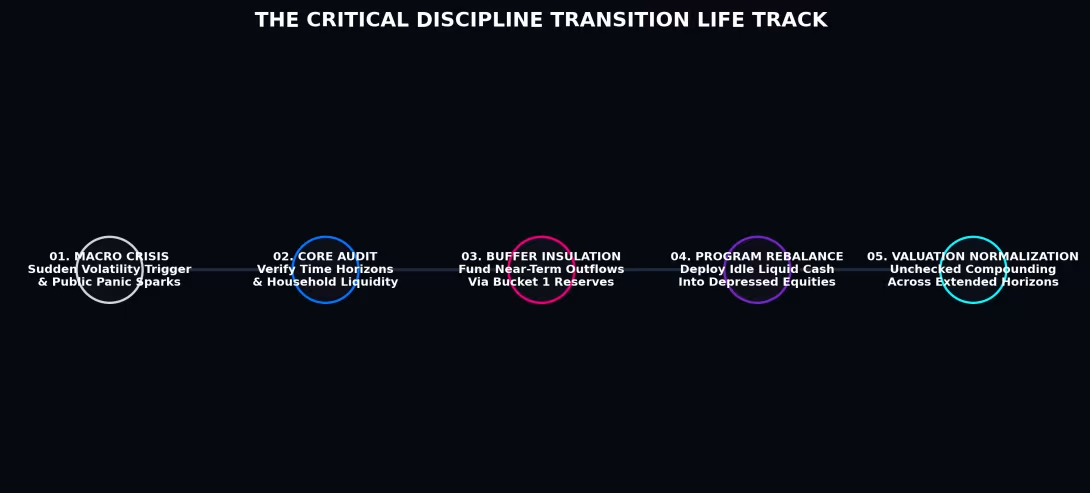
- Systematically rebalance their portfolios, moving capital out of outperforming, overvalued asset classes to add to depressed equity tranches.
- Deploy excess cash reserves into high-quality core equities once prices clear pre-set valuation targets.
- Audit their asset location setup to ensure their compounding engines remain fully optimized for post-tax returns.
The Power of Having Liquidity During Market Corrections
The primary tool required to maintain complete psychological objectivity during a market correction is a robust, dedicated Liquidity Buffer. Maintaining an exceptional net worth on a spreadsheet can create a false sense of security if your underlying capital is entirely locked up in illiquid, long-term real estate or concentrated equity lines.
Structuring your balance sheet into distinct time-horizon buckets ensures you hold sufficient cash, liquid funds, and arbitrage assets to cover your immediate lifestyle expenses for three to five years. This liquidity shield delivers a vital psychological benefit: knowing your near-term cash needs are fully secured means you never have to worry about short-term stock market drops, allowing your core equity tranches to compound undisturbed across full economic horizons.
Actionable Execution Checklists for Market Corrections
To transition from emotional, uncoordinated execution to a highly secure wealth preservation framework, affluent households must systematically adopt a disciplined, rule-based response plan.
When volatility hits, prioritize the following steps: first, completely tune out sensationalized headlines and short-term media forecasts; second, review your long-term family goals to verify your liability timelines remain unchanged; third, examine your current asset allocation across all accounts; fourth, ensure your automated SIP lines continue to run undisturbed; fifth, execute programmatic rebalancing if an asset class drifts past its pre-set target corridors; and finally, consult your fee-only fiduciary adviser to maintain perspective.
Conversely, you must avoid critical behavioral mistakes that can permanently damage your capital: do not halt active SIP plans during a decline, do not liquidate your core portfolio to move completely into cash, do not act on unvouched advice from online messaging groups, and never make major financial decisions based on short-term social media trends.
The Role of a SEBI Registered Investment Adviser During Market Volatility
Navigating the intersections of multi-asset allocation, complex tax compliance, holding bucket adjustments, and estate continuity completely on your own can quickly turn into an exhausting second job. That is precisely why partnering with a fee-only, SEBI Registered Investment Adviser (RIA) is so vital. A true fiduciary adviser looks past short-term transaction volumes or product distribution sales pitches. Their focus is completely on your long-term success.
A professional RIA serves primarily as an objective behavioral coach for your balance sheet. The greatest value of a fiduciary relationship does not come from trying to pick the single best performing fund during a bull market; it comes from providing steady, disciplined guidance when market uncertainty peaks. Your adviser helps you tune out short-term noise, implement rule-based rebalancing frameworks, manage sequence of returns risks, and protect your long-term compounding plans from emotional, panic-driven mistakes.
Behavioral Coaching: The Most Underrated Return Enhancer
In wealth management, preventing a single emotional, panic-driven asset liquidation at the bottom of a correction creates significantly more long-term value than successfully locating a top-performing fund. Behavioral coaching functions as a powerful, quiet return enhancer across your financial life.
By establishing strong regulatory guardrails around your execution and ensuring your portfolio stays aligned with your strategic asset allocation throughout severe corrections, you protect your capital from permanent losses. This disciplined protection ensures your family assets remain positioned to capture the full upside of the next economic expansion, preserving your compounding velocity over the long term.
Focus on Your Plan, Not the Prediction
The ultimate reality of wealth preservation is that sustainable financial success depends entirely on repetitive, goal-oriented planning rather than chasing short-term market forecasts. Predictions are inherently uncertain, driven by emotional recency bias, and designed to capture attention across digital platforms. A comprehensive financial plan is a structured, repeatable discipline built to manage real-world risks and keep your portfolio insulated across changing economic environments.
At Wealth Together, our relationship model is completely decoupled from conflict-laden sales commissions or hidden product distribution networks. Having successfully navigated this exact corporate transition ourselves, we understand the unique pressures facing high-end technology professionals, promoters, and modern families. Our mission is to serve as an objective, trusted sounding board—helping you define an uncompromised asset location strategy, build rule-based harvesting frameworks, manage real portfolio risks, and ensure your global assets operate within a highly secure financial architecture built to preserve your family's autonomy and peace of mind for generations.
We invite you to explore our custom Get Started Roadmap to understand our transparent, fee-only advisory onboarding process, or seamlessly utilize our floating portal block to secure your personalized, uncompromised wealth preservation discovery session today.
Skip commission-driven sales pitches and align your capital with a pure fee-only fiduciary adviser.