For high-earning technology professionals, corporate CXOs, and affluent Indian families stationed globally in jurisdictions like Silicon Valley, London, Singapore, and Dubai, the financial landscape is split across borders. Managing wealth across multiple jurisdictions involves navigating a highly fragmented web of conflicting regulations.
Most investors collect cross-border assets in pieces—opening local accounts, sending capital home via online bank apps, and purchasing Indian real estate or mutual funds based on casual advice. However, managing wealth across borders without a unified structural roadmap introduces invisible structural risks. Misinterpreting the interaction between foreign tax rules and Indian compliance requirements can lead to severe tax drag, unexpected regulatory penalties, and broken estate plans. This guide serves as the definitive reference map to build a resilient, compliant, and optimized global wealth infrastructure.
Understanding the NRI Wealth Architecture
The single greatest point of confusion for global Indian investors stems from a failure to separate the concepts of Tax Residency and Investment Eligibility. These two frameworks are governed by completely separate laws, use different definitions, and operate independently of each other.
| Core Concept | Governing Legislation | Primary Operational Purview | Core Determinant Metric |
|---|---|---|---|
| Tax Residency | Income Tax Act, 1961 | Determines global vs. localized tax exposure in India. | Physical day counts inside India within a financial year. |
| Investment Eligibility | Foreign Exchange Management Act (FEMA), 1999 | Controls capital movement, banking account choices, and asset ownership. | Intention of residency and location of primary economic interest. |
| Citizenship | The Citizenship Act, 1955 | Defines legal nationality, passport issuance, and political rights. | Sovereign legal nationality status (NRI vs. OCI passport hold). |
Critical Definitions Deconstructed
- Non-Resident Indian (NRI): An Indian citizen who resides outside India for employment, business, or any vocation indicating an indefinite period of stay abroad.
- Overseas Citizen of India (OCI) / Persons of Indian Origin (PIO): Foreign citizens of Indian origin who hold an OCI card. Under FEMA, OCIs enjoy near-parity with NRIs for financial and investment benefits, excluding agricultural land acquisition.
- Resident But Not Ordinarily Resident (RNOR): A crucial transitional tax status for returning NRIs. You qualify if you have been a non-resident for 9 out of 10 preceding years, or have been in India for 729 days or less over the 7 preceding years.
- Resident: An individual meeting the physical presence threshold under the Income Tax Act (182 days in the current financial year).
Failing to register this distinction can lead to immediate compliance failures, such as continuing to operate standard domestic resident savings accounts while working abroad, which violates FEMA section 6(5).
Global Capital Allocation Framework for NRIs
Sophisticated cross-border wealth management structures capital into four distinct, non-correlating asset buckets. This framework ensures optimized compounding while insulating the household's global balance sheet from localized economic shocks or currency devaluations.
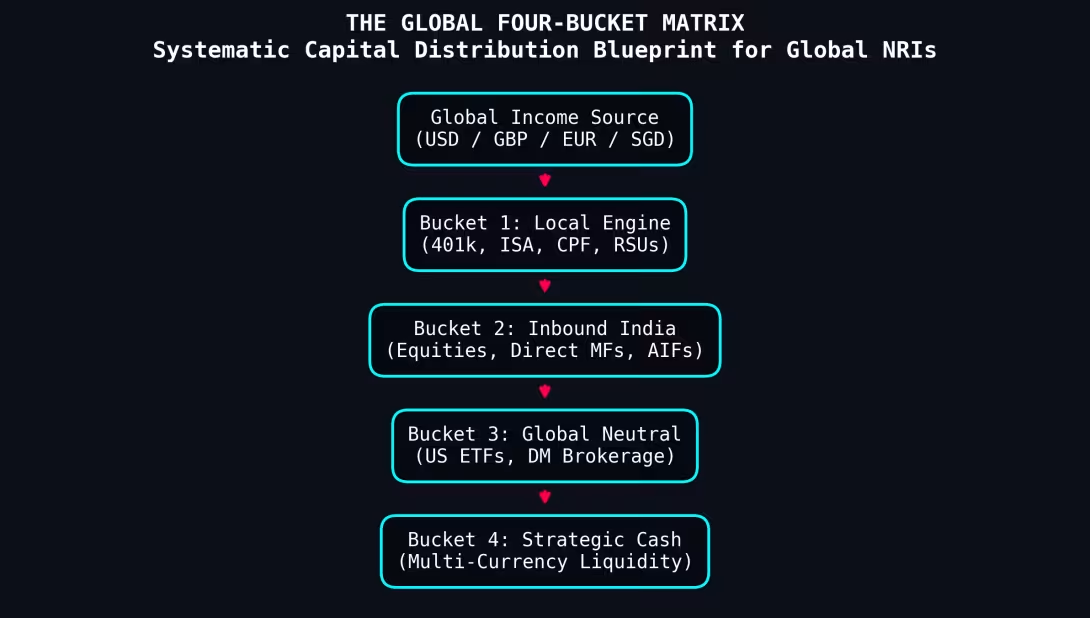
- Bucket 1 — Country of Residence Assets: Maximizes localized tax-advantaged engines like the US 401(k)/IRA, UK ISA, Singapore CPF, local employer stock options (RSUs/ESOPs), and primary host-country real estate.
- Bucket 2 — Indian Inbound Assets: Deployed to capture the structural growth premium of India's domestic economy through direct equities, fee-optimized mutual funds, bonds, REITs, and institutional AIF/Properties.
- Bucket 3 — International Diversification Assets: Neutral offshore accounts (typically US-domiciled brokerage accounts) holding broad global equity funds and developed-market index ETFs to act as an absolute counter-weight to local and Indian sovereign risk.
- Bucket 4 — Strategic Reserve Assets: The operational defense core consisting of highly secure multi-currency cash allocations and short-term sovereign debt to handle emergencies without disrupting long-term compounding blocks.
Indian Inbound Asset Allocation for NRIs
Deploying capital into Indian financial markets requires a deep understanding of structural routing rules and regulatory boundaries.
Direct Equities: PIS vs. Non-PIS Routes
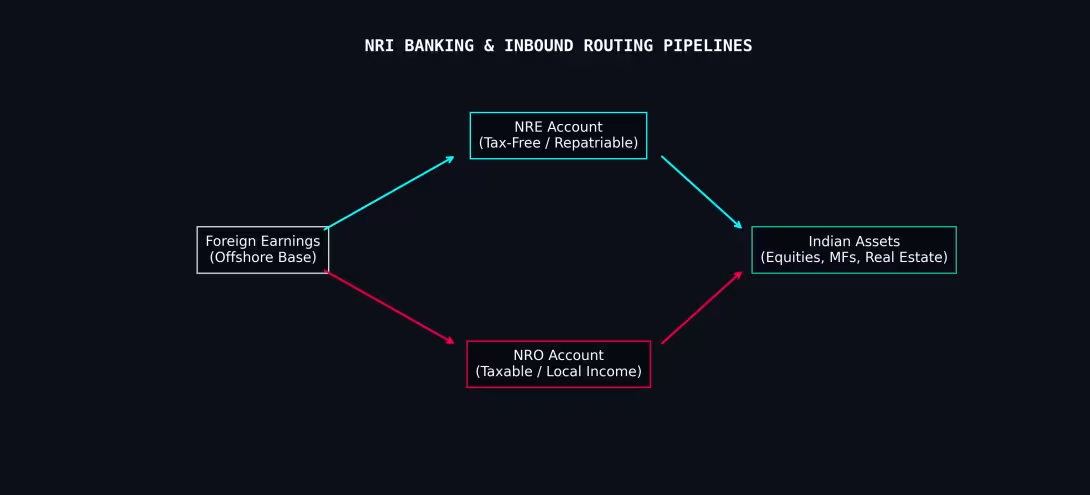
NRIs can access direct Indian equities through the Portfolio Investment Scheme (PIS) for repatriable investments via NRE accounts, or the Non-PIS route for non-repatriable investments via NRO accounts. The Non-PIS route offers significantly lower operational friction and is highly recommended if the ultimate goal is local Indian spending. Note that FEMA strictly prohibits NRIs from executing intraday trading or participating in unhedged domestic F&O contracts.
Mutual Funds: FATCA and PFIC Constraints
Due to the compliance requirements of the Foreign Account Tax Compliance Act (FATCA), major Indian AMCs completely block or restrict investments from individuals residing in the US or Canada. Furthermore, for US tax residents, Indian mutual funds are classified as Passive Foreign Investment Companies (PFICs), which are subject to punitive tax rates and complex reporting via IRS Form 8621. For US-based NRIs, utilizing direct stock portfolios or US-domiciled ETFs is often a far more tax-efficient alternative.
NRI Banking Structure Map
The foundation of cross-border capital management rests on three specialized banking structures:
| Account Variant | Permitted Capital Input Sources | Repatriability Status | Indian Tax Liability Profile |
|---|---|---|---|
| Non-Resident External (NRE) | Foreign currency earnings generated outside India exclusively. | 100% Fully and freely repatriable back abroad. | Completely exempt from Indian Income Tax (Section 10(4)). |
| Non-Resident Ordinary (NRO) | Legitimate inward domestic Indian revenues (Rent, Dividends, Pension). | Restricted up to USD 1 Million per financial year. | Subject to standard domestic tax rates and strict TDS cuts. |
| Foreign Currency Non-Resident (FCNR) | Offshore foreign currency blocks (USD, GBP, EUR, SGD). | 100% Fully and freely repatriable back abroad. | Completely exempt from Indian Income Tax until status shifts. |
The Repatriation Framework and the USD 1 Million Corridor
Under current FEMA frameworks, the RBI allows NRIs to repatriate up to USD 1 Million per financial year out of legitimate balances held in their NRO accounts (such as real estate sale proceeds, inheritance, or accumulated domestic investments).
| Asset Origin Type | Repatriable Status? | Core Regulatory Condition & Threshold |
|---|---|---|
| NRE Fixed Deposit Principal | Yes (100% Free) | No limit; flows freely via NRE liquidation channels. |
| Domestic Indian Rental Revenues | Conditional / Limited | Must route through NRO; subject to standard tax verification clearings. |
| Equity Portfolio Mutual Fund Sales | Depends on Origin Path | NRE-routed capital scales out freely; NRO-routed capital faces the USD 1M cap. |
| Inherited Family Assets | Conditional | Requires valid succession proof; moves strictly within the USD 1M limit block. |
To legally clear capital through this remittance corridor, you must file Form 15CA (online self-declaration filing) along with Form 15CB (a formal audit clearance certificate signed by a Chartered Accountant) to verify that all domestic tax liabilities on the source funds have been paid in full.
FEMA Compliance Map: Eliminating Systemic Violations
FEMA compliance operates on strict liability. NRIs can extend interest-free loans to resident Indian relatives in INR, but the funds must be routed strictly via NRO channels and cannot be repatriated. Similarly, a resident Indian can gift up to USD 250,000 per financial year to an NRI relative under the Liberalized Remittance Scheme (LRS), which must be credited to the NRI's NRO account.
Cross-Border Compliance Matrix
| Regulatory Compliance Area | Indian Jurisdiction Rules | Foreign Host Country Rules |
|---|---|---|
| Tax Filing Obligations | Yes (On Indian-Sourced Income) | Yes (On Universal Global Income) |
| Offshore Asset Reporting | Required during RNOR transition window paths | Strictly Required (FATCA / FBAR / Asset Forms) |
| FEMA Statutory Bounds | Fully Applicable Constraints | Non-Applicable |
| DTAA Tax Treaty Relief | Active Harmonization Available | Active Harmonization Available |
Cross-Border Taxation and DTAA Harmonization
Double taxation can be minimized by utilizing Double Taxation Avoidance Agreements (DTAAs). The DTAA framework provides clear relief mechanics, allowing you to claim a direct tax credit in your home country for taxes already paid in India, or secure lowered withholding tax rates (TDS) by submitting a valid Tax Residency Certificate (TRC) alongside Form 10F.
| Income Classification Track | Tax Liability inside India | Tax Liability inside Host Foreign Country |
|---|---|---|
| Capital Gains (Indian Equities) | Taxable at source (Short-Term / Long-Term Rates) | Taxable; subject to local capital gains rules and brackets. |
| Corporate Dividends (India) | Taxable at source via mandatory TDS cuts | Taxable; can scale out via DTAA credit offset paths. |
| Indian Real Estate Rental Yield | Taxable at source after a standard 30% deduction | Typically reportable; foreign tax files calculate net credits. |
| NRE Bank Account Interest | Completely Exempt (Section 10(4)) | Taxable in most western jurisdictions (US, UK, Canada). |
Country-Specific Compliance Challenges
- United States (USA): US NRIs face aggressive compliance under FATCA, FBAR, and Form 8938. Any holding in Indian mutual funds triggers punitive PFIC tax rates unless Mark-to-Market elections are established. Holding substantial assets in individual US brokerage accounts as a non-citizen non-domiciliary also exposes those assets to a 40% US federal estate tax on balances exceeding USD 60,000.
- United Kingdom (UK): Must carefully monitor the interaction between India-sourced asset growth and the UK Remittance Basis of Taxation, alongside CGT triggers on the liquidation of ancestral Indian property.
- UAE & Singapore: UAE NRIs must plan for newly introduced local corporate tax rules to ensure local business structures do not conflict with their Indian inbound portfolio routing. Singapore NRIs must focus on managing long-term multi-currency pools to align with global lifestyle transitions.
Real Estate Allocation for NRIs
While real estate remains a culturally preferred asset class for many global Indians, it is subject to strict FEMA boundaries and complex tax withholding rules.
| Property Allocation Classification | Purchase Via Foreign Funds Allowed? | Inheritance Option Allowed? | Repatriation of Sale Proceeds Conditions |
|---|---|---|---|
| Residential Apartments | Yes (Unlimited Units) | Yes | Allowed for up to two residential properties maximum. |
| Commercial Spaces | Yes (Unlimited Units) | Yes | Allowed fully under the standard USD 1 Million corridor. |
| Agricultural Land / Plots | No (Strictly Prohibited) | Yes | Subject to strict RBI case-by-case approval paths. |
| Farmhouse Properties | No (Strictly Prohibited) | Yes | Banned for active purchase; violations trigger immediate enforcement actions. |
When an NRI sells an Indian property, the buyer is legally required to deduct TDS at the highest applicable rate—often exceeding 20% of the gross sale proceeds for long-term capital gains, rather than the net capital gains. To avoid this massive cash flow lock-up, the NRI must proactively file for a Lower TDS Certificate (under Section 197) from the Income Tax department before executing the sale transaction.
Estate & Succession Planning Across Borders
A frequently overlooked risk in cross-border wealth management is estate planning. A standard Indian will is often insufficient to govern assets held across multiple jurisdictions, as foreign courts may refuse to recognize local probate orders.
- Concurrent Jurisdictional Wills: Maintain separate, legally valid wills for each country where you hold substantial wealth (e.g., one explicit will for your Indian asset base, and a separate will for your US or UK assets) ensuring they do not accidentally revoke each other.
- Nomination vs. Legal Ownership Clarification: In India, a bank or mutual fund nomination is merely an administrative tool. A nominee acts as a trustee, not the permanent legal heir. Your assets will ultimately be distributed according to your valid will or succession laws, making proper testamentary planning essential.
- Foreign Estate Tax Protection: For US-based NRIs, holding substantial assets in individual US brokerage accounts without proper estate structures exposes those assets to aggressive federal estate taxes (up to 40%) on balances exceeding USD 60,000 if citizenship shifts. Utilizing specialized trust structures or joint holding patterns can mitigate this exposure.
Currency Risk Management and Long-Term Depreciation
An investment that generates a 12% return in INR terms can see its real value significantly diluted when converted back into a strengthening hard currency like USD. Over long historical horizons, the Indian Rupee has experienced structural depreciation against the USD. Sophisticated wealth planning accounts for this currency drag by matching your asset allocations directly to your ultimate consumption goals. If your long-term objective is financing a child's higher education in Europe or purchasing a home in the US, maintaining your core capital base in INR introduces structural currency risk.
Returning NRI Transition Blueprint
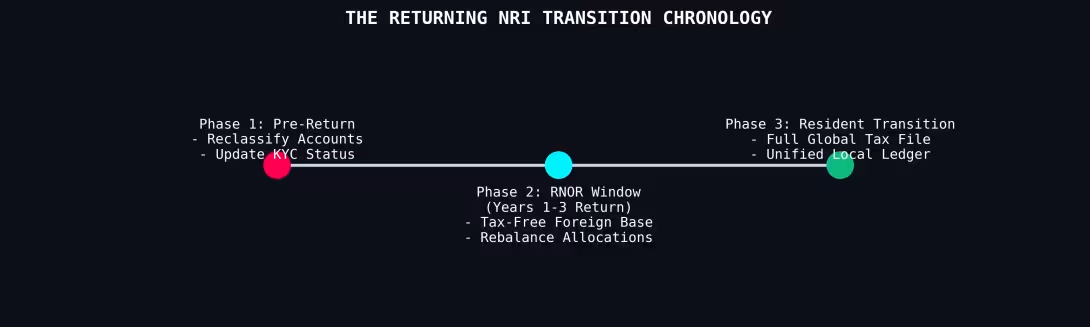
Planning a permanent return to India requires executing a structured timeline to transition your legal status smoothly and protect your global wealth from immediate tax exposure.
The Returning NRI Status Update Checklist
Upon your physical relocation back to India, you must systematically update your operational footprint across five core vectors:
- Banking Architecture: Convert your NRE and NRO accounts into a unified Resident Foreign Currency (RFC) account framework to preserve your foreign currency liquidity handles.
- Demat Portfolio Migration: Reclassify your non-resident trading channels into standard resident asset status blocks.
- FEMA Compliance Realignment: Notify your insurance, banking, and corporate registries of your permanent change in residential status.
- Tax Residency Tracking: Monitor your day counts to capitalize on your transitional RNOR tax optimization window.
- Asset Base Restructuring: Rebalance your global portfolio out of host-country accounts and systematically deploy it into fee-optimized domestic fiduciary platforms.
Compliance Calendar & Documentation Tracker
To maintain complete regulatory alignment and protect your wealth from audit flags, your cross-border portfolio must adhere to a strict compliance calendar:
| Required Compliance Metric | Mandatory Frequency | Core Operational Action Required |
|---|---|---|
| FATCA Self-Certification | Periodic / Event-Driven | Submit status updates to AMCs upon any physical shift in foreign residency. |
| Mutual Fund KYC Updates | As Required | Re-anchor bank files and out-of-country physical address records cleanly. |
| Indian Income Tax Filing | Annual (By July 31) | Disclose all Indian-sourced revenues and claim DTAA tax credit offsets. |
| Foreign Host Country Tax Returns | Annual | Report all worldwide asset balances and foreign accounts (e.g., US FBAR by April 15). |
| DTAA Treaty Disclosures | Annual | File Form 10F and secure an official Tax Residency Certificate (TRC). |
Eight Critical Mistakes Global Indian Investors Commit
- Operating standard resident savings accounts inside India after securing a foreign employment visa.
- Deploying capital into Indian mutual funds without evaluating foreign passive holding code rules (such as US PFIC constraints).
- Neglecting to use DTAA frameworks, resulting in paying full double taxes on the same underlying dividend or capital gains asset block.
- Failing to plan for structural currency depreciation, leaving long-term foreign liabilities backed by unhedged INR assets.
- Concentrating an excessive percentage of global wealth inside localized Indian real estate markets, crippling liquidity.
- Overlooking multi-jurisdictional estate planning, exposing foreign assets to prolonged probate delays and aggressive estate taxes.
- Assuming that an asset nomination on an Indian bank account functions as a permanent legal will.
- Believing that because NRE interest is tax-free inside India, it is automatically exempt from taxation within their foreign country of residence.
Ideal Sample Allocation Models
- The Young NRI Technology Professional (Silicon Valley / London): Prioritizes long-term growth and tax optimization. Maximizes employer 401(k) or ISA matches locally, holds zero Indian mutual funds to avoid complex PFIC tax traps, and routes inbound Indian capital strictly through the Non-PIS channel into direct, blue-chip large-cap equities. Global neutral index ETFs form the core of this strategy.
- The Mid-Career Global Executive (Singapore / Dubai): Focuses on capturing aggressive regional expansion while building a solid baseline currency hedge. Utilizes tax-free local accounts to accumulate USD-denominated developed-market assets, routes capital into India via NRE tracks into fee-optimized direct mutual funds and corporate debt arrays, and maintains short-duration FCNR deposits to protect upcoming international school tuition allocations from currency risk.
- The Returning NRI Family Cluster: Focuses entirely on capitalizing on the transitional tax window. Utilizes the RNOR status phase to systematically liquidate foreign brokerage accounts and offshore holdings completely tax-free. Capital is moved securely into liquid RFC bank blocks inside India, before being methodically deployed over a 36-month timeline into domestic core equities, institutional AIF structures, and tax-efficient target maturity debt portfolios.
The Role of a SEBI Registered Investment Adviser (RIA)
Navigating the intersections of FEMA compliance, cross-border tax treaties, multi-currency allocations, and estate governance requires an expert, uncompromised advisory relationship. At Wealth Together, our fee-only fiduciary framework completely removes product commissions and distribution incentives. We serve as your objective strategic partner, building a unified cross-border wealth architecture tailored entirely to your family's long-term security. We help you eliminate regulatory risk, optimize net-of-tax compounding across borders, and preserve your household legacy across generations.
We invite you to explore our comprehensive Get Started Onboarding Roadmap to learn about our international diagnostic workflows, or use our secure portal gateway to schedule your private, zero-obligation cross-border strategy consultation today.
Skip commission-driven sales pitches and align your capital with a pure fee-only fiduciary adviser.