Most financial websites populate the digital ecosystem with identical market commentaries, short-term stock predictions, automated calculators, and superficial product comparison charts. Yet, behind the complex spreadsheets and numerical abstractions, very few address the core human element: Why do we accumulate wealth in the first place? People do not connect deeply with sterile product wrappers or dense regulatory handbooks; people connect with authentic human stories. This blueprint deconstructs the structural parameters, unexpected lessons, and behavioral frameworks from my 15-year journey to financial independence within the technology industry, and why that platform eventually compelled me to become a pure fee-only SEBI Registered Investment Adviser (RIA).
My Relationship With Money Started Early
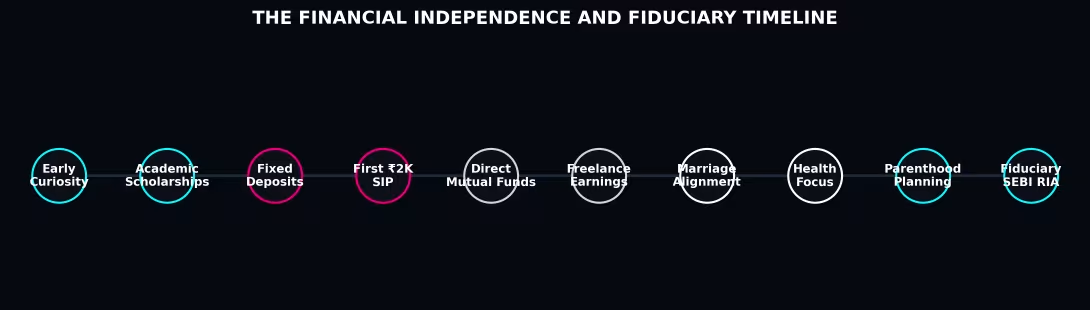
My relationship with money began long before I understood asset allocation matrices or corporate billing architectures. As a young observer, I developed a quiet fascination with money—not out of a desire for material luxury, consumer displays, or expensive status markers, but because I recognized its true structural utility. I was deeply fascinated by what financial security could enable. Money was fundamentally about options: the ability to make independent decisions, navigate sudden household constraints without panic, and maintain absolute ownership over your daily schedule. This perspective framed money as a tool for expansion rather than consumption, anchoring every financial choice that followed.
Pocket Money, Competitions, and Early Savings Habits
I realized early on that wealth creation begins with behavioral habits long before large-scale investable surpluses are ever achieved. During my school years, I practiced strict self-control over my basic pocket money, logging minor inflows and managing expenses. When opportunities arose to participate in local academic or technical competitions, the core motivation behind securing prize money wasn't the immediate retail purchase it could fund. It was the process of setting a target, executing a plan under pressure, and transforming those raw earnings into independent cash reserves. This habit formation proved that financial discipline must be established when capital is scarce; waiting for a high income to automatically trigger financial responsibility is an institutional myth.
The Scholarship That Changed My Thinking
This systematic perspective on capital became far more defined during my engineering college years. To insulate my family from the full overhead of tuition costs, I focused heavily on maintaining an academic benchmark, keeping my cumulative CGPA above 9.0 to qualify for competitive semester scholarships. I still remember the exact moment I received the first formal scholarship check issued directly in my own name. Receiving a check in my own name felt different. It wasn't money given to me; it was money I had earned through structured focus and execution. That validation permanent changed my psychology: it proved that intellectual capital could be converted systematically into financial capital, creating an early blueprint for my future career choices.
My First Investment Decisions
When I transitioned from college into my early years as a technology professional, my initial investment decisions matched my limited exposure to complex global markets. I operated with a strict, conservative safety mindset, directing my early salary surpluses entirely into standard bank fixed deposits. My goal at that stage wasn't chasing high double-digit active returns or hunting for alpha. The goal was simple: don't lose what I worked hard for. This protection-first instinct provided a baseline liquid cushion, ensuring that before I ever stepped out onto the risk spectrum, my foundational capital base was secure.
Why I Was Initially Afraid of Equity Investing
Despite my professional background in computing and data logic, I was initially quite afraid of equity investing. Entering the professional arena right around the catastrophic global financial crisis of 2008 made the stock market appear highly volatile, irrational, and dangerous to hard-earned savings. Watching legacy wealth institutions collapse and reading constant media predictions of structural economic ruin created an intense fear of loss. This behavioral barrier kept my capital locked inside low-yielding fixed assets for years, an experience that allows me to connect with clients who feel paralyzed by near-term market drawdowns today.
The ₹2,000 SIP That Changed Everything
My entry into equity compounding didn't begin with a sudden surge of macroeconomic conviction or sophisticated technical analysis; it began with an automated ₹2,000 monthly Systematic Investment Plan (SIP). I chose a minor capital threshold to minimize my emotional stakes, taking a small operational step to test the plumbing of the mutual fund system. You don’t need deep conviction to start your wealth building journey; you need curiosity. Automating that minor transaction removed the daily decision-making friction, forcing me to watch the behavior of volatile assets without panicking over the immediate downside.
Discovering Direct Mutual Funds and the Importance of Costs
As my small portfolio began to grow, my technology background pushed me to look deeper into the underlying fees and structural parameters of the Indian asset management industry. This was the first time I calculated the massive, compounding drag of embedded distribution fees across Regular Plans. Discovering that commission-heavy regular funds routinely deduct an extra 0.50% to 1.25% from your total assets every single year to reward intermediaries changed my perspective entirely. Mapping this out mathematically proved that small costs have a massive impact over decades, quietly redirecting millions in terminal wealth away from the investor's balance sheet and straight to product distributors. This realization was my first structural introduction to the necessity of fee-only alignment.
The Power of Consistency
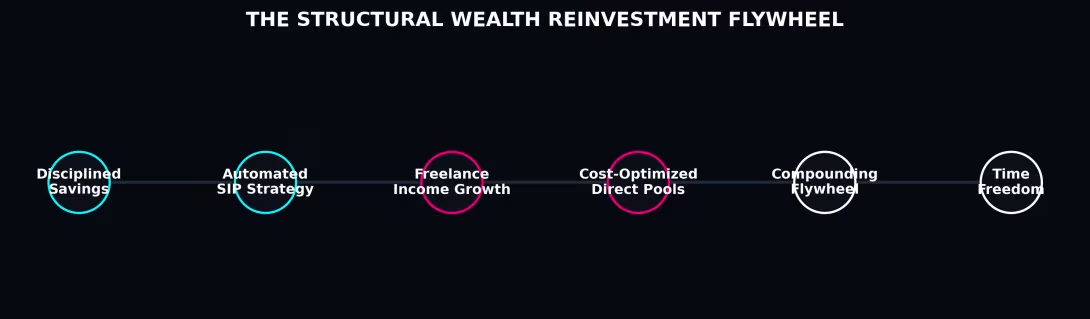
As my tech career advanced and my salary grew over the next decade, the core driver of my wealth accumulation was not sophisticated stock picking, identifying niche sector trends, or timing macroeconomic market entries. The centerpiece of the entire strategy was absolute, automated consistency. Every single time my corporate salary scaled up, I immediately raised my automated monthly SIP tranches proportionately, keeping my household lifestyle overheads entirely steady. I ignored market forecasts, index corrections, and global economic cycles, treating my monthly investment targets like an essential, non-negotiable utility bill. Consistency outpaced market timing every single fiscal year.
Freelancing Accelerated the Journey
To accelerate my timeline toward financial independence, I began utilizing my late nights and weekend horizons to take on independent technology freelancing opportunities. Every rupee generated from these side income channels was completely isolated from my standard lifestyle budget. These lump-sum flows were redirected straight into my core direct equity pools, completely raw and untouched by consumer spending. This phase taught me a foundational financial planning truth: increasing your active income capacity can sometimes be significantly more impactful than taking on excessive portfolio risk to chase marginal extra returns.
The Goal Was ₹1 Crore. Life Had Other Plans.
When I first designed my tracking framework, I established an initial target corpus of ₹1 Crore, assuming that reaching that number would mark the final finish line of my financial journey. But life had other plans. I completely underestimated the velocity of the compounding flywheel once a portfolio clears its early accumulation stages and gains critical mass. Because I left the core capital base entirely undisturbed, the terminal growth curve accelerated far beyond my original models. The journey proved much more surprising than the destination, demonstrating that real wealth builds silently behind the scenes when execution stays out of its own way.
Why I Rarely Checked My Portfolio
One of the most effective behavioral strategies I deployed during this high-growth phase was that I rarely checked my active portfolio valuations. Outside of receiving automated monthly auto-debit SMS confirmations and auditing my multi-asset Consolidated Account Statement (CAS) exactly twice a year, I completely ignored daily Net Asset Value (NAV) movements. Most retail investors destroy their long-term compounding returns by constantly accessing their dashboards, reacting to short-term volatility, and tweaking their holdings out of sheer anxiety. Compounding performs best when it is left completely undisturbed by emotional intervention.
Two years ago, this empirical compounding milestone was officially validated when I was invited to share my personal financial thesis on a premium thought-leadership podcast. You can access the full uncompromised strategic discussion regarding my multi-decade capital building journey directly inside the responsive media playback canvas below:
The Most Important Financial Discussion Before Marriage
Long before entering into any legal marital registries, my partner and I sat down to have an intense, open conversation regarding our individual relationships with capital. We spent hours aligning our spending philosophies, our boundaries around debt, our approach to lifestyle upgrades, and our definitions of financial security. Financial compatibility is vastly more vital to a household's long-term wealth survival than advanced technical market knowledge. Being completely unified on your cash flow goals prevents lifestyle creep and ensures your wealth building operates as a synchronized partnership.
COVID Changed My Perspective
When the global COVID-19 crisis hit, it forced a complete re-evaluation of my personal definitions of wealth. Watching the world halt disrupted my purely analytical focus on financial numbers, shifting my primary perspective from simple asset accumulation to preserving health and vitality. I realized that an independent portfolio loses its utility if you lack the health to enjoy the time it buys. This realization sparked a permanent, non-negotiable daily lifestyle overhaul anchored around extreme physical discipline: committing to walking a minimum 10,000 steps every single day, executing targeted gym strength-training tracks, and embracing clean nutritional parameters.
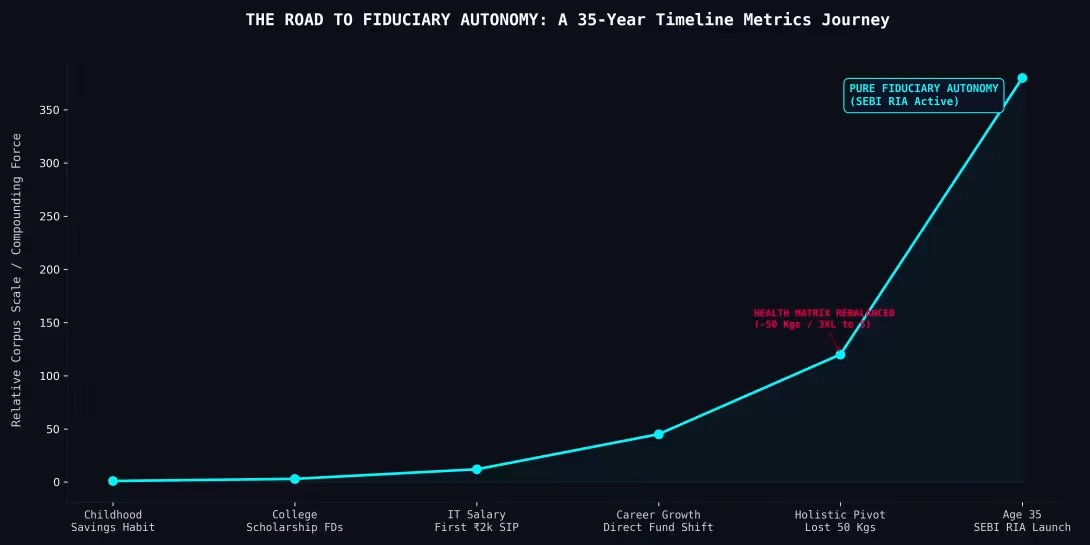
LIFETIME REBALANCING — Applying the exact same uncompromised consistency from my investment loops to my physical training routines (walking, clean nutrition, disciplined gym regimens) resulted in a massive, 10-month holistic rebalancing. The outcome was a drop of 50 kilograms in body mass—safely shifting my frame from a tighter 3XL profile down to an ultra-fit, normal Small fit size.
The Surprising Similarity Between a 50kg Weight Loss and Long-Term Compounding
As I maintained this daily physical routine alongside my financial tracking, I underwent a radical transformation—eventually losing 50 kilograms of weight. Shedding 50kg, completely rebuilding my metabolic health, and building peak physical conditioning provided a living, empirical masterclass in the laws of nature. This profound physical transformation proved that the exact behavioral frameworks required to completely reshape your body are identical to the frameworks required to build multi-generational wealth. I noticed a striking similarity between the journey to a 50kg weight loss and the journey to financial independence:
| Operational Dimension | The Financial Compounding Blueprint | The 50kg Physical Transformation Blueprint |
|---|---|---|
| The Core Execution Input | Maintaining an automated, monthly SIP allocation. | Showing up for a disciplined, daily minimum 10,000-step routine. |
| The Growth Mechanism | Long-term capital compounding across full market cycles. | Gradual, daily caloric optimization and structural metabolic reconstruction. |
| The Behavioral Requirement | Patience to endure temporary, short-term index drawdowns. | Patience to stay disciplined when weight plateaus occur on the scale. |
| The Ultimate Strategic Focus | Multi-decade wealth retention and multi-generational legacy. | Sustained lifetime mobility, functional clarity, and permanent long-term vitality. |
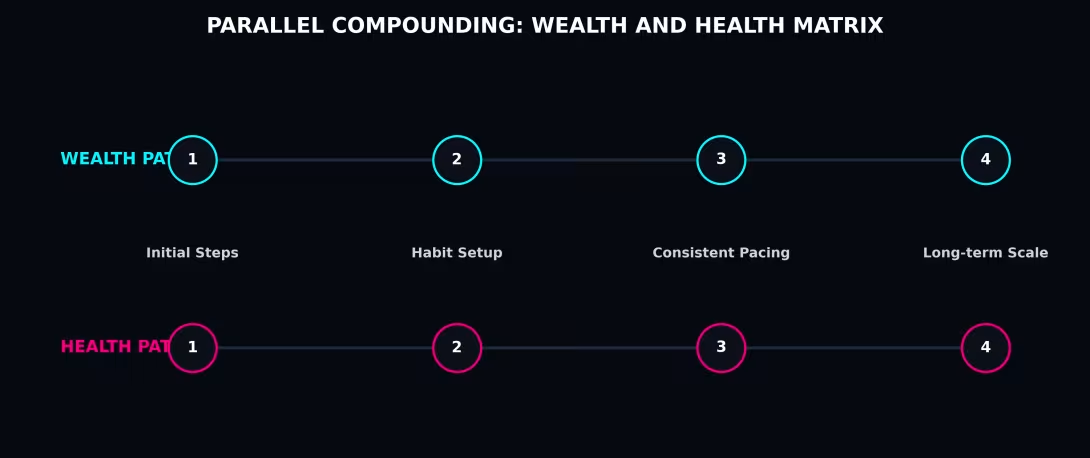
Losing 50kg is never achieved through a one-off extreme effort; it is the mathematical result of minor, unglamorous daily choices repeated for years without emotional intervention. Both fitness and finance prove that intensity matters far less than routine. A brief, severe crash diet means nothing without a permanent lifestyle shift—just as a random, one-time lump-sum investment deployment is completely diluted without an automated monthly capital blueprint. True wealth and physical vitality are parallel, compounding assets that demand structural tracking, zero behavioral drift, and absolute personal execution.
Becoming a Parent Changed My Financial Planning Again
The transition into parenthood completely re-engineered my approach to asset management. Welcoming my daughter shifted my financial planning focus from a self-centric timeline to structuring robust safety guardrails around a multi-generational family core. It required re-allocating our surpluses to fund explicit long-term targets, structuring comprehensive medical protection walls, and building estate plans designed to shield our family from unexpected disruptions. This milestone reinforced that a true financial architecture must be dynamic, adjusting its safety parameters as your real-world responsibilities evolve.
The Question That Changed Everything
Once my personal portfolio reached a stage where it could reliably sustain my family's lifestyle independently, I hit a deep transition point. I found myself looking past my tech milestones and asking a fundamental question: If achieving true financial independence feels this empowering, how can I use the lessons from my own journey to help other families experience the same peace of mind? This question moved my professional focus away from the technology sector and led me to study the financial advisory ecosystem in India.
Building Expertise While Continuing My IT Career
Transitioning into professional wealth architecture demanded a deep commitment to technical and regulatory mastery. While continuing to fulfill my responsibilities within a demanding, 12-year remote IT career, I dedicated my late nights and weekends to intensive study. I systematically worked through the rigorous Certified Financial Planner (CFP) curriculum and undertook detailed preparation to clear the mandatory NISM Series X-A and X-B Investment Adviser examinations. Balancing a senior technology role with hours of regulatory studying required immense personal discipline, but it was essential to build the technical foundation needed to deliver institutional-grade financial guidance.
Discovering Financial Planning and SEBI RIA
Throughout my deep dive into the financial advisory ecosystem, I analyzed the various intermediary business models operating in India. I wasn't looking to launch a traditional, commission-led product distribution firm or a standard wealth management factory focused on pushing complex products. I wanted a framework that aligned entirely with investor interests. This search led me straight to the heavily regulated, independent SEBI Registered Investment Adviser (RIA) architecture. The strict compliance codes mandated by SEBI provided the ideal foundation to deliver pure, uncompromised financial planning.
Why I Chose the Fiduciary Route
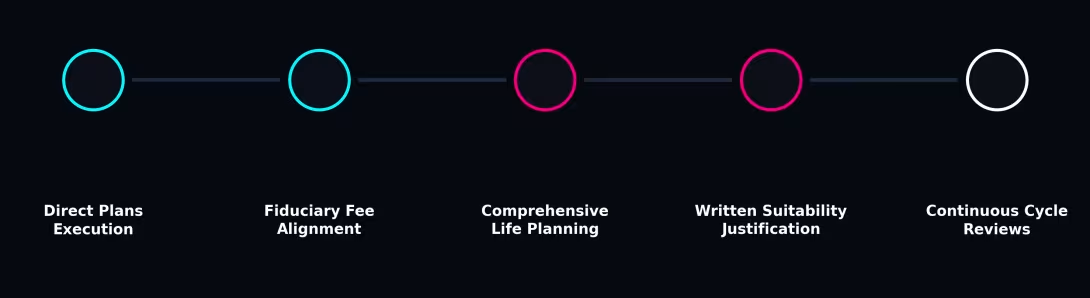
Choosing the fee-only SEBI RIA route meant building a practice centered around a pure fiduciary commitment across every dimension of advice:
- Advice Before Products: Deconstructing your cash flows before discussing any specific asset wrapper.
- Planning Before Investing: Mapping out your structural financial vulnerabilities before deploying capital.
- Goals Before Returns: Prioritizing your family's real-world milestones over short-term market indices.
- Relationships Before Transactions: Building deep, trusted multi-generational partnerships over brief product sales.
Financial Independence Was Never the Final Goal
When I started this multi-decade wealth journey, financial independence appeared to be the ultimate destination—the final finish line of my financial plan. Eventually, once achieved, I realized that financial independence was never the final goal. It was simply a platform. It provides a secure, uncompromised launchpad designed to take on purpose-driven work, create genuine impact, and guide other families through their own financial lives with complete peace of mind, free from corporate pressures or product sales targets.
What I Learned Along the Way: Core Life Lessons
Reflecting on this 15-year path, my key takeaways can be distilled into seven operational principles for long-term wealth retention:
- Lesson 1 — Consistency Beats Intensity: Automating a steady monthly investment habit is vastly more powerful than occasionally deploying large sums of capital based on casual market timing.
- Lesson 2 — Income Matters, but Behavior Matters More: High active revenue is completely diluted without an optimized savings rate and structural self-control. Your ultimate net worth is determined by your behavior, not your salary.
- Lesson 3 — Health and Wealth are Parallel Compounding Assets: An independent investment portfolio loses its utility if you neglect the physical health required to enjoy the freedom and choices your capital has bought.
- Lesson 4 — Choosing the Right Life Partner is a Critical Financial Choice: Being completely aligned with your spouse on cash flows, lifestyle overheads, and long-term values is essential for a stable wealth-building journey.
- Lesson 5 — Time in the Market Beats Timing the Market: Real compounding rewards patient, long-term asset retention. True portfolio safety means ignoring short-term predictions and letting your assets grow undisturbed.
- Lesson 6 — Financial Independence Gives Options: Reaching financial security doesn't mean entering a phase of passive consumerism; it grants you the freedom to choose your work based on purpose rather than survival.
- Lesson 7 — Money is a Tool, Not the Destination: Capital is simply a mechanism designed to buy back control over your time. True wealth is measured by the number of independent choices you can make every single day.
What Comes Next: My Commitment to Your Journey
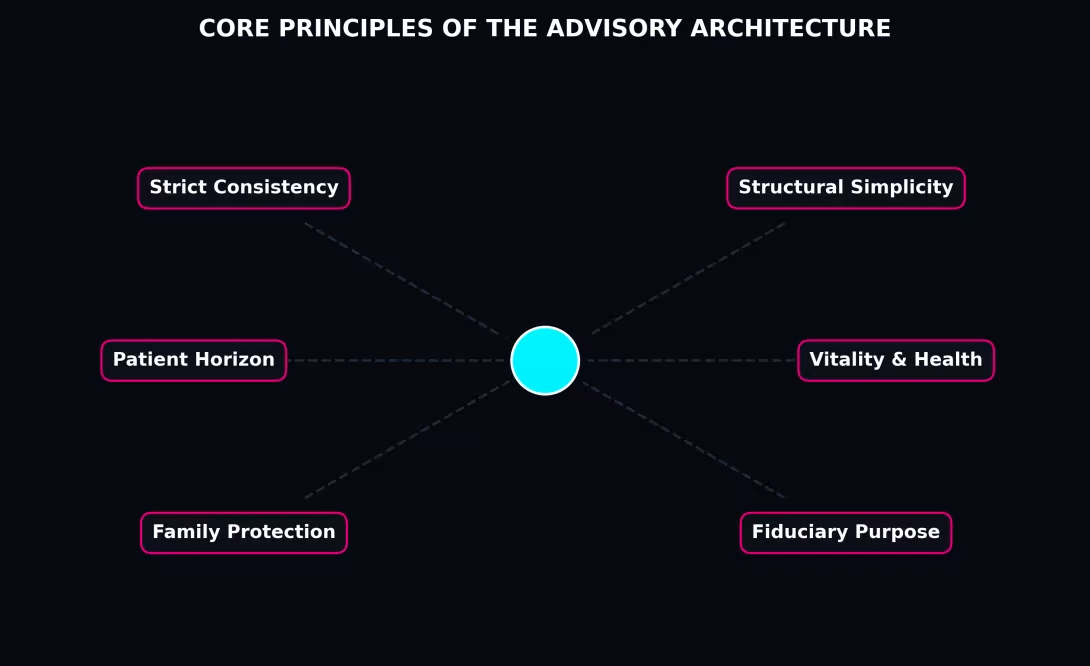
Today, my primary objective is no longer about accumulating more capital for myself. The focus has completely shifted to using the practical, behavioral lessons from my own journey to help other families build financial confidence, protect their assets, and secure complete control over their time. I continue to blend my technical analytical background with a strict fiduciary commitment, helping clients eliminate hidden product costs, navigate complex regulatory boundaries, and design resilient portfolios.
True wealth management is not about purchasing more products. It is about building a secure financial architecture that gives your family freedom and choices across your entire lifetime. We invite you to explore our comprehensive, commission-free advisory framework through our structured Get Started Onboarding Portal, or connect with our secure gateway to arrange a private, zero-obligation introductory consultation today.
Financial independence gave me freedom. Helping others achieve it gave me purpose.
Skip commission-driven sales pitches and align your capital with a pure fee-only fiduciary adviser.