For high-earning technology executives, medical specialists, corporate promoters, and affluent families in India, active capital generation is rarely the primary point of failure. The silent risk to long-term financial security is systematic fiscal erosion. In top marginal income tax brackets, a portfolio that generates strong nominal performance can lose a significant portion of its real compounding power over a multi-year cycle due to uncoordinated asset liquidations, frequent churning, and inefficient ownership structuring.
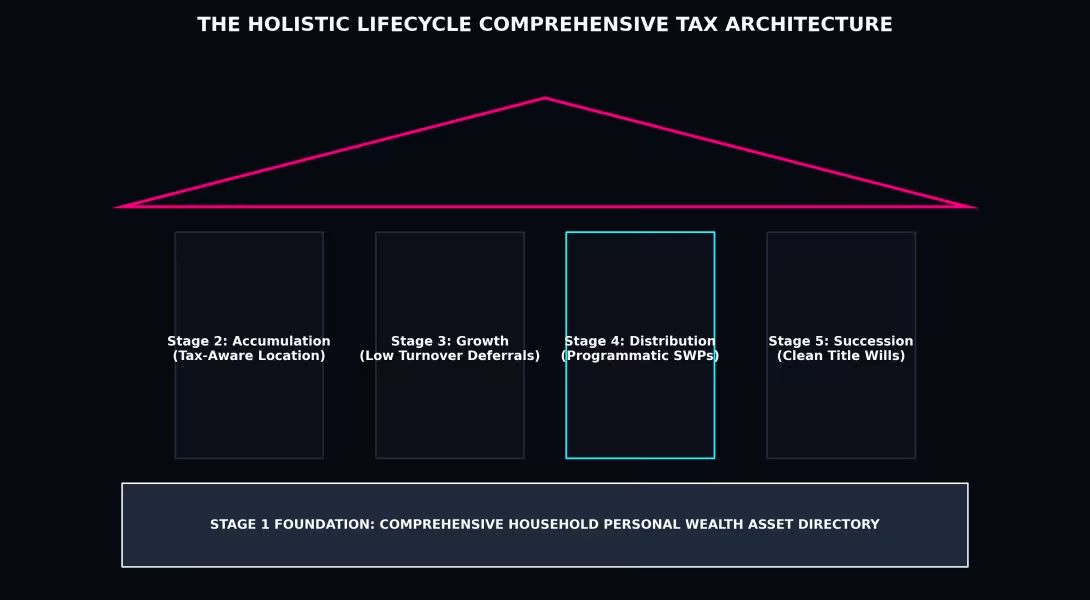
A professional fiduciary framework ignores the short-term focus of retail tax-saving products. True wealth management treats tax optimization as an ongoing engineering discipline that spans four distinct lifecycle phases: accumulation, growth, distribution, and intergenerational succession. By focusing on your Return After Tax (RAT) rather than raw pre-tax returns, you ensure your family's global asset base is structurally insulated from unnecessary leakage, maximizing what you keep across full economic horizons.
The Fiduciary Axiom: Legal Optimization vs. Annual Product Chasing
Tax planning within an institutional framework has nothing to do with aggressive shadow structures or illegal evasion. It is the deliberate, rule-based alignment of your investments with prevailing statutory codes. Most affluent investors focus entirely on finding the next high-performing fund, while ignoring the ongoing drag of taxes. A great investment selection cannot compensate for a broken financial plan. True wealth preservation treats tax efficiency as a core portfolio enhancer, building structural guardrails that protect your capital from unnecessary fiscal liabilities.
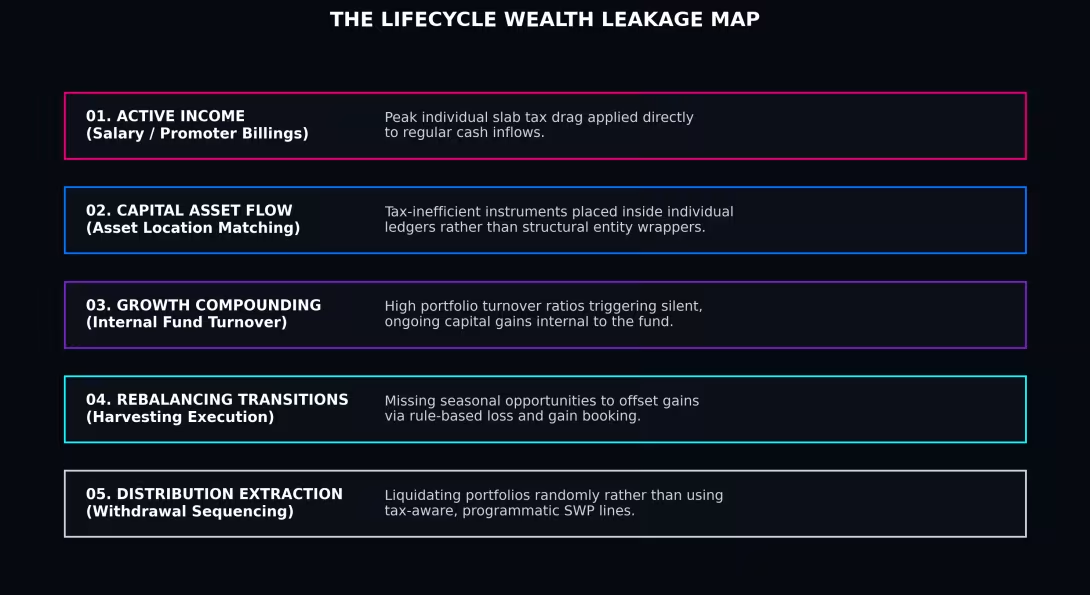
The Wealth Leakage Most Investors Ignore
To understand the massive compounding impact of tax efficiency, consider two successful professionals who begin their investment journeys with identical capital bases and achieve exactly the same 12% gross nominal annual return over a 20-year cycle. The first investor operates without structural tax coordination—frequently churning assets, keeping high-yield fixed deposits inside their individual peak marginal slab, and realizing short-term capital gains. The second investor uses an optimized framework—mapping tax-inefficient assets to protected entities, using low-turnover index tracking, and harvesting gains systematically.
Over a multi-decade horizon, the difference in their final net worth can scale into crores of rupees. The first portfolio suffers from continuous, compounding tax leakage that acts as a structural drag on every transaction. The second portfolio benefits from unchecked post-tax compounding, illustrating that what matters is not what you earn on paper, but what you keep cleanly on your balance sheet.
Understanding Tax-Efficient Investing Principles
Fiduciary tax planning relies on a few core principles that must guide your ongoing asset management decisions:
- The Power of Tax Deferral: Keeping capital compounding inside low-turnover, direct-plan mutual funds allows your gains to grow unchecked for decades. Delaying the tax event means money that would have gone toward annual tax outlays remains fully invested, compounding for your family's estate.
- Structural Optimization of Withdrawals: Ensuring that liquid cash required for lifestyle expenses is generated through capital gains redemptions rather than high-tax regular income streams.
- Strategic Alignment of Asset Ownership: Allocating capital across multiple family members' accounts to legally split income streams and make full use of individual lower tax brackets.
The New Tax Reality for High-Income Earners
The domestic fiscal landscape has shifted toward increased regulatory compliance, digitized reporting networks, and an institutional transition toward the New Tax Regime. With traditional deductions being phased out and data tracking across Annual Information Statements (AIS) becoming instantaneous, classical retail methods of hiding or delaying tax information are completely obsolete.
This high-compliance environment makes structural tax planning more vital than ever before. For an affluent household, optimizing taxes under modern regulations means evaluating your salary architecture, utilizing employer-backed retirement routing, and matching your holding periods to clear statutory definitions to shield your active compounding pools from high surcharge rates.
Asset Location vs. Asset Allocation
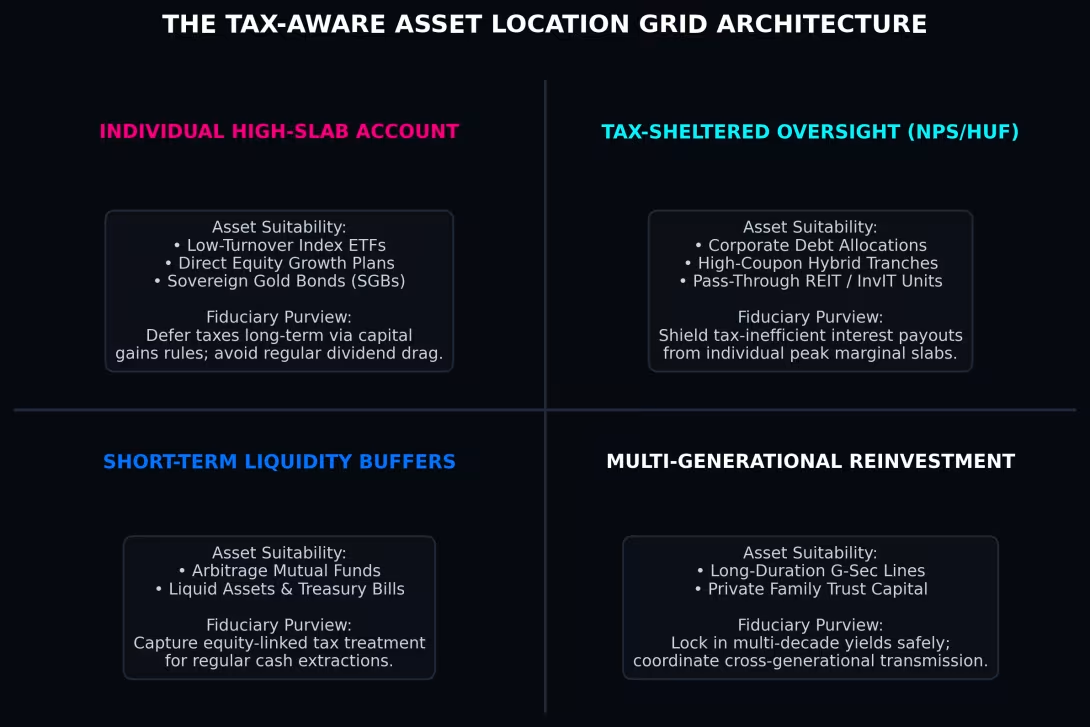
While individual market participants often discuss Asset Allocation (deciding how much to invest across equities, debt, gold, and international tranches), very few understand the critical discipline of Asset Location. Asset allocation dictates your portfolio's risk-return blueprint. Asset location determines *which specific accounts or legal entities should hold each asset class* to maximize your overall net post-tax returns.
An institutional asset location framework applies a clear sorting strategy across your household balance sheet:
- Tax-Inefficient Assets: High-yield corporate bonds, commercial real estate REIT distributions, and high-frequency dividend streams should be located inside tax-sheltered structures like the National Pension System (NPS) or mapped to family members in lower income tax brackets to prevent peak slab leakage.
- Tax-Efficient Assets: Low-turnover equity mutual funds, long-term index ETFs, and international growth tranches should be held directly in your high-income accounts, where they can take full advantage of flat, lower long-term capital gains tax rates.
Fixed Income Taxation and the Shift in Debt Strategies
Recent taxation amendments have completely re-engineered the fixed-income landscape for Indian HNIs. Capital gains realized from debt mutual funds, target maturity strategies, and international funds are now taxed fully at your individual marginal income tax slab rate, regardless of your holding period. This shift removed traditional indexation benefits, fundamentally altering how conservative capital blocks must be managed.
To minimize the impact of this high tax drag, affluent investors look past traditional debt funds to explore tax-aware fixed-income alternatives. These options include utilizing arbitrage mutual funds for short-term liquidity needs, holding tax-free public sector undertaking (PSU) bonds, or locking in stable yields via long-duration sovereign G-Secs within specific family entities to preserve your baseline capital from heavy slab erosion.
Capital Gains Optimization Across Asset Tranches
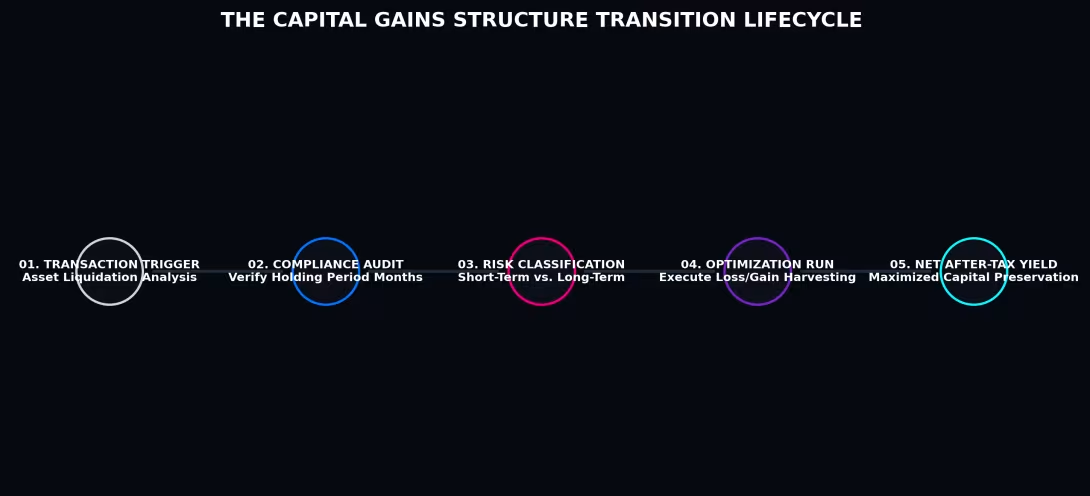
Managing capital gains efficiently requires matching your transaction timing precisely to statutory holding milestones. A few months' difference in liquidating an asset can mean the difference between paying high short-term slab rates or qualifying for lower, flat long-term capital gains taxes:
| Asset Class Tranche | Long-Term Holding Threshold | Short-Term Tax Treatment | Long-Term Tax Treatment |
|---|---|---|---|
| Listed Domestic Equities / Mutual Funds | Greater than 12 Months | Flat 20% Tax Rate | Flat 12.5% Tax Rate (Exempt up to ₹1.25 Lakhs/year) |
| Physical Property & Real Estate Parcels | Greater than 24 Months | Taxed fully at your individual slab rate | Flat 12.5% Tax Rate (Without traditional indexation updates) |
| Physical Gold, ETFs, & EGR Instruments | Greater than 24 Months | Taxed fully at your individual slab rate | Flat 12.5% Tax Rate (Without traditional indexation updates) |
| Debt Mutual Funds & Fixed Income | No Long-Term Distinction | Taxed fully at your individual slab rate | Taxed fully at your individual slab rate across all horizons |
Systematic Portfolio Tuning: Tax-Loss and Tax-Gain Harvesting
A proactive fiduciary framework uses automated portfolio harvesting strategies to systematically lower your annual tax liabilities:
- Tax-Loss Harvesting: Involves selectively liquidating specific underperforming equity units at a loss during market corrections. This realized loss is used to directly offset active short-term or long-term capital gains, immediately lowering your net tax outlays before you reinvest the proceeds back into target asset allocation tracks.
- Tax-Gain Harvesting: Capitalizes on the statutory ₹1.25 Lakh annual exemption limit for long-term equity capital gains. By programmatically selling appreciated mutual fund units to book up to ₹1.25 Lakhs in gains tax-free each year and immediately buying them back, you systematically step up your portfolio's cost basis, lowering your future tax burden.
Tax-Efficient Mutual Fund Selection Strategies
Building a tax-efficient mutual fund portfolio looks past simple past performance metrics to analyze internal fund management behavior. A critical metric to evaluate is the fund's Portfolio Turnover Ratio. Mutual funds that trade frequently trigger continuous capital gains internal to the fund structure, which can create a silent drag on performance.
Choosing low-turnover, direct-plan equity indices ensures your capital compounds cleanly with minimal internal transaction frictions. Furthermore, avoiding regular dividend-payout options and sticking strictly to growth tracks ensures your gains remain deferred, allowing your capital to compound undisturbed over the long term.
The National Pension System (NPS): The Corporate CXO Advantage
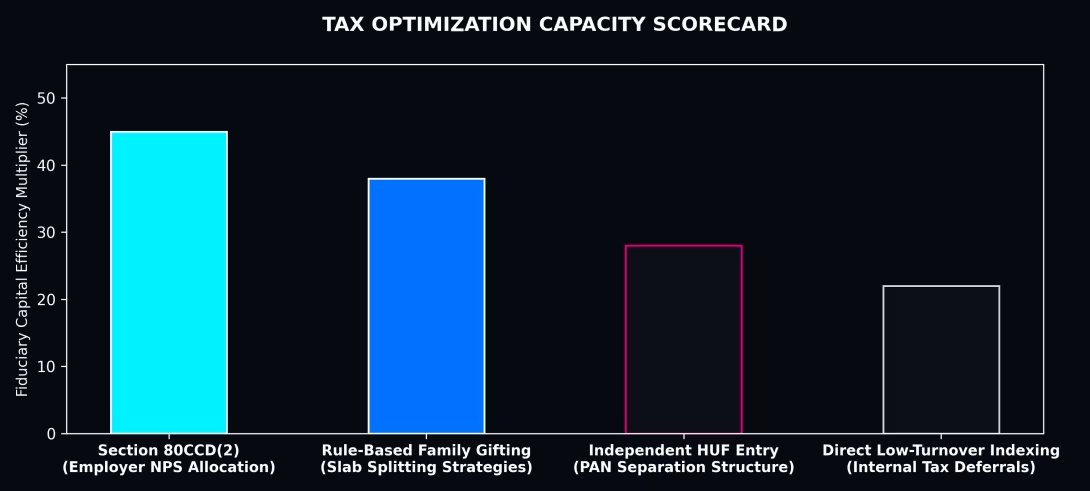
The National Pension System (NPS) represents a highly effective corporate tax-planning tool for senior executives and high earners under modern regulations. Beyond the basic individual savings limits, affluent professionals can leverage the Employer Contribution Route governed under Section 80CCD(2).
This provision allows your employer to route up to 10% of your salary (Basic Salary + Dearness Allowance) directly into your personal NPS account, fully exempt from income tax up to an annual limit of ₹7.5 Lakhs. By diverting this portion of your active compensation before it hits your standard salary payslip, you instantly lower your taxable income at your peak marginal rate, allowing that capital to compound cleanly inside low-cost equity and corporate debt tracks.
Structuring Multi-Generational Wealth: HUFs and Family Gifting
Affluent families can optimize their lifetime tax brackets by utilizing structured family entities and rule-based wealth distribution tracks:
- The Hindu Undivided Family (HUF) Entity: Establishing a formal HUF creates an independent legal entity that carries its own distinct PAN card, separate bank accounts, and basic tax slab exemptions. By routing ancestral income streams, real estate rental flows, or specific investment portfolios through the HUF, you can legally split family income away from your individual peak marginal slab.
- Fiduciary Family Gifting: Moving capital to specified relatives (such as parents or adult children) is fully exempt from immediate gift taxes under Section 56(2)(x). While gifting to a spouse triggers income clubbing rules, shifting capital to parents allows you to invest those funds in their lower tax brackets, optimizing your household's overall post-tax returns.
Tax-Efficient Investing for Married Couples and Business Owners
Married couples can improve their financial planning by matching investments to individual career phases and lower individual tax brackets. For example, asset ownership can be structured so that high-yield fixed income is held by the spouse in the lower bracket, while growth equities are positioned in the higher earner's name to defer capital gains tax.
For business owners, managing surplus capital requires balancing company structures with personal distributions. Corporate promoters often benefit from keeping surplus business revenue compounding within the company's lower corporate tax framework, rather than drawing large personal salaries or high-tax dividend payouts that face top individual marginal slabs.
Cross-Border Tax Location for Non-Resident Indians (NRIs)
Non-Resident Indians face unique tax challenges that require careful asset location and account structuring. NRIs must manage their capital across separate NRE (Non-Resident External) accounts, which offer tax-free interest and full repatriation, and NRO (Non-Resident Ordinary) accounts, which hold localized Indian revenue subject to standard withholding taxes.
Furthermore, NRI portfolio execution must be coordinated with the Double Taxation Avoidance Agreement (DTAA) provisions signed between India and their host country. Utilizing formal Tax Residency Certificates (TRC) ensures that capital gains realized on domestic exchanges are not subjected to double taxation, preserving your global capital's compounding velocity.
Tax-Efficient Withdrawal Planning in Distribution Phases
The tax sensitivity of your portfolio spikes significantly when you transition from the wealth accumulation phase to the distribution and cash flow extraction phase. Managing your cash flows during retirement or early financial independence requires a disciplined sequencing strategy to minimize capital gains liabilities.
Instead of liquidating assets randomly, an institutional strategy extracts cash flows using a multi-asset Systematic Withdrawal Plan (SWP). Because each SWP redemption consists primarily of a tax-free return of your original principal and only a minor capital gains component, it operates with massive tax efficiency compared to drawing interest payouts or high-tax dividends. This structured approach preserves more active capital within your compounding pools, providing sustainable, long-term funding for your lifestyle needs.
Tax Implications of Inheritance and Cross-Generational Transfer
An investment strategy remains incomplete if it fails to coordinate lifetime accumulation with tax-efficient succession planning. Under current domestic tax guidelines, India levies no inheritance tax or estate duty on wealth transferred via a valid Will or intestate succession rules. Inherited assets are also fully exempt from immediate gift taxes at the point of transfer.
However, significant tax events occur later when your beneficiaries choose to liquidate those inherited holdings. To minimize future capital gains liabilities, your heirs must accurately trace their Cost of Acquisition and holding period metrics back to the original date of purchase by the previous owner. Maintaining clear, centralized financial records and secure estate documentation ensures your heirs can claim these historical cost bases, completely shielding their inherited legacy from unnecessary tax erosion.
Common Tax Mistakes Made by High-Income Earners
In wealth management, some of the most expensive financial errors occur because of sudden, uncoordinated actions that trigger permanent, uncorrectable tax liabilities. Consider the critical structural mistakes that no level of subsequent portfolio returns can ever fix:
- Selling Highly Appreciated Core Assets Without Timing Layouts: Liquidating large real estate holdings or long-term stock blocks without matching the transaction to specific reinvestment windows (like Section 54EC bonds) locks in immediate, irreversible tax liabilities.
- Missing Your Annual Tax Harvesting Window: Failing to utilize your statutory ₹1.25 Lakh annual tax-free long-term gain allowance means that exemption is lost forever, missed year after year.
- Operating inside Incorrect Ownership or Account Structures: Purchasing major family real estate assets or large corporate blocks in individual names rather than using private family trusts or corporate holding companies exposes those assets to long-term tax friction.
- Delaying Retirement and Withdrawal Tax Structuring: Entering your cash flow extraction phase without a formal bucket framework or clear extraction sequences forces you to draw from high-tax accounts, leading to unnecessary tax leakage.
- Neglecting Meticulous Transaction Documentation: Failing to retain the original purchase bills, improvements invoices, and asset transfer deeds ensures your heirs cannot claim accurate indexation or cost basis updates during future estate audits.
"A 15% return portfolio cannot compensate for a broken financial plan. True tax efficiency is achieved by establishing clear, regulatory guardrails around your capital, ensuring your assets can withstand real-world compliance shocks across full economic cycles."
The True Role of a SEBI Registered Investment Adviser
Navigating the intersections of structural asset allocation, complex capital gains codes, multi-currency asset location, and cross-generational succession completely on your own can quickly turn into an exhausting second job. That is precisely why partnering with a fee-only, SEBI Registered Investment Adviser (RIA) is so vital. A true fiduciary adviser looks past short-term transaction volumes or product distribution sales pitches. Their focus is completely on your long-term success.
At Wealth Together, our relationship model is completely decoupled from conflict-laden sales commissions or hidden distribution networks. Having successfully navigated this exact corporate transition ourselves, we understand the unique pressures facing high-end technology professionals and modern families. Our mission is to serve as an objective, trusted sounding board—helping you define an uncompromised asset location strategy, build rule-based harvesting frameworks, optimize your net after-tax cash flows, coordinate with your legal professionals, and ensure your financial blueprints survive every life transition with absolute peace of mind.
We invite you to explore our custom Get Started Roadmap to understand our transparent, fee-only advisory onboarding process, or seamlessly utilize our floating portal block to secure your personalized, uncompromised lifetime wealth discovery session today.
Skip commission-driven sales pitches and align your capital with a pure fee-only fiduciary adviser.