For High-Net-Worth Individuals (HNIs), seasoned corporate executives, and individuals approaching financial independence, the transition from wealth accumulation to cash flow extraction represents a major psychological and structural pivot. In the accumulation phase, success is defined by a simple metric: maximizing the total growth rate of your global capital. However, designing a sustainable regular income engine requires a completely different approach. It demands a shift away from chasing raw performance numbers and toward building an integrated strategy that balances ongoing cash flow needs with long-term purchasing power preservation.
Most mainstream financial media oversimplifies this transition, narrowing the passive income conversation to locating the highest-yielding fixed deposits or assembling concentrated baskets of high-dividend retail stocks. This narrow approach introduces significant structural risks into an affluent household balance sheet. A professional fiduciary framework evaluates passive income as an integrated asset allocation problem. This strategy relies on balancing non-correlating income streams, optimizing for real after-tax returns, managing sequence of returns risk, and ensuring your underlying capital remains insulated from inflation across long market cycles.
The Yield Trap Fallacy: Re-Evaluating Nominal Cash Flows
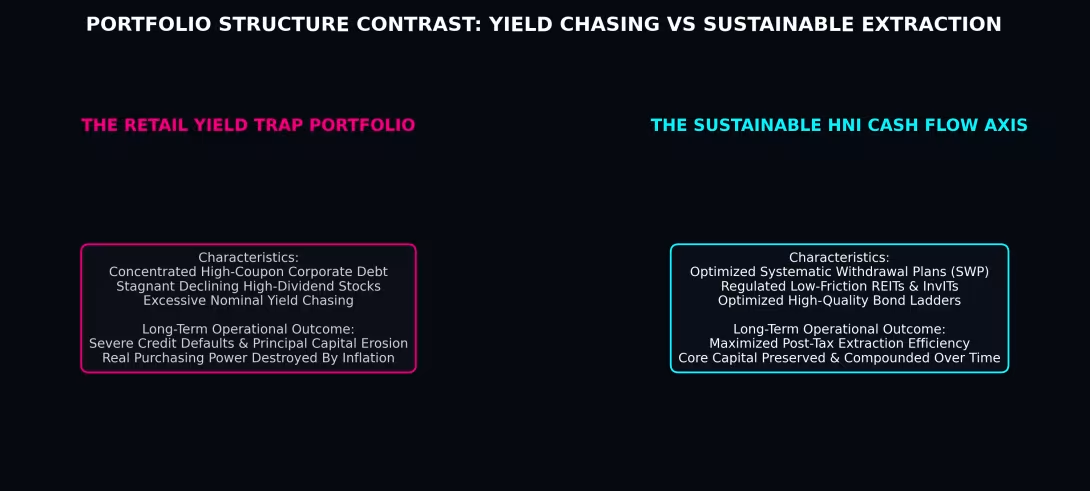
The defining error across affluent portfolios is chasing high nominal yields without verifying the underlying capital structure. If an investor secures a 12% nominal yield from a concentrated corporate debt asset or a declining dividend stock, but the underlying principal value drops by 5% annually due to business stress or structural changes, their total return is deeply compromised. Chasing yield often leads to concentrated portfolios and excessive risk. A true passive income strategy focuses on protecting real purchasing power over time, ensuring your regular cash flow is supported by an asset base that continues to grow alongside inflation.
The Passive Income Myth
The initial barrier to building a resilient cash flow engine is the common myth that passive income simply equals the sum of your interest and dividends. This baseline retail definition completely ignores the destructive mechanics of inflation, multi-layered taxes, changing longevity tables, and equity market volatility.
A professional, HNI-grade passive income strategy treats cash flow as a dynamic harvesting process. In this framework, nominal payouts are continually re-evaluated against real purchasing power preservation and clear legacy objectives. A truly sustainable cash flow model does not search for a single high-yielding product; it builds a multi-asset allocation matrix designed to generate liquidity smoothly without eroding the core capital base across full economic horizons.
Understanding the Three Sources of Passive Income
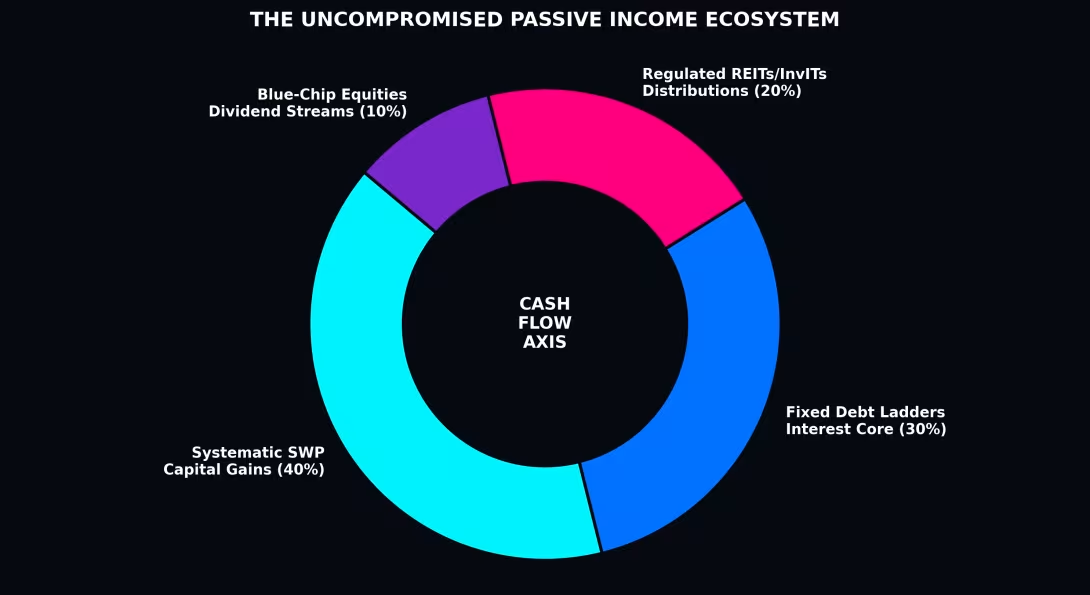
Affluent families must separate their income sources into three distinct, non-correlating capital mechanics. Relying exclusively on any single tranche introduces severe structural concentration into your balance sheet:
- Interest Income: Derived from traditional corporate bonds, government securities listings, fixed deposits, and debt mutual fund allocations. This component delivers high near-term predictability but lacks built-in inflation protection.
- Distribution Income: Generated through Real Estate Investment Trusts (REITs), Infrastructure Investment Trusts (InvITs), and corporate dividend distributions. This track provides regular pass-through yields backed by tangible commercial infrastructure and corporate profitability.
- Systematic Withdrawal of Capital Gains: Formulated through automated, programmatic Systematic Withdrawal Plans (SWP) across liquid equity and hybrid mutual fund portfolios. This modern cash flow engine transforms equity compounding into predictable regular income while maximizing tax location benefits.
Why Yield Alone Is a Dangerous Metric
To understand why chasing raw yield destroys long-term capital wealth, consider a direct portfolio contrast over an extended multi-year cycle:
- Portfolio A (The Yield Trap): Allocates capital into high-coupon unrated corporate debt and distressed equity tranches, generating a 12% nominal distribution yield. However, because the underlying corporate entities face structural stress, the primary principal drops by 4% annually. The real capital base is systematically eroded.
- Portfolio B (The Total Return Engine): Establishes a diversified asset allocation generating a modest 5% cash flow yield through controlled distributions and structured withdrawals, while the remaining capital base grows at 7% within productive equity channels.
Over a multi-decade horizon, Portfolio B consistently wins. Portfolio A suffers from a structural capital drag, eventually reducing its absolute cash flow output as the underlying principal shrinks. Portfolio B preserves and expands its baseline capital, ensuring a sustainable, growing stream of regular income.
Defining "Capital Preservation" in an Inflationary Environment
For an affluent family balance sheet, true capital preservation does not mean locking your money in a nominal vault where the principal digit never changes. Real capital preservation means maintaining the absolute purchasing power of your wealth across your family's lifetime.
Consider a corpus baseline of ₹10 Crores sitting in a non-compounding account. Over a 20-year cycle, a steady 6% lifestyle inflation rate will reduce the real-world purchasing power of that capital to less than ₹3 Crores. If your financial framework fails to grow the primary principal alongside inflation, you are slowly eroding your wealth. True estate insulation demands that your portfolio's growth rate naturally matches or exceeds your long-term consumption inflation.
The SWP Strategy: The Modern Income Engine
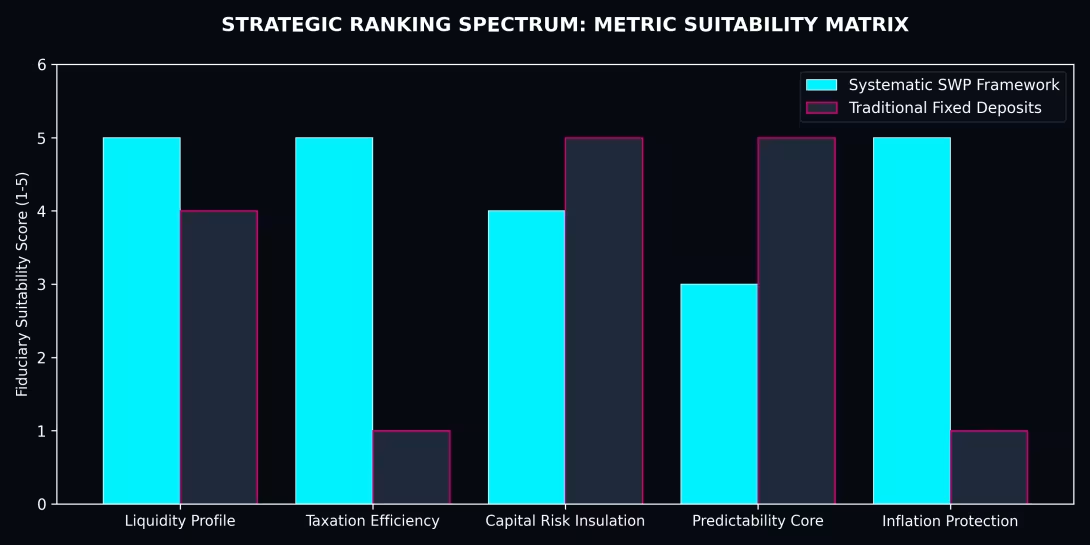
A Systematic Withdrawal Plan (SWP) represents the most efficient mechanism for extracting regular monthly income from a compounding multi-asset framework. Rather than waiting for a corporate board to distribute a dividend or a bond to pay a coupon, an SWP allows the investor to create customized, predictable cash flows by programmatically redeeming specific units from their mutual fund folios.
This automated approach delivers unmatched flexibility. It allows you to systematically adjust your withdrawal values to naturally match changing lifestyle inflation or specific household cash flow demands. By shifting from passive yield collection to an active, programmatic withdrawal strategy, you maintain complete control over your portfolio's extraction schedule, ensuring your regular income remains fully insulated from short-term market adjustments.
Dividend Strategies: Income from Ownership
Allocating capital into dividend-paying equities, dividend-focused mutual funds, and specialized dividend ETFs allows HNIs to capture consistent regular income backed directly by corporate profitability. This approach ensures your cash flow benefits from structural business growth, as resilient enterprises regularly scale up their dividend payouts over time.
However, building an income engine solely around high-yielding dividend stocks introduces hidden risks. High dividend yields can mask deep corporate stress—a phenomenon known as a yield trap—where an enterprise maintains a high trailing distribution layout while its underlying business model decays. Over-allocating to these companies leads to severe sector concentration risks and leaves your portfolio exposed to sudden dividend cuts. This dynamic makes it essential to evaluate corporate metrics on a total-return basis rather than focusing on raw yield alone.
Debt Ladders: Predictable Cash Flows
For conservative asset classes and near-term capital needs, affluent families construct optimized Bond Ladders to secure predictable cash flows while managing interest-rate volatility. This strategy involves spreading your fixed-income allocations across instruments with staggered, chronological maturity horizons:
| Maturity Horizon Tranche | Target Fixed-Income Vehicle | Core Operational Function | Reinvestment Strategy |
|---|---|---|---|
| 1-Year Horizon Block | Sovereign Treasury Bills / Liquid Debt | Provides direct, low-volatility cash flow to secure near-term household liquidity needs. | Liquidates automatically to fund immediate income requirements without market friction. |
| 3-Year Horizon Block | Short-Duration Corporate Debt / G-Secs | Locks in attractive, stable yields across intermediate economic cycles. | Rolls forward systematically into shorter tranches as time horizons progress. |
| 5-Year Horizon Block | Target Maturity Funds / PSU Bonds | Secures extended baseline income stability, protecting principal from macro shifts. | Captures long-term rate structures, rolling down cleanly toward maturity. |
| 7-Year Horizon Block | Long-Duration Government Securities | Anchors the multi-generational estate with high-predictability sovereign backing. | Reinvests capital selectively into emerging high-yield opportunities if macro rates rise. |
This laddered design ensures a portion of your fixed-income portfolio matures regularly every cycle. This structure delivers constant, natural liquidity to meet lifestyle expenses while protecting your primary principal from being locked into low yields if macroeconomic interest rates rise.
Fixed Income Strategies Beyond Fixed Deposits
While traditional retail investors often stop at basic bank fixed deposits, an institutional income strategy looks past these vehicles to eliminate high tax drag and counterparty lockups. HNIs look to sophisticated fixed-income alternatives to maximize their net post-tax returns:
- Government Securities (G-Secs): Held directly via demat accounts, providing absolute sovereign protection against credit defaults while offering predictable, long-term interest payouts across multi-decade horizons.
- AAA-Rated Listed Corporate Bonds: Selected across resilient public sector undertakings (PSUs) and leading financial institutions, delivering an attractive yield premium over traditional bank rates.
- Target Maturity Debt Funds: Pass-through mutual fund vehicles that invest in a defined portfolio of sovereign and high-grade corporate debt matching a specific maturity date. These funds eliminate interest-rate price sensitivity when held to maturity, while offering superior operational liquidity.
REITs: Monetizing Real Estate Without Owning Property
Real Estate Investment Trusts (REITs) allow affluent families to participate in premium commercial real estate yields without the illiquidity and high maintenance overhead of physical property ownership. By holding units in regulated entities—such as Embassy Office Parks REIT or Mindspace Business Parks REIT—investors gain direct exposure to Grade-A commercial spaces, corporate IT parks, and logistics centers.
REITs are legally mandated to distribute at least 90% of their net net-of-tax cash flows back to unit holders on a regular basis. This pass-through model delivers stable, institutional-grade rental payouts while providing secondary exchange liquidity and long-term capital appreciation, allowing you to diversify your real estate footprint seamlessly.
InvITs: Infrastructure-Based Cash Flows
Infrastructure Investment Trusts (InvITs) operate similarly to REITs but focus on long-term infrastructure assets like power transmission lines, toll roads, and renewable energy grids. Because these projects operate under long-term contractual agreements with sovereign or corporate counterparties, they deliver highly predictable, resilient cash flows that carry very low correlation to standard equity market cycles.
However, allocating capital to InvITs requires a thorough analysis of operational risks. Investors must carefully evaluate structural factors like project completion timelines, long-term asset usage trends, asset depreciation cycles, and shifting regulatory frameworks to ensure these infrastructure-backed distributions remain viable across full economic horizons.
Rental Income: The Traditional Passive Income Model
Owning physical residential property remains a deeply ingrained traditional model for generating passive income across India. It offers a tangible, familiar asset class with the potential for long-term capital appreciation.
However, when analyzed under a strict fiduciary standard, physical rental real estate introduces significant structural friction into an HNI balance sheet. The real-world net rental yield for Indian residential real estate routinely hovers at a low 2% to 3%, which fails to clear the hurdle rate of inflation. When you factor in ongoing maintenance expenses, recurring property taxes, unexpected tenant vacancies, property management efforts, and severe liquidity constraints, physical real estate can create an inefficient drag on an income-focused portfolio.
Creating a Passive Income Portfolio Using Asset Allocation
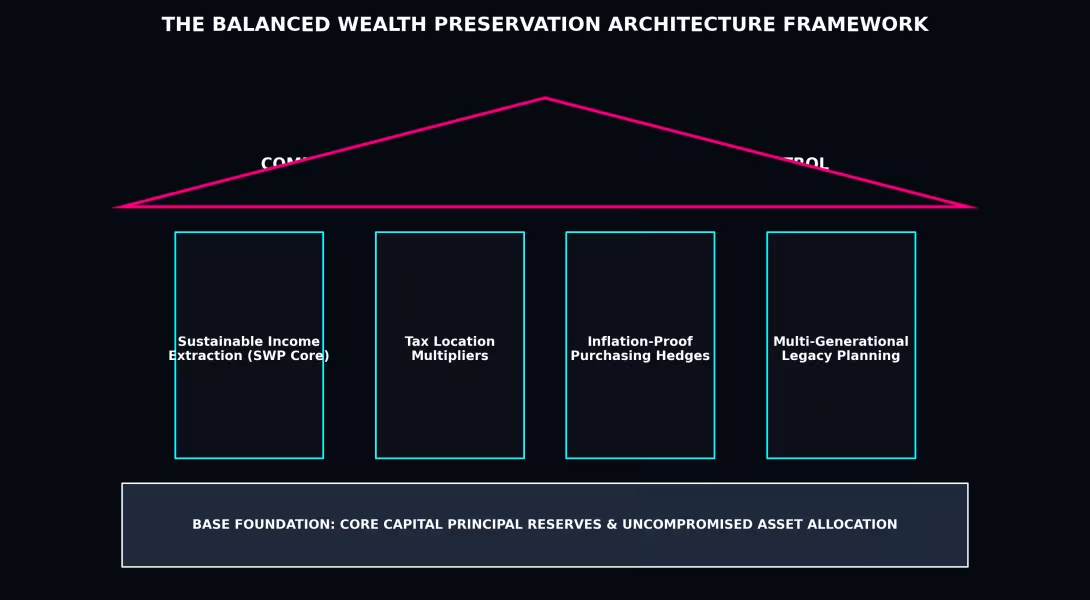
A professional passive income framework relies on a diversified, multi-asset allocation model designed to generate stable regular income while keeping your core principal insulated from single-market shocks:
- Growth Bucket: Focused entirely on direct-plan equities and global index ETFs, acting as the primary engine built to beat long-term inflation and grow your family's estate.
- Income Bucket: Built using high-quality corporate bond ladders, government securities, and target maturity funds to deliver highly predictable, short-term cash flows.
- Stability Bucket: Maintained in low-volatility arbitrage funds, liquid assets, and short-duration debt instruments to handle immediate liquidity demands without friction.
- Alternative Income Bucket: Allocates capital to regulated REITs and InvITs to capture steady pass-through rental and infrastructure yields that carry low correlation to public equity cycles.
The Bucket Strategy for Income Planning
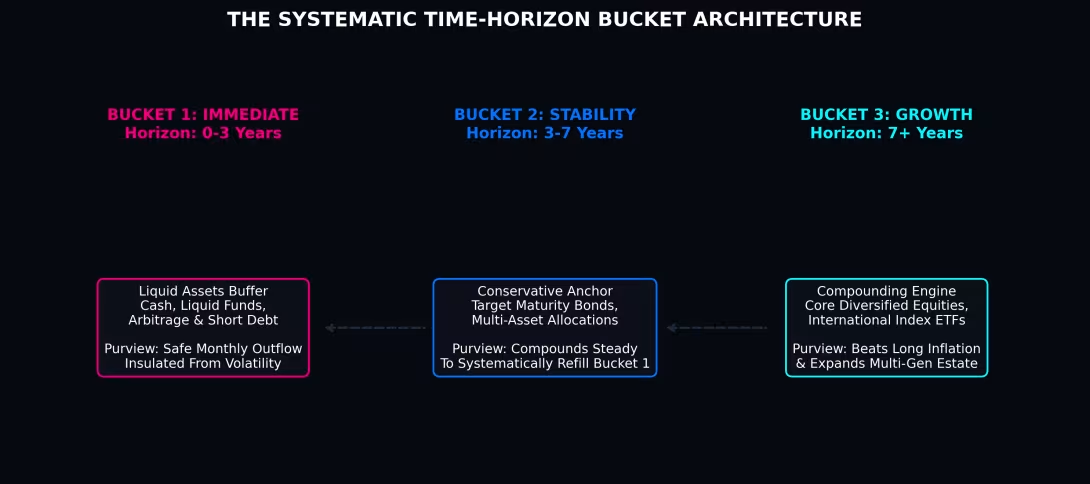
To eliminate short-term market anxiety and prevent forced asset liquidations during corrections, affluent portfolios utilize a structured Three-Tiered Bucket Strategy:
- Bucket 1 (Immediate Income - 0 to 3 Years): Maintained in highly secure, low-volatility liquid funds, arbitrage, and short-duration debt. This layer acts as your immediate liquidity buffer, funding your monthly lifestyle expenses completely insulated from stock market swings.
- Bucket 2 (Medium-Term Stability - 3 to 7 Years): Invested in target maturity funds, corporate bond ladders, and conservative multi-asset allocation strategies. This tier compounds steadily, serving as the automated refill line for Bucket 1 across changing credit cycles.
- Bucket 3 (Long-Term Growth - 7+ Years): Allocated to core equities and international index tranches. This bucket is given a long horizon to ride out public equity volatility, driving the wealth creation needed to protect your future purchasing power.
Passive Income and Tax Efficiency
True portfolio yield must always be calculated on a net post-tax baseline. Because different investment vehicles are governed by completely separate tax rules, matching your assets to the correct account type is essential to minimize revenue leakage:
| Income Vehicle Source | Current Tax Compliance Treatment | Impact on High-Slab Portfolios |
|---|---|---|
| Fixed Deposit & Bond Interest | Taxed fully at your individual marginal income tax slab rate. | Creates significant tax drag, taking up to 30%+ of your raw nominal yields. |
| Corporate Dividend Distributions | Taxed directly at your individual marginal income tax slab rate. | Subject to an automatic 10% TDS cut on layouts exceeding ₹5,000 annually. |
| Mutual Fund SWP Withdrawals | Regulated under capital gains guidelines based on equity holding metrics. | Highly efficient; long-term gains exceeding annual exemptions face a flat 12.5% tax rate. |
| REIT / InvIT Payout Streams | Split into interest, dividend, and principal amortization components. | Taxation varies by component; interest tranches pass through to your individual slab. |
Inflation: The Silent Enemy of Passive Income
Inflation acts as a continuous, silent erosion force on regular income strategies. A fixed nominal payout that comfortably supports your lifestyle today will quickly lose its real-world purchasing power over an extended multi-year cycle.
Consider an annual lifestyle requirement of ₹6 Lakhs today. If long-term consumption inflation averages a steady 6%, your family will require over ₹12 Lakhs annually in 12 years just to maintain the exact same standard of living. Portfolios packed exclusively with fixed nominal assets like traditional bank deposits can struggle over time, confirming that a sustainable income engine must include growth assets to keep your cash flow expanding alongside inflation.
Sequence of Returns Risk
The most severe hazard confronting an income-focused investor is Sequence of Returns Risk—the vulnerability of experiencing an extended equity market crash right at the start of your regular withdrawal timeline. If you are forced to programmatically redeem equity units to meet monthly expenses during a market correction, you end up liquidating assets at deeply depressed valuations.
This forced extraction permanently reduces your absolute unit count, crippling your portfolio's ability to compound effectively when the market eventually recovers. Managing this risk requires maintaining a robust liquid buffer in Bucket 1, ensuring your lifestyle cash flows remain fully insulated from short-term public equity drops.
Passive Income for Different Investor Profiles
A passive income structure cannot utilize a generic, one-size-fits-all template; it must be carefully engineered to match your specific career phase, capital scale, and liability timeline:
- Retirees & Conservative HNIs: Prioritize absolute capital insulation and high income predictability, utilizing structured bond ladders and sovereign G-Sec paths to secure baseline household liquidity.
- Early Retirees (FIRE Frameworks): Require an extended compounding horizon, keeping a larger portion of capital in equity SWP channels to protect long-term purchasing power over a multi-decade timeline.
- Corporate CXOs & High-Earning Professionals: Focus heavily on tax optimization and structural asset location, shifting out of heavily taxed dividend lines into capital gains extraction models.
- Business Owners & Family Offices: Implement highly customized private family trust structures to separate active corporate business risks from the household's long-term lifestyle assets.
Common Passive Income Mistakes
Affluent families frequently compromise their compounding momentum by falling into preventable behavioral and operational traps. The most common regular income errors include:
- Chasing high nominal distribution numbers into concentrated, low-quality corporate debt yield traps.
- Concentrating an excessive percentage of global net worth inside illiquid physical real estate markets.
- Locking significant capital blocks inside low-yielding bank deposits that lose real value to inflation.
- Ignoring the high tax drag applied to dividend and interest streams within top marginal slabs.
- Failing to maintain a dedicated liquid buffer, exposing the core portfolio to sequence of returns risk.
- Operating with unrealistic, aggressive withdrawal rates that systematically deplete the primary principal.
Passive Income and Estate Planning
An investment strategy remains incomplete if it fails to coordinate cash flow generation with legally sound asset protection across generations. Building a regular income engine requires ensuring your financial accounts, demat folios, and trust structures feature clean, updated beneficiary nominations to prevent unexpected account freezes.
For complex family structures or substantial asset pools, establishing a Private Family Trust provides an elegant succession framework. A private trust allows you to direct precise, long-term cash flow distributions to support minor children, a surviving spouse, or elderly parents, completely shielding your family's legacy from public probate friction and external business liabilities.
How Much Wealth Is Needed to Generate Sustainable Income?
To transform abstract regular income concepts into a structured planning framework, you must accurately calculate the exact asset base required to support your desired monthly lifestyle expenses. For an affluent family, a sustainable regular income engine is modeled using a conservative, tax-aware 3.5% to 4.0% Safe Withdrawal Rate across full economic horizons.
This disciplined extraction rate ensures your regular cash flows are fully covered by your portfolio's natural earnings and capital gains, protecting your primary principal from being depleted over time. Let's look at the quantitative capital baselines required to generate regular monthly income sustainably over a multi-decade timeline:
| Target Regular Monthly Income | Equivalent Annual Cash Requirement | Required Corpus Baseline (4% Safe Extraction Rate) | Strategic Portfolio Purview Guidelines |
|---|---|---|---|
| ₹1 Lakh / month | ₹12 Lakhs / year | ₹3 Crores Core Portfolio | Supports baseline financial independence or localized regular retirement needs. |
| ₹5 Lakhs / month | ₹60 Lakhs / year | ₹15 Crores Core Portfolio | Secures premium global lifestyle freedom, funding international travel and family education timelines. |
| ₹10 Lakhs / month | ₹1.2 Crores / year | ₹30 Crores Core Portfolio | Establishes a resilient legacy structure capable of supporting multi-generational estate planning goals. |
Disclaimer: These metrics serve as通 planning simulations based on a globally diversified, tax-optimized multi-asset framework. Actual asset calculations must match your personal tax brackets, specific lifestyle inflation rates, and real timeline requirements.
Passive Income Is a Financial Planning Problem, Not an Investment Product Problem
The ultimate reality of wealth management is that sustainable regular income depends entirely on comprehensive, multi-variable planning rather than selecting a single, perfect investment product. Chasing after the "best passive income scheme" or following the latest market trends is an incomplete strategy that fails to account for your unique tax brackets, inflation risks, and lifestyle timelines. Reliable, long-term cash flow is the mathematical result of an integrated asset allocation framework, disciplined holding buckets, automated tax optimization, and regular professional reviews.
The True Role of a SEBI Registered Investment Adviser
Navigating the intersections of structural asset allocation, complex tax compliance, holding bucket adjustments, and estate continuity completely on your own can quickly turn into an exhausting second job. That is precisely why partnering with a fee-only, SEBI Registered Investment Adviser (RIA) is so vital. A true fiduciary adviser looks past short-term transaction volumes or sales pitches. Their focus is completely on your long-term success.
At Wealth Together, our relationship model is completely decoupled from conflict-laden sales commissions or hidden distribution networks. Having successfully navigated this exact corporate transition ourselves, we understand the unique pressures facing high-end technology professionals and modern families. Our mission is to serve as an objective, trusted sounding board—delivering algorithmically sound advice paired with dedicated, empathetic handholding to guide you through every major financial decision.
We invite you to explore our custom Get Started Roadmap to understand our transparent, fee-only advisory onboarding process, or seamlessly utilize our floating portal block to secure your personalized, uncompromised regular cash flow discovery session today.
Skip commission-driven sales pitches and align your capital with a pure fee-only fiduciary adviser.