For high-earning technology executives, corporate promoters, and affluent Indian families, domestic wealth creation often masks an underlying structural vulnerability. In the modern financial landscape, international investing has evolved away from an optional diversification strategy into a core risk-management decision. True portfolio resilience requires shifting your focus past localized index returns into a sophisticated, multi-jurisdictional wealth architecture built to preserve purchasing power across diverse global markets.
Most retail financial media narrows the international investment discussion to simple access to US technology stocks or basic remittance processing steps. This surface-level framing misses the core objective of cross-border asset management. A professional framework evaluates global investing as an integrated tool built to handle currency risk, optimize international asset location, protect multi-generational succession tracks, and insulate your balance sheet from geographic concentration risks that traditional domestic-only portfolios cannot address.
The Risk Profile Illusion: Re-Evaluating the Domestic Safe Haven
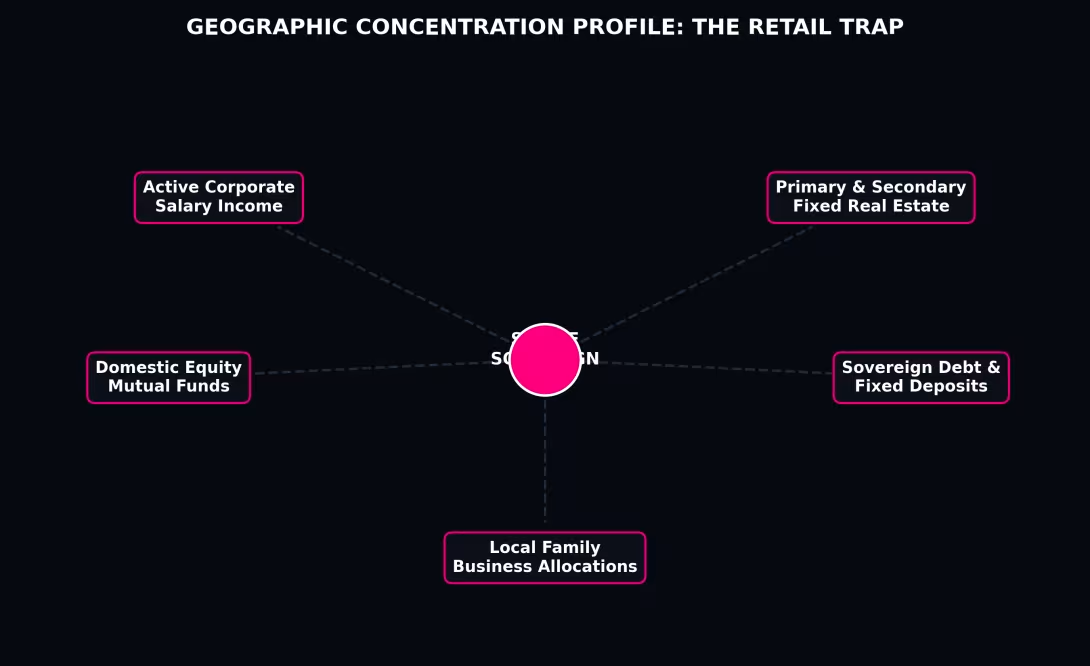
The defining error of affluent portfolios is the systemic accumulation of single-country concentration risk. A successful professional commanding a high salary in India, owning premium domestic real estate, and allocating capital across local equity mutual funds and sovereign fixed-income instruments may believe their portfolio is well-diversified. In reality, their entire financial lifestyle remains completely exposed to a single macroeconomic ecosystem. If that single economic system hits a prolonged structural slowdown, their career revenue, asset values, and liquid reserves all face simultaneous downward stress.
Geographically Disrupted Realities: Tracking Global Liabilities
HNIs do not structure cross-border allocations purely to beat domestic returns; they build them to match the physical and geographic transformation of their lives. Affluent families increasingly operate on an international scale—navigating cross-border corporate careers, funding elite international education timelines, accessing global healthcare systems, and establishing multi-country residency profiles.
When a household's future financial liabilities are priced in foreign currencies like USD, GBP, or EUR, keeping 100% of your capital compounding inside an INR-denominated ledger introduces an unhedged mismatch. A sharp drop in currency purchasing power can immediately inflate your real-world costs. Shifting capital into global asset classes ensures your wealth matches your family's future consumption realities, preserving absolute lifestyle autonomy.
Structural Diversification: Accessing Global Sectors and Leaders
While the Indian capital market offers robust compounding avenues across financials, industrials, infrastructure, and energy, it remains structurally underrepresented across key global sectors. Allocating capital internationally allows HNIs to diversify into critical structural horizons that are nearly absent in domestic exchanges:
| Global Megatrend Sector | Domestic Availability Profile | Target Global Enterprise Leaders | Strategic Purview within Portfolio |
|---|---|---|---|
| Advanced Semiconductors | Minimal direct public equity options | NVIDIA Corp., TSMC, ASML Holding | Captures the hardware manufacturing infrastructure driving global compute demands. |
| Hyperscale Cloud & AI | Limited to localized IT services platforms | Microsoft Corp., Alphabet Inc., Amazon.com | Provides direct ownership in the foundational algorithmic engines shaping global commerce. |
| Global Consumer Brands | Mainly localized manufacturing footprints | Apple Inc., LVMH Moët Hennessy, Meta Platforms | Secures resilient revenue exposure generated across diversified international consumer markets. |
Strategic diversification ensures your equity growth is not dependent on the corporate earnings cycle of a single country, allowing you to capture global growth vectors seamlessly.
Deconstructing the Currency Complement: Total Investor Return Math
A critical omission in retail investment planning is the failure to evaluate cross-border performance on a unified basis that accounts for both asset growth and currency movement. When you invest internationally, your total performance matches a specific two-part formula:
$$Total\ Investor\ Return = Asset\ Class\ Capital\ Appreciation + Currency\ Conversion\ Movement$$
Over long-term historical horizons, the Indian Rupee has experienced structural depreciation against the US Dollar, driven by persistent inflation differentials and trade balances. When an Indian investor holds a USD-denominated asset, this structural currency shift serves as a continuous tailwind. Even during periods when the global equity index consolidates sideways, the underlying appreciation of the hard currency protects your global purchasing power, acting as an automated macroeconomic hedge for your family's estate.
Sovereign Allocation Geography: Looking Beyond the United States
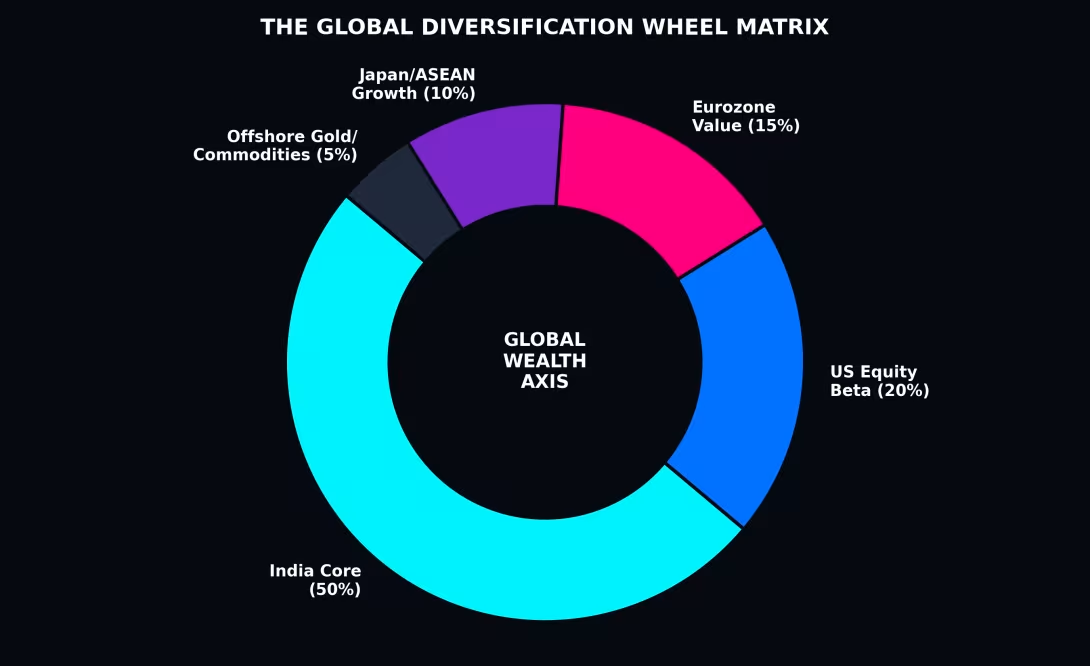
While the United States dominates global equity indices due to its deep innovation ecosystems and liquid public markets, an optimized HNI portfolio looks past single-country concentration. Relying exclusively on US mega-cap technology stocks simply exchanges domestic concentration for sector overconcentration, exposing your capital to valuation risks when premium multiples correct.
A sophisticated cross-border strategy utilizes a balanced global allocation framework. It anchors the portfolio in the stable corporate cash flows of European developed markets, captures structural value resets within Japanese equities, and incorporates targeted, low-correlation emerging market tracks across the ASEAN corridor. This systematic footprint dampens portfolio volatility across full global economic cycles.
Operational Evaluation: Cross-Border Investment Channels
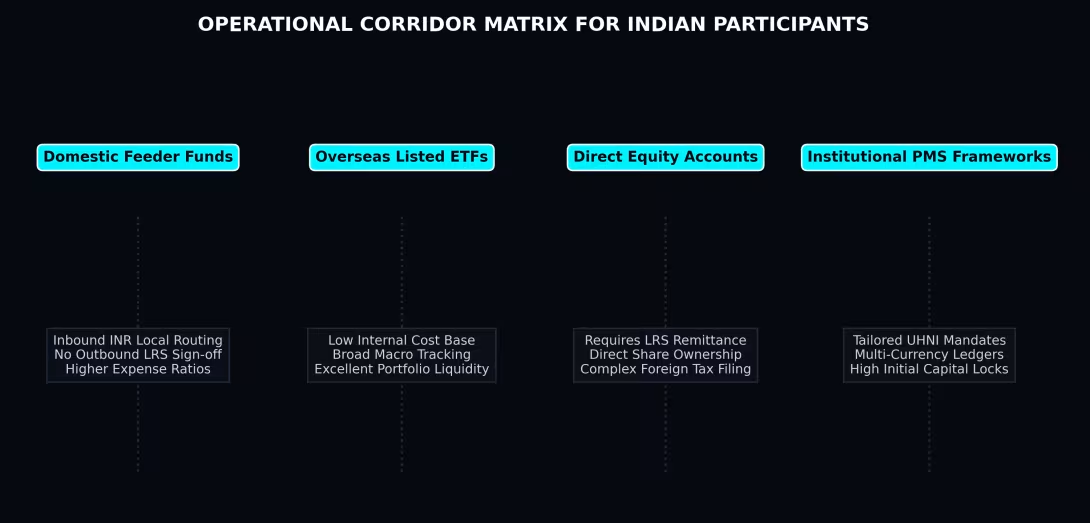
Deploying capital into international markets requires matching your specific liquidity requirements, tax bracket parameters, and net asset scale to the correct routing mechanism:
- International Mutual Funds & Feeder Funds: These vehicles offer high convenience, allowing you to invest in INR through domestic asset management companies without setting up offshore accounts. However, they carry higher internal management costs and are subject to localized regulatory investment caps that can restrict fresh inflows during critical market corrections.
- Overseas Exchange-Traded Funds (ETFs): Traded directly on international exchanges, global ETFs provide transparent, low-cost tracking across broad benchmarks like the S&P 500 or MSCI World Index. This approach removes single-manager risk and offers excellent baseline liquidity.
- Direct Global Brokerage Platforms: Best suited for ultra-high-net-worth portfolios looking to hold individual equities or specialized thematic allocations. This channel demands active maintenance, thorough compliance tracking, and detailed attention to host-country regulatory rules.
- Global Portfolio Management Services (PMS): Tailored for substantial asset pools, providing customized international advisory mandates, direct multi-currency execution channels, and structured institutional asset placement.
Navigating the Liberalised Remittance Scheme (LRS) Architecture
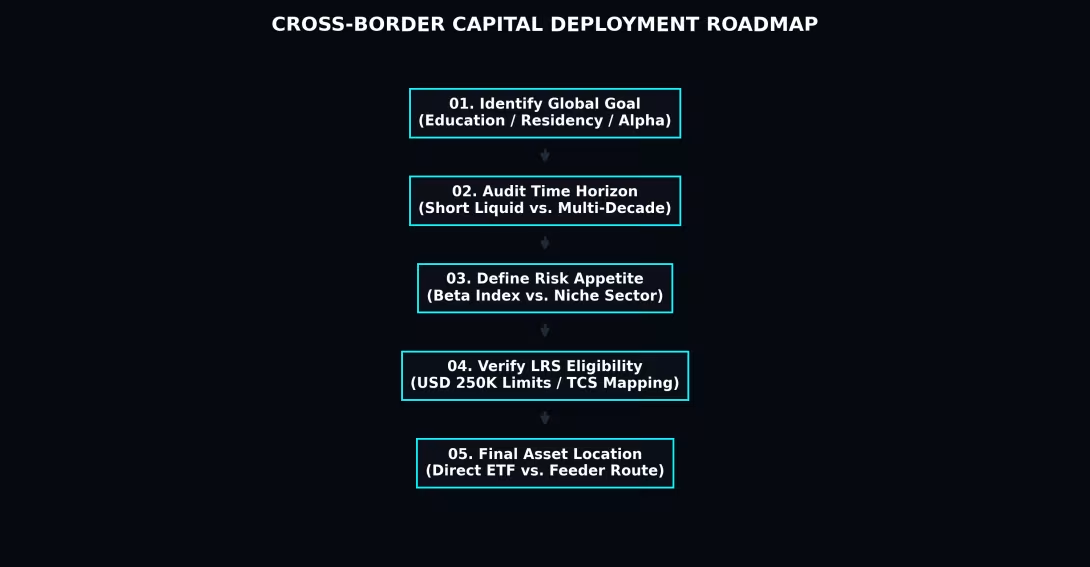
Every outbound investment transaction executed by an individual resident Indian is governed by the Reserve Bank of India under the Liberalised Remittance Scheme (LRS). Navigating this framework requires strict adherence to statutory limits, documentation standards, and reporting tracking:
| LRS Statutory Parameter | Current Regulatory Boundary Guidelines | Mandatory Documentation Requirements |
|---|---|---|
| Annual Remittance Limit | Up to USD 250,000 per individual per financial year. | Valid Permanent Account Number (PAN), Form A2 self-declaration tracking. |
| Tax Collected at Source (TCS) | 20% TCS applied on investment remittances exceeding ₹7 Lakhs annually. | Bank transaction certification; TCS is fully claimable against your final income tax liability. |
| Permitted Outbound Actions | Overseas equities, mutual funds, debt instruments, immoveable property. | Strict prohibition on outbound leverage, margin trading, or overseas F&O execution. |
When clearing capital through this gateway, investors frequently stumble into critical compliance traps. The most common errors include failing to combine individual family member quotas correctly for large asset purchases, missing the rigid reporting deadlines required to track outbound funds on annual tax filings, and routing remittances through unauthorized or non-designated dealer channels. Avoiding these operational errors requires strict procedural oversight.
Cross-Border Taxation and Advanced Asset Location
True portfolio performance must always be evaluated on a net-of-tax baseline. Shifting assets internationally introduces complex tax layers that require careful strategic location mapping:
- Taxation of International Mutual Funds and ETFs: Under updated domestic tax rules, capital gains realized from international mutual funds and ETFs are taxed according to your individual income tax slab rates, making proactive holding-period management essential.
- Foreign Corporate Dividend Cash Flows: Dividends distributed by international corporations are generally subject to withholding taxes in the host country (e.g., a baseline 25% withholding tax under the US-India tax treaty). These inflows must be reported on your Indian tax returns, where you can utilize Double Taxation Avoidance Agreement (DTAA) provisions to claim foreign tax credits and eliminate double taxation.
- The US PFIC Reporting Trap: For families navigating cross-border relocations involving the United States, holding regular Indian mutual funds triggers the IRS's punitive Passive Foreign Investment Company (PFIC) guidelines. This classification subjects your returns to high tax rates and complex reporting requirements via IRS Form 8621, making direct equities or US-domiciled ETFs a far more tax-efficient alternative.
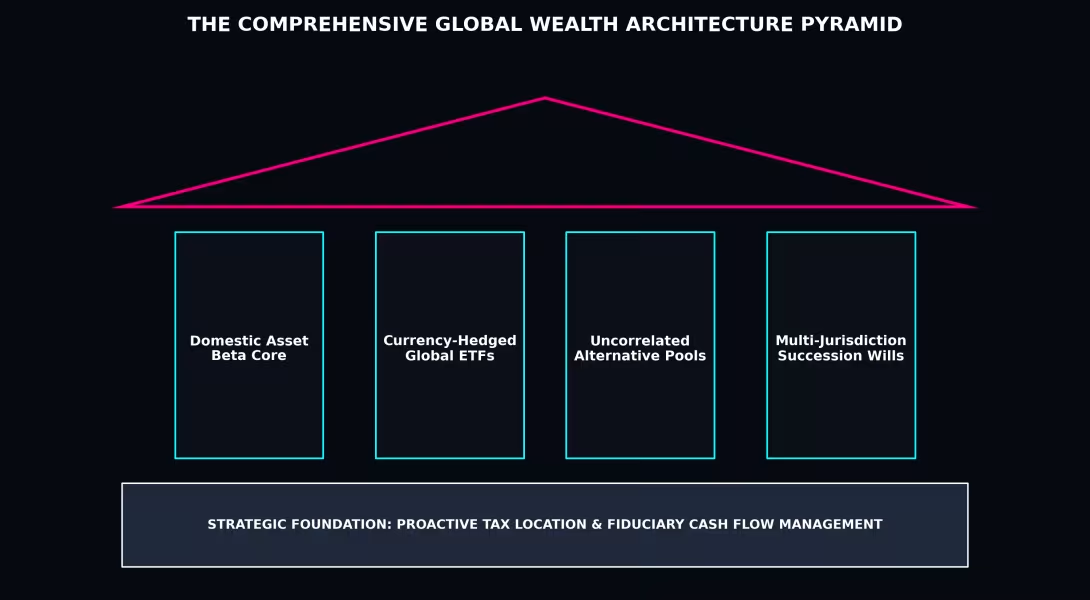
Estate Planning and Generational Asset Protection Across Borders
An international investment strategy remains incomplete if it fails to coordinate wealth accumulation with legally sound asset protection across borders. Foreign brokerage ledgers and international property allocations do not automatically follow standard domestic succession rules. If an unexpected life event occurs, your family can face prolonged probate blockades, complex foreign court challenges, and unexpected legal costs.
Securing cross-border wealth transmission requires establishing independent, concurrent jurisdictional Wills. Your Indian Will should be designed to govern your domestic investments cleanly, while separate, legally valid Wills are executed to guide the succession of your offshore accounts or foreign real estate according to host-country estate laws. Furthermore, US-based assets held directly by non-citizens face an aggressive federal estate tax of up to 40% on account values exceeding a baseline threshold of just USD 60,000. Managing this risk requires structuring your accounts using private family trusts or joint holding patterns to shield your family's legacy.
What Happens If India Underperforms for a Decade?
The single most dangerous behavioral blind spot in wealth management is recency bias—the tendency to project recent market trends indefinitely into the future. Because the domestic index has delivered strong performance over the preceding cycle, many retail investors operate under the comfortable assumption that local assets will always lead global growth tables.
A professional fiduciary framework ignores speculative market predictions and manages for multiple economic outcomes. Consider this risk-management thought experiment: What happens to your retirement timeline and family milestones if the domestic economy enters a prolonged period of underperformance?
Economic history proves that equity markets operate in cycles of growth and consolidation. Major economic shifts—such as sudden regulatory adjustments, changes in global trade policy, energy supply disruptions, or cyclical currency corrections—can cause individual countries to underperform for extended periods. A globally diversified investor does not try to predict which region will lead the next cycle; they construct a balanced portfolio designed to ensure that whether India, the US, developed European markets, or emerging economies lead the next decade, their family's baseline security remains fully insulated from localized downturns.
Financial Planning Mistakes That Cannot Be Fixed by Higher Returns
The most expensive error an affluent investor can make is believing that a high-performing asset or excellent fund selection can compensate for a broken structural foundation. In cross-border wealth management, a single compliance failure or regulatory mismatch will easily wipe out any marginal investment returns. Consider the critical structural mistakes that no level of market outperformance can ever fix:
- Retaining Domestic Resident Savings and Demat Structures Abroad: Continuing to operate standard resident accounts inside India after securing an overseas employment visa directly violates FEMA regulations, exposing your baseline liquid capital to compounding statutory penalties.
- Deploying Capital Into Indian Mutual Funds Under US Tax Residency: Investing in domestic mutual funds without mapping the strict US tax treatment of Passive Foreign Investment Companies (PFICs) ensures that the IRS subsequently claws back your gains via punitive tax brackets and complex reporting formulas.
- Operating Without Independent, Cross-Border Health Covers: Relying exclusively on temporary host-country employee group insurance means that if a sudden career transition or medical emergency forces a relocation back to India, your protection disappears instantly, exposing your core equity portfolio to forced liquidations to fund private medical inflation.
- Relying Solely on Account Nominations Across Global Registries: Allocating multi-crore investment pools across borders without drafting concurrent, jurisdiction-specific Legal Wills guarantees that your family faces severe probate friction, frozen asset registries, and prolonged legal blockades that no return profile can bypass.
- Failing to Implement Tax Treaty Disclosures (DTAA Friction): Accumulating assets in parallel corridors without filing formal Tax Residency Certificates (TRC) or executing treaty declarations leads to immediate, automated double-taxation leakage on your core dividend and capital gains streams.
"A 15% return portfolio cannot compensate for a broken financial plan. True global financial independence is achieved by establishing clear, regulatory guardrails around your cross-border capital, ensuring your assets can withstand international compliance shocks across full economic cycles."
The True Role of a SEBI Registered Investment Adviser
Navigating the intersections of FEMA compliance, cross-border tax regulations, multi-currency asset location, and estate continuity completely on your own can quickly turn into an exhausting second job. That is precisely why partnering with a fee-only, SEBI Registered Investment Adviser (RIA) is so vital. A true fiduciary adviser looks past short-term transaction volumes or sales pitches. Their focus is completely on your long-term success.
At Wealth Together, our relationship model is completely decoupled from conflict-laden sales commissions or hidden distribution networks. Having successfully navigated this exact corporate transition ourselves, we understand the unique pressures facing high-end technology professionals and modern families. Our mission is to serve as an objective, trusted sounding board—delivering algorithmically sound advice paired with dedicated, empathetic handholding to guide you through every major financial decision.
We invite you to explore our custom Get Started Roadmap to understand our transparent, fee-only advisory onboarding process, or seamlessly utilize our floating portal block to secure your personalized, uncompromised cross-border portfolio discovery session today.
Skip commission-driven sales pitches and align your capital with a pure fee-only fiduciary adviser.