When affluent high-net-worth individuals plan their long-term asset allocations, the conversation almost always hits a product-centric bottleneck: Which active portfolio manager or boutique strategy topped the trailing return charts over the last 36 months? However, looking purely at trailing returns is an incomplete way to analyze wealth. Experienced investors understand that the wrapper holding an asset can have a massive impact on net performance, liquidity, operational friction, and overall legal safety.
Choosing between a Mutual Fund (MF), Portfolio Management Services (PMS), and an Alternative Investment Fund (AIF) is not just a choice between different underlying stock ideas. It is a choice between fundamentally different legal structures, operational workflows, and tax frameworks. If you select the wrong investment vehicle, you could face unexpected tax bills due to high portfolio turnover, find your capital locked up during a market crash, or deal with complicated capital calls that disrupt your liquid cash flow. For portfolios exceeding ₹5 Crores, optimizing the structural design of your investments is just as vital as choosing the right stock or sector.
Why Investment Structure Matters More Than Most Investors Realize
Many investors focus entirely on returns, star managers, or recent performance metrics. But sophisticated investors understand that long-term net wealth retention depends heavily on systemic parameters: taxation friction, structural liquidity timelines, trade reporting transparency, portfolio customization boundaries, regulatory frameworks, scalability, and holistic portfolio fit. The structural wrapper dictates how much of your gross return actually survives down to the net bottom line.
Understanding the Three Structural Frameworks
To choose the right investment wrapper, you first need to understand the structural and legal mechanics of each vehicle:
- Mutual Funds: A public trust that pools capital from thousands of investors into a single collective fund. This capital is managed against a predefined regulatory mandate issued by SEBI under the Mutual Fund Regulations, 1996. When you invest, you own fractional units of the total fund pool based on its Daily Net Asset Value (NAV), making it suitable for broad investor participation.
- PMS (Portfolio Management Services): Does not pool your money into a shared collective asset. Instead, it functions as a Separately Managed Account (SMA) held in your independent name. When you sign a PMS contract, you open a separate, segregated demat account linked to an individual bank account under a Power of Attorney (POA) framework. The portfolio manager buys and sells securities directly within your personal account, allowing for customized allocations.
- AIFs (Alternative Investment Funds): A privately pooled investment vehicle established as a trust, company, or limited liability partnership (LLP). Regulated under the SEBI (Alternative Investment Funds) Regulations, 2012, AIFs are designed specifically for sophisticated capital that can handle complex strategies. These include unlisted private equity buyouts, structured venture debt, long-short hedge fund mechanics, and less conventional asset exposure.
Quick Snapshot Comparison
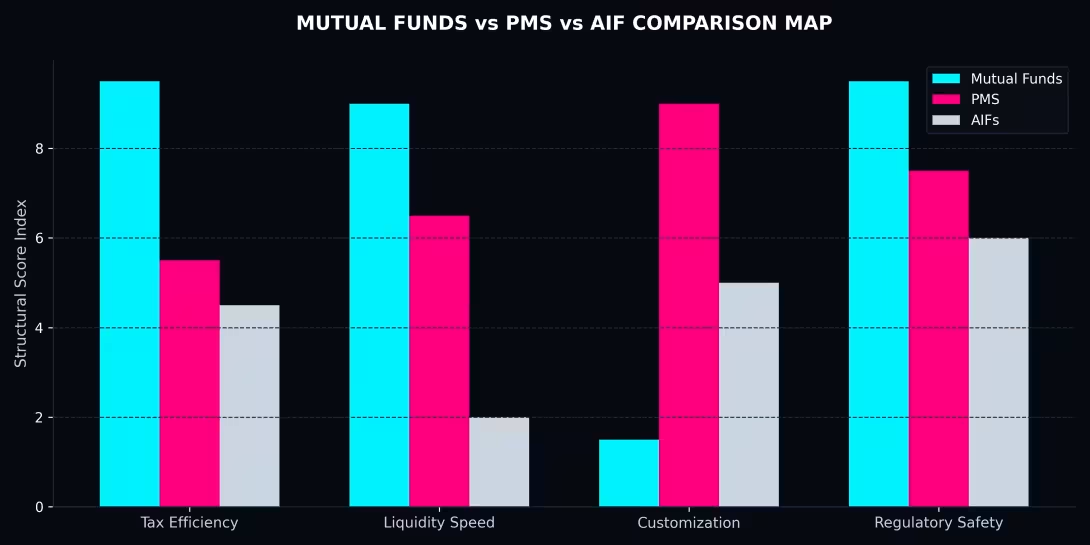
| Parameter | Mutual Funds | PMS | AIF |
|---|---|---|---|
| Minimum Investment | Low entry floor | Ref 50 Lakh regulatory entry | Ref 1 Crore strategy entry |
| Customization | Low standardized tracking | High personal account filtering | Moderate strategy framework |
| Liquidity | High daily NAV redemption | Moderate market access | Low fixed multi-year locks |
| Transparency | High public factsheets | Moderate-High live dashboards | Lower quarterly updates |
| Complexity | Low retail management | Medium active management | High institutional tracking |
| Regulation | Strong public oversight | Strong direct guidelines | Specialized sophisticated logic |
| Investor Suitability | Mass affluent foundations | HNIs with long asset horizons | Sophisticated HNIs / UHNIs |
| Risk Level | Moderate diversified matching | Moderate-High style betting | High strategy execution risk |
| Portfolio Ownership | Indirect fractional units | Direct legal shareholding | Pooled trust private units |
| Taxation Complexity | Lower deferred compounding | Medium annual ledger hit | High asset class treatment |
Minimum Investment Thresholds and Strategic Allocation
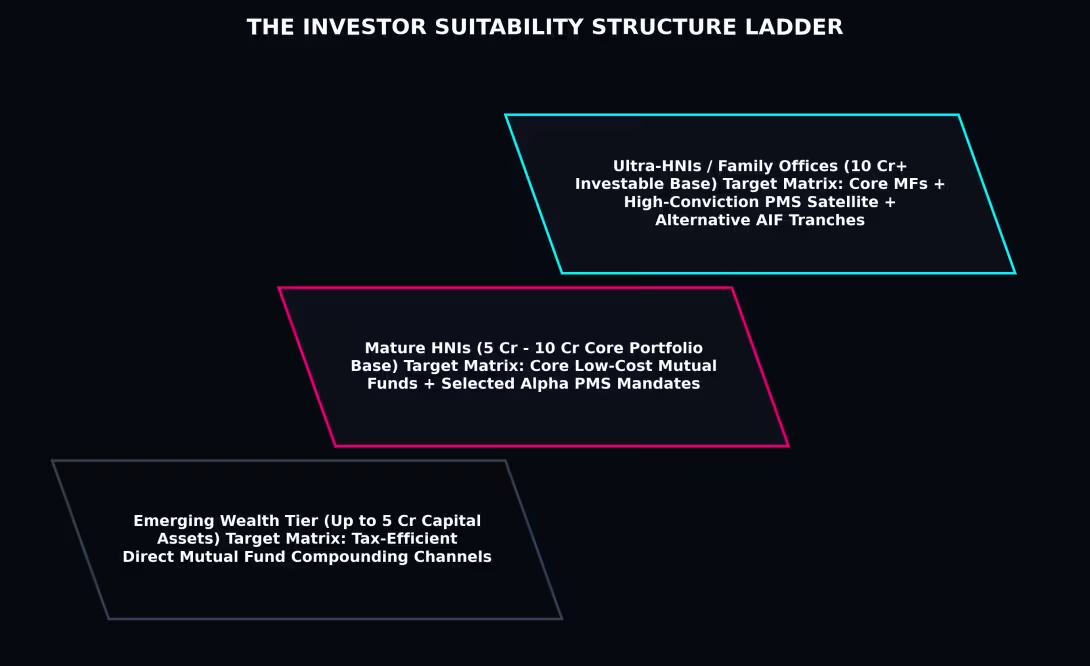
The entry barriers for these structures are intentionally designed by regulators to separate mass retail products from institutional strategies.
Mutual funds offer ultimate capital democratization, with Systematic Investment Plans (SIPs) starting from minor values alongside flexible lump sum deployments. This accessibility allows for high diversification at low capital thresholds, providing an optimal retail and core wealth structural foundation.
Conversely, SEBI enforces a strict minimum investment threshold of Ref 50 Lakh per client strategy inside a PMS. However, in practical wealth architecture reality, many HNIs allocate significantly higher sizes. Deploying exactly the entry floor into a single concentrated portfolio can expose an emerging investor to high manager concentration risk. A PMS becomes truly meaningful at larger overall corpus sizes where it can generate target alpha without threatening baseline liquidity.
For AIFs, the regulatory baseline is set at Ref 1 Crore per strategy. This high entry bar ensures that alternative vehicles are targeted strictly toward sophisticated investors who possess long-term capital horizons, large overall balance sheets, and a high risk tolerance to navigate institutional asset lock-ins.
Risk-Return Expectations and Downside Realities
A fiduciary approach requires looking past common marketing claims that alternative platforms work as guaranteed return upgrades. Higher return potential is never a guaranteed outcome; it is a direct architectural tradeoff against style concentration, volatility, and structural drawdowns.
- Mutual Funds: Moderate return targets, moderate volatility index, and moderate drawdown risk due to strict diversification caps (such as the 10% single-stock holding ceiling).
- PMS: Potentially higher active benchmark tracking, accompanied by higher volatility and deep drawdown risk due to concentrated active allocations.
- AIFs: Performance is entirely strategy-dependent, exposing capital to high institutional-grade volatility and tail-risk drawdowns.
Sophisticated wealth builders evaluate structures based on performance consistency across full economic cycles, risk-adjusted returns (Sharpe/Sortino), downside management frameworks, tax drag, and asset correlation. Higher return potential does not mean a better outcome if it introduces structural risks that break your long-term plan.
The Liquidity Spectrum: Access Windows Deconstructed
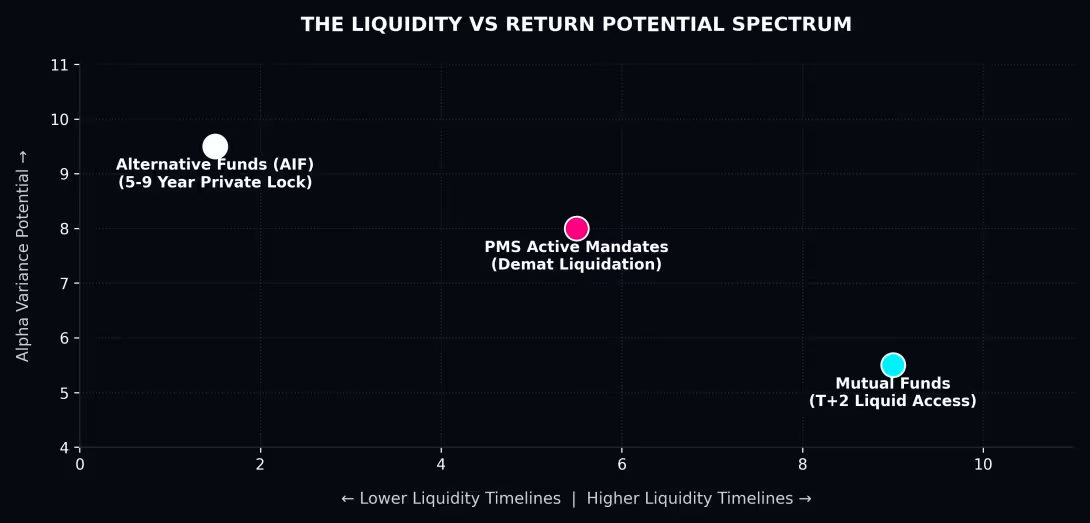
Liquidity access rules vary wildly across these structures, making this a critical parameter during market downturns.
Mutual funds provide high open-ended liquidity with predictable daily NAV calculation frameworks and T+2 redemption cycles. PMS strategies require a physical portfolio liquidation process. Selling large blocks of mid- or small-cap stocks during a market panic can trigger high market impact costs and execution settlement delays across your segregated accounts.
AIF vehicles operate on a completely different paradigm. Closed-ended Category I and II AIFs enforce rigid 5-to-7-year lock-in structures, utilizing staggered capital drawdown mechanisms and tight redemption windows that restrict early capital access.
Transparency and Reporting Visibility
Mutual funds offer public disclosure through standardized monthly factsheets, NAV publications, and compliance logs. PMS frameworks grant transaction-level transparency, providing real-time direct holding visibility across your demat ledger. AIF reporting varies significantly, relying on periodic quarterly valuations and institutional strategy summaries.
Fiduciary Note: Transparency does not automatically mean simplicity. Tracking complex operational derivative statements or private valuations demands high analytical discipline to avoid emotional decision-making.
Fee Structures and High-Water Mark Logic
Understanding cost extraction methods is critical because net returns matter far more than gross performance numbers:
- Mutual Funds: Regulated via a single Total Expense Ratio (TER). Investing through Direct Plans blocks distributor commissions, keeping active costs low.
- PMS: Combines a base management cost (1.5% to 2.25%) with active performance-linked fees (often 15% to 20% above a set hurdle rate), bound by strict high-water mark tracking rules.
- AIFs: Typically mirrors global "2 and 20" institutional structures, combining standard base fees with carried interest profit participation and setup costs.
Structural Taxation Differences
Mutual funds are highly tax-efficient due to their trust status. Under Section 10(23D), all internal active portfolio rebalancing is completely exempt from capital gains taxes—taxation is deferred entirely until you redeem your units.
A PMS transfers tax liability directly to your personal file. Every transaction executed by the manager is a taxable event for you in that fiscal year. A high portfolio turnover rate creates a significant annual tax drag on your compounding growth.
AIF tax rules depend on their regulatory category: Category I and II AIFs enjoy pass-through status (taxed at the investor level based on the type of income). Category III AIFs are taxed at the fund level as an Association of Persons (AOP) at the highest applicable individual tax slab, deduction-free.
Portfolio Customization Boundaries
Mutual funds are highly standardized public pools where individual customization is impossible. Conversely, customization is a major strength of the PMS structure. Investors can establish personalized exclusion flags—such as filtering out a specific stock due to corporate lock-ins or corporate governance concerns—while actively deploying tax-harvesting rules at the end of the fiscal year. AIF customization is limited at the individual account level, offering fixed strategy-level participation instead.
Diversification Characteristics
Mutual funds naturally favor broad market diversification, often holding 40 to 75 securities to reduce single-stock risk. PMS models typically deploy high-conviction, concentrated active strategies holding 15 to 25 companies. AIF structures focus on highly targeted alternative themes, providing access to unlisted private debt markets, venture ecosystems, or specialized arbitrage opportunities.
Complete Risk Management Framework
Affluent wealth builders must evaluate risk dimensions across multiple operational layers:
- Concentration Risk: High in concentrated PMS models; requires balancing via a diversified core base.
- Liquidity Risk: High in private placement AIF structures; requires patient capital deployment lines.
- Manager Risk: Active dependency on the strategy choice or rotation accuracy of a specific fund house.
- Strategy, Valuation, and Regulatory Risk: Complexity across unlisted valuations or shifting tax codes.
AIF structural sophistication does not automatically mean real-world suitability. True portfolio protection demands managing concentration and vehicle risks before deploying capital.
Suitability by Investor Journey and Wealth Tier
- First-Time Investors / Core Portfolios: Best structural fit is Direct Mutual Funds for maximum tax-deferred compounding, high liquidity, and operational simplicity.
- Emerging HNIs: Core Mutual Fund allocations combined with 1 or 2 highly targeted PMS active strategies to capture alpha.
- Mature HNIs / Family Offices: A diversified core of Mutual Funds and PMS strategies, layered with alternative AIF private structures as complementary, non-correlated allocations.
Navigating the Three SEBI AIF Categories
- Category I AIF: Targets positive economic sectors, investing in early-stage startups, venture capital deals, social impact platforms, or early infrastructure projects.
- Category II AIF: The most common alternative trust class, pooling capital for private equity updates, private credit asset lines, or real estate development funds. Prohibited from taking on active operational leverage.
- Category III AIF: Functions like a global hedge fund, executing long-short derivative pairs, complex equity trading strategies, and active structural leverage.
Behavioral Suitability and Personal Psychology
Your vehicle selection must match your emotional tolerance for risk. Mutual funds are optimized for disciplined, automated SIP investing and calm execution tracking. A PMS demands high emotional resilience, as you must stay patient during inevitable periods of active manager underperformance and sharp concentration swings. AIF structures demand comfort with complete illiquidity, requiring you to remain unbothered by multi-year capital locks and private appraisal timelines.
International Exposure Possibilities
Sophisticated portfolios use these structures to capture global diversification. Mutual funds access offshore markets through international feeder funds, navigating domestic remittance caps. PMS models utilize specialized GIFT City structures to invest in international markets using foreign currency denominations under the LRS framework. AIF structures allow family offices to participate directly in cross-border private equity deals, global real estate assets, and venture programs.
Common Industry Misconceptions Debunked
- Myth 1: "PMS strategies will always outperform diversified mutual funds." The Reality: Alpha is highly dependent on cycle alignment. Concentrated PMS models can underperform significantly during active style shifts or sector corrections.
- Myth 2: "A higher regulatory minimum entry ticket guarantees higher strategy quality." The Reality: Minimum investment barriers are investor protection rules designed by SEBI, not certifications of outperformance.
- Myth 3: "Mutual funds are just basic starter products for retail portfolios." The Reality: Low-cost, passive mutual funds are highly efficient tools for capturing core beta. Even multi-family offices use index funds as foundational building blocks because of their high liquidity and excellent tax design.
How Sophisticated HNIs Combine These Structures Together
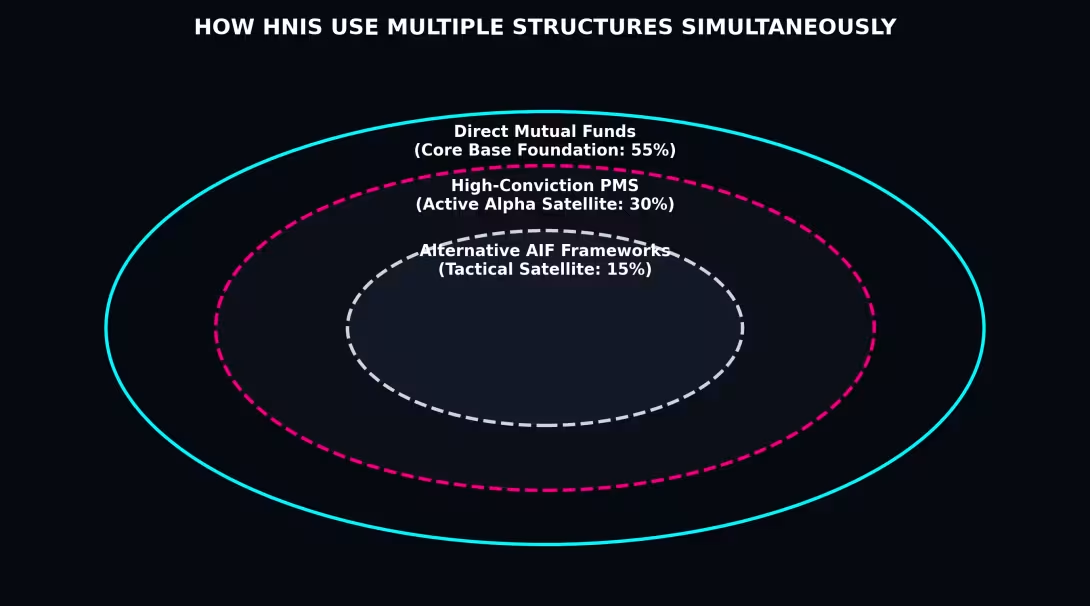
Experienced wealth builders understand that these vehicles are not mutually exclusive choices. A professional wealth architect combines all three structures to optimize performance, liquidity, and tax efficiency across the portfolio:
| Portfolio Bucket | Preferred Structure Wrapper | Core Strategic Purpose |
|---|---|---|
| Core diversified exposure | Mutual Funds (Direct Allocation Tracks) | Maintains standard baseline liquid compounding rules. |
| High-conviction equity | PMS active lines (Concentrated mandates) | Captures active manager alpha outperformance targets over indices. |
| Tactical / alternative exposure | AIF private placement vehicles | Secures entry into private credit markets or long-short hedge funds. |
| International diversification | Combination mechanisms (GIFT City / Feeders) | Insulates the global balance sheet from localized sovereign risks. |
Essential Due Diligence Checklist Before Selecting a Structure
Before deploying your capital into advanced investment structures, ensure you can check off every item on this operational security list:
- [ ] Strategy clarity and performance consistency mapping
- [ ] Portfolio concentration limits and style drift tracking
- [ ] Liquidity terms, lock-in frames, and exit load schedules
- [ ] Total fee transparency across baseline costs and variable metrics
- [ ] Tax implications and annual capital gains filing impacts
- [ ] Historical drawdown history across down-cycles
- [ ] Risk management and corporate governance frameworks
- [ ] Regulatory structure and alignment with long-term financial goals
Questions Investors Should Ask Before Choosing Any Structure
Ask yourself these six foundational questions to keep your asset allocation clear and prevent product-driven mistakes:
- What is my actual liquidity requirement over a 3 to 5 year horizon? Tying up core money in alternative vehicles can trigger severe cash flow crunches during personal emergencies.
- Am I genuinely comfortable with high portfolio concentration? If temporary underperformance or high daily volatility triggers anxiety, stick to diversified mutual fund trusts.
- Do I fully understand the manager's active strategy? Never allocate capital to sophisticated private options simply because they are popular in wealth circles.
- What happens during deep market drawdowns? Assess whether the strategy possesses clear downside mitigation guardrails or relies on pure beta.
- How tax-efficient is this wrapper on my individual file? High-turnover strategies transfer a high annual short-term tax drag straight to your personal ledger.
- How does this vehicle fit into my overall long-term asset allocation? Ensure your wrappers function in alignment rather than competing against each other.
The Role of a Fiduciary SEBI Registered Investment Adviser (RIA)
In a wealth management industry driven by product sales commissions and distributor pitches, a SEBI Registered Investment Adviser serves as your independent financial advocate. An RIA does not sell financial products or collect hidden commissions from fund houses or alternative managers. Instead, an RIA operates on a transparent, client-funded model that guarantees complete alignment with your financial goals.
Our role as your fiduciary adviser is to design a resilient wealth architecture tailored to your life plan: providing unbiased suitability frameworks, optimizing your investment wrappers to minimize tax friction, and continually auditing underlying managers to protect and grow your multi-generational wealth. We invite you to explore our comprehensive Get Started Onboarding Roadmap to learn about our transparent processes, or connect with our secure gateway to arrange your private, zero-obligation portfolio diagnostic session today.
Skip commission-driven sales pitches and align your capital with a pure fee-only fiduciary adviser.