For high-earning technology executives and corporate professionals navigating the upper bands of the Indian tax system, alpha is typically sought through aggressive asset selection or market timing. However, a far more predictable source of wealth acceleration sits directly in the compliance code: the optimization of pre-tax capital flows via the Corporate National Pension System (NPS).
When individual market participants evaluate retirement options, the common consensus is to view the NPS simply as a rigid, illiquid pension lockbox. This surface-level view misses a massive structural advantage. By routing capital directly through an employer gateway, investors can completely bypass the initial income tax drag loop, unlocking an unparalleled compounding velocity that traditional post-tax investment avenues simply cannot match.
The Core Architecture: Tier I vs. Tier II Storage
The NPS framework is divided into two distinct account types. Tier I acts as your primary, tax-incentivized core retirement vehicle. It features strict regulatory lock-in boundaries designed to protect your capital until the age of 60, paired with an exempt-exempt-exempt (EEE) tax designation. Tier II functions as a fully liquid, optional investment ledger with zero lock-in rules, but it lacks any specific tax deductions or structural arbitrage advantages.
The 2026 Regulatory Paradigm: Unlocking Capital Velocity
Historically, a major criticism of the Tier I structure was its forced illiquidity at maturity, which required investors to convert a large 40% chunk of their corpus into a taxable annuity stream. However, recent landmark regulatory updates have dramatically transformed this environment for non-government corporate sector employees.
Under the updated PFRDA guidelines, corporate sector participants can now withdraw up to 80% of their accumulated maturity corpus as a completely tax-free lump sum at age 60. The mandatory annuity component has been compressed down to just 20%. This 20% annuity block remains fully insulated from tax at the moment of transition, with income taxes applying only to the monthly annuity distributions as they are received. This update dramatically reduces long-term tax drag and gives serious investors unprecedented control over their terminal capital pool.
The Baseline Configuration: Tax Drag Across High CTC Bands
To truly quantify the power of this pre-tax vector, we must first establish a baseline using the New Tax Regime slabs. Let’s evaluate three high-earning corporate executive salary tracks—₹30 Lakhs, ₹50 Lakhs, and ₹70 Lakhs gross CTC—assuming zero deductions claimed apart from the standard ₹75,000 corporate deduction and explicitly factoring in mandatory statutory surcharges:
| Gross Household CTC Track | Standard Deduction Allocation | Net Taxable Income Base | Calculated Income Tax (Inc. Surcharge & Cess) | Absolute Net In-Hand Salary Base |
|---|---|---|---|---|
| ₹30,00,000 | ₹75,000 | ₹29,25,000 | ₹4,75,800 | ₹25,24,200 |
| ₹50,00,000 | ₹75,000 | ₹49,25,000 | ₹10,99,800 | ₹39,00,200 |
| ₹70,00,000 | ₹75,000 | ₹69,25,000 | ₹18,96,180 | ₹51,03,820 |
The Corporate Hack: Deploying the 14% Section 80CCD(2) Shield
Now, let's look at the optimized scenario. Under Section 80CCD(2), corporate sector employees can opt to restructure their CTC, routing up to 14% of their Basic Salary directly into their Tier I NPS account as an employer-driven contribution. Assuming your basic salary is mapped conservatively at exactly 50% of your gross CTC, let’s analyze the immediate, upfront tax savings achieved across our three benchmark tracks:
| Gross CTC Track | 14% Basic NPS Contribution Block | New Optimized Tax Liability | Upfront Annual Income Tax Saved | Net Monthly Tax Savings Pocketed |
|---|---|---|---|---|
| ₹30,00,000 | ₹2,10,000 (Basic: ₹15L) | ₹4,10,280 | ₹65,520 / yr | ₹5,460 / month |
| ₹50,00,000 | ₹3,50,000 (Basic: ₹25L) | ₹9,90,600 | ₹1,09,200 / yr | ₹9,100 / month |
| ₹70,00,000 | ₹4,90,000 (Basic: ₹35L) | ₹17,28,012 | ₹1,68,168 / yr | ₹14,014 / month |
By executing this structural adjustment, an executive on the ₹70 Lakh track completely prevents ₹1,68,168 from being stripped away by the tax system every single year. Instead, that capital is deployed straight into their investment pool.
The Showdown: Pre-Tax NPS Capital vs. Post-Tax Mutual Funds
This brings us to the core financial arbitrage opportunity that is rarely discussed across the wealth management industry. What happens if we compare investing pre-tax capital through the Corporate NPS against taking that exact same salary block, paying your income tax first, and investing the remaining post-tax amount into an identical equity mutual fund?
Let's look at a rigorous 20-year timeline simulation for an executive on the 34.32% effective marginal tax bracket deploying a ₹3,50,000 annual corporate block. If routed through the NPS, the full ₹3,50,000 goes to work on day one. If routed into a mutual fund, the tax system immediately takes its cut, leaving only ₹2,29,880 available to invest. Assuming both options achieve an identical 12% annualized market return:
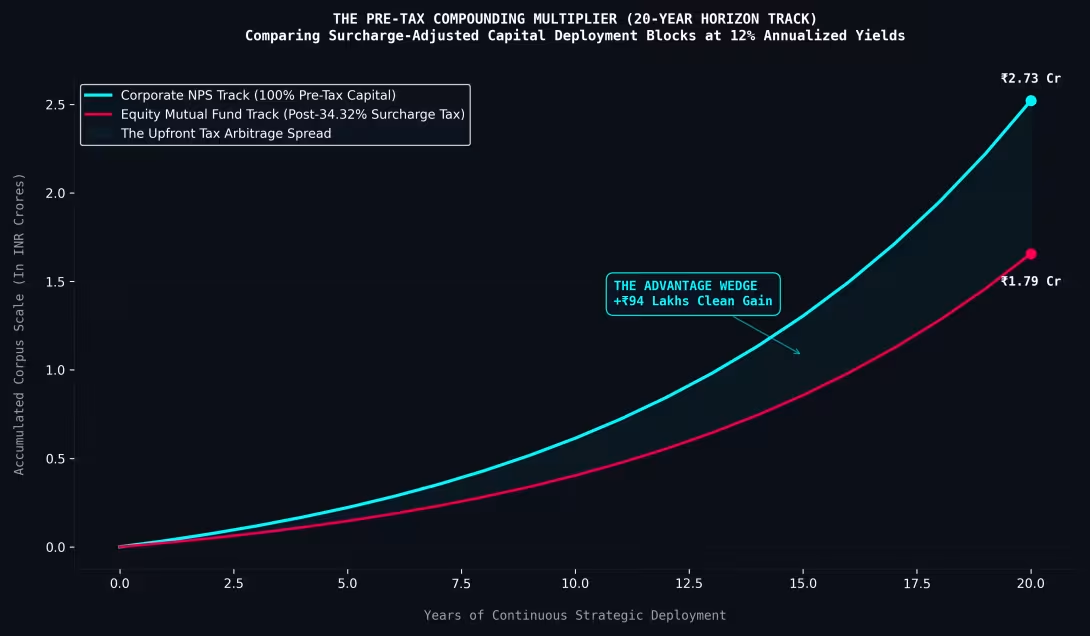
The long-term mathematical variance between these two approaches is staggering:
- The Pre-Tax NPS Compounding Terminal Value: Over a 20-year horizon at a 12% return, your full, untaxed ₹3,50,000 annual contribution accelerates into a massive terminal corpus of ₹2.73 Crores.
- The Post-Tax Mutual Fund Terminal Value: Because your annual starting capital was cut down by the tax system to just ₹2,29,880, the exact same 12% market path yields only ₹1.79 Crores.
- The Pure Upfront Tax Arbitrage Spread: You secure an additional ₹94 Lakhs of clean household wealth simply by choosing to compound pre-tax capital rather than post-tax income. *Note: Long-Term Capital Gains (LTCG) taxes applied to the mutual fund track at redemption will widen this performance delta even further, securing an unbridgeable head start for pre-tax wealth architecture.*
The NPS 3.0 Paradigm: Breaking the Legacy Restrictions
The regulatory evolution of the National Pension System has entered a completely new phase under the NPS 3.0 Multiple Scheme Framework (MSF). If your initial perception of the NPS was shaped by the old constraints, three specific updates completely redefine the utility of this instrument for private sector professionals:
- The 100% Equity Allocation Unlock: Historically, private-sector corporate subscribers were restricted by a strict 75% upper ceiling on Asset Class E (Equity). Under the new guidelines, corporate sector participants can now allocate up to 100% of their contributions directly into Equity, enabling the account to function with the growth profile of a pure diversified equity pool.
- The "Mix & Match" Fund Manager Framework: Corporate participants are no longer restricted to picking a single Pension Fund Manager (PFM) for their entire account. You can now dynamically distribute your asset classes across multiple competing fund houses—for example, allocating your Equity portion to HDFC Pension Fund while choosing SBI Pension Fund for your Government Securities ledger.
- Extended Deferral Horizons up to Age 85: The maximum timeline to stay invested and let your assets compound under full tax deferral has been extended from 75 up to 85 years of age. This extension adds an extra decade of tax-sheltered growth, making it a powerful vehicle for generational wealth transfer and estate continuity.
Auditing the E, C, and G Allocation Matrix and Management Cost Caps
To implement an optimized strategy under Active Choice rules, investors must understand the unique parameters and risk features of each core asset class wrapper:
| NPS Asset Class Blueprint | Maximum Exposure Thresholds | Core Internal Risk Parameters | Strategic Role in Asset Architecture |
|---|---|---|---|
| Asset Class E (Equity) | Up to 100% via MSF Guidelines | Market Volatility / Systematic Beta Risk | Acts as the core engine for long-term growth and shielding against inflation. |
| Asset Class C (Corporate Debt) | Up to 100% Allocation Allowed | Credit Spreads / Interest Rate Sensitivity | Generates predictable institutional yields to support portfolio stability. |
| Asset Class G (Govt Securities) | Up to 100% Allocation Allowed | Duration Exposure / Yield Curve Shifting | Provides a secure, sovereign capital preservation anchor for the family estate. |
From a cost management perspective, tracking internal fund management expenses is vital. Historically, legacy Active and Auto choices operated under a strict expense ratio cap of 0.01% to 0.10% per annum. Under the modern Multiple Scheme Framework updates, while the baseline common active/auto options remain tightly optimized at those original micro-caps, the PFRDA allows an investment management expense cap of up to 0.30% per annum for the advanced specialized portfolios. Even at this updated 0.30% cap, the internal costs remain a fraction of standard active retail mutual funds, preserving your compounding momentum.
Intergenerational Wealth Architecture: The NPS Vatsalya Framework
The most progressive dimension of the updated pension ecosystem is the launch of NPS Vatsalya, a dedicated micro-architecture built explicitly for minors. For high-earning professionals looking to establish long-term financial foundations for their children, this framework bridges the gap between childhood savings and early adulthood wealth accumulation. It operates as a seamless extension of the core family wealth engine.
NPS Vatsalya allows parents or legal guardians to open a minor pension ledger with a baseline entry commitment of just ₹1,000 per annum. There is no statutory upper investment limit, allowing families to deploy large surpluses into high-compounding asset tiers early in a child's lifecycle. Capital is systematically allocated across the same institutional choices available to adults—including options for up to 75% equity exposure—ensuring the assets bypass expensive retail mutual fund fee structures.
The primary strength of the Vatsalya framework lies in its structural transition path when the child reaches maturity. On the day the minor turns 18, the architecture undergoes an automatic regulatory migration into a standard Tier I NPS account. This shift happens without triggering a capital redemption event, completely avoiding capital gains tax liabilities. The young adult can then take ownership of an established compounding engine, choosing to integrate it into their future employer’s corporate Section 80CCD(2) program or maintain it as an independent long-term asset platform.
Advanced Exit Architecture: Eliminating Forced Annuity Traps
The updated guidelines introduce two modern withdrawal mechanisms that completely eliminate the old problem of forced, immediate annuity cash-outs:
- SLW (Systematic Lump Sum Withdrawal): This tool works like a reverse EMI, allowing retirees to withdraw their 80% lump-sum corpus systematically over time. You can set up automated monthly, quarterly, or half-yearly cash credits directly to your primary bank account, keeping the remaining balance fully invested in your asset classes to compound tax-deferred.
- SUR (Systematic Unit Redemption): Functioning identically to a mutual fund's Systematic Withdrawal Plan (SWP), this mechanism automatically liquidates a set number of fund units at periodic intervals. This approach keeps your asset allocation weights perfectly intact, allowing you to fund your retirement lifestyle smoothly while avoiding large, one-time tax triggers.
The Tactical Framework: Advantages vs. Constraints
While the mathematical upside of pre-tax investing is undeniable, a sound financial strategy requires analyzing your ongoing structural liquidity limits.
CAPITAL ALLOCATION MATRIX — The primary trade-off of the Tier I account is its mandatory lock-in until age 60. Therefore, this pre-tax framework is best utilized by high-earning professionals who have already built robust emergency cash reserves and have fully cleared their short-term financial goals. It serves as an elite core preservation engine to safely backstop your long-term retirement security.
The True Role of a SEBI Registered Investment Adviser
Navigating this multi-variable financial machine completely on your own can quickly turn into an exhausting second job. That is precisely why partnering with a fee-only, SEBI Registered Investment Adviser (RIA) is so vital. A true fiduciary advisor looks past short-term transaction volumes or sales pitches. Their focus is completely on your long-term success.
At Wealth Together, our relationship model is completely decoupled from conflict-laden sales commissions or hidden distribution networks. Having successfully navigated this exact corporate transition ourselves, we understand the unique pressures facing high-end technology professionals and modern families. Our mission is to serve as an objective, trusted sounding board—delivering algorithmically sound advice paired with dedicated, empathetic handholding to guide you through every major financial decision.
We invite you to explore our custom Get Started Roadmap to understand our transparent onboarding process, or seamlessly use the floating portal gateway to secure your personalized, zero-obligation portfolio diagnostic session today.
Skip commission-driven sales pitches and align your capital with a pure fee-only fiduciary adviser.