For high-earning technology executives, corporate promoters, and affluent Indian families, reaching significant financial milestones brings a new set of responsibilities. In the initial wealth accumulation phase, success is driven by clear metrics: increasing active income, maximizing savings rates, and identifying high-performing equity investment opportunities. However, once you cross major capital thresholds, the primary risk to your financial security shifts. True resilience requires moving past trend-chasing product selection and embracing a comprehensive wealth management framework built to protect your assets across long market cycles.
Most retail financial media oversimplifies this shift, narrowing the wealth management conversation to basic asset allocation adjustments or comparisons of trending tax-saving products. This narrow view ignores the structural risks that silently erode mature balance sheets. A professional fiduciary framework evaluates wealth preservation as an integrated problem. This discipline requires managing asset location, minimizing structural tax leakage, building robust family governance protocols, and coordinating cross-border estate protection. Managing these moving parts carefully ensures your wealth safely transitions across generations without unnecessary loss or conflict.
The Risk Manager Paradigm: Moving Beyond Product Selection
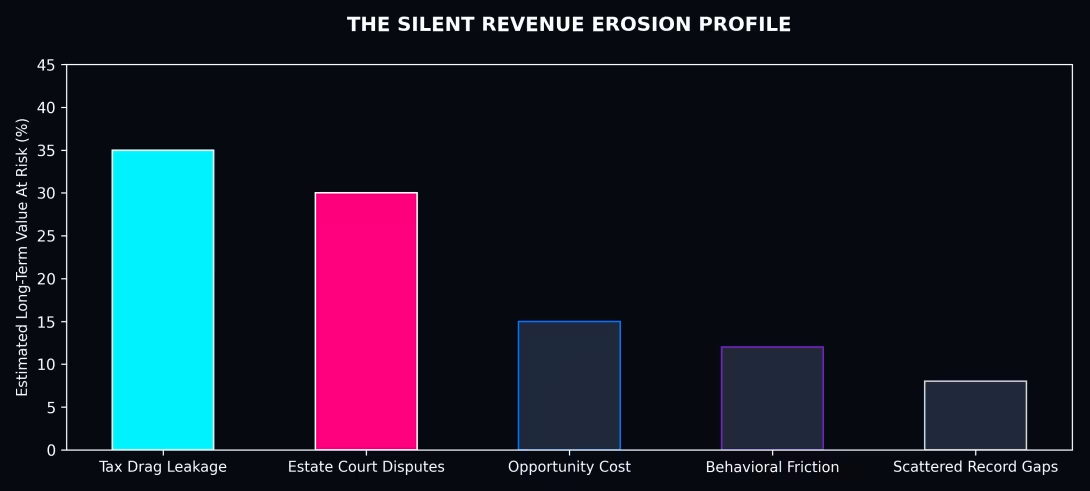
The defining error across affluent portfolios is treating wealth management as nothing more than a search for high investment returns. A family may spend significant effort optimizing mutual fund selections, while leaving their broader financial plan exposed to systemic vulnerabilities. If your balance sheet lacks proper liquidity planning, clear estate structures, and proactive tax mapping, a single unexpected life transition can easily erase decades of market compounding. A high-performing investment portfolio cannot compensate for a broken structural foundation.
The Wealth Management Paradox
The initial barrier to long-term wealth preservation is the paradox of the successful accumulator. Many affluent professionals earn exceptionally well, maintain high savings rates, and invest regularly, yet still make critical structural errors that leave their assets exposed to unnecessary risk.
This vulnerability stems from a fundamental misunderstanding: assuming that the skill set required to build wealth is exactly the same as the discipline required to preserve, structure, document, and transfer it. Holistic wealth management moves past basic product picking to integrate tax location efficiency, multi-tiered contingency planning, clear estate coordination, and family governance into a single, cohesive framework designed to insulate your capital from avoidable real-world shocks.
Mistake #1: Treating Wealth Management as Investment Management
Equating comprehensive financial planning with simple asset collection is a fundamental error that leaves portfolios exposed to unmanaged risks. Many investors assume their financial plan is structurally sound simply because they hold a collection of mutual funds or individual stocks.
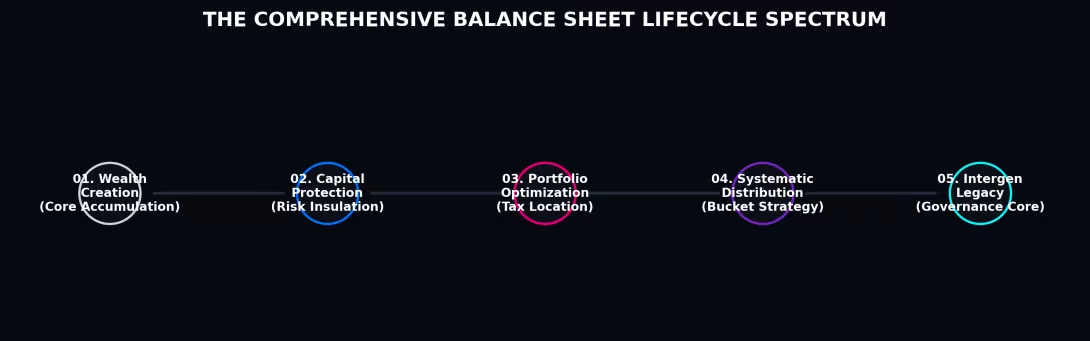
In reality, investment management is only one component of a resilient balance sheet. A comprehensive framework demands integrating emergency planning, proactive tax mapping, lifestyle cash flow matching, risk insurance shields, and cross-border succession tracking into a single strategy. Shifting your focus from simple return-chasing behavior to holistic risk management ensures your portfolio is built to support your long-term goals through changing economic environments.
Mistake #2: Overexposure to Physical Real Estate
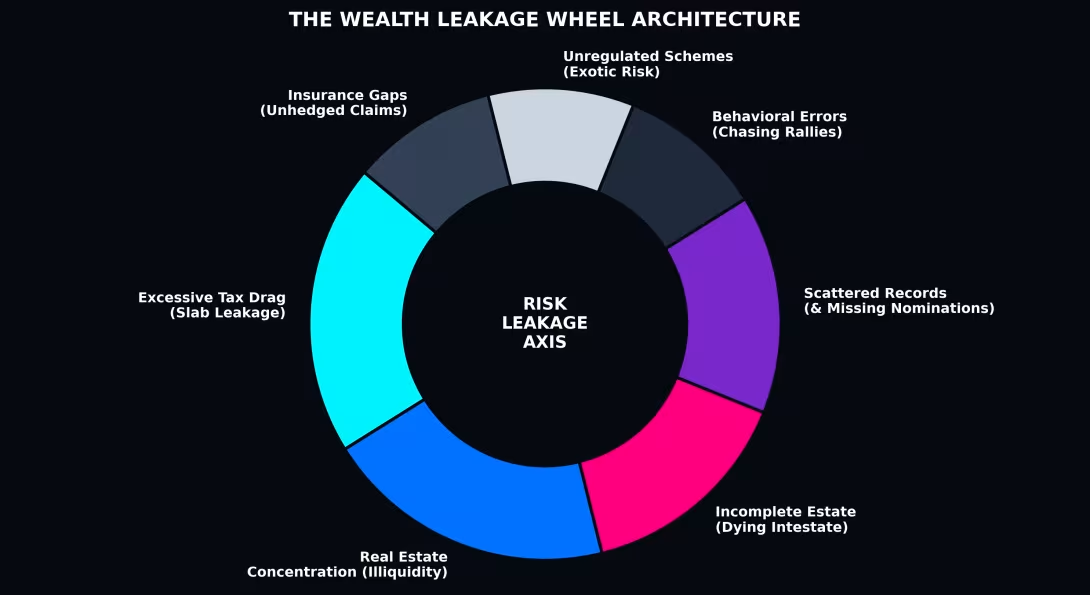
An incredibly common structural error among affluent Indian households is accumulating a massive concentration in physical real estate. A typical portfolio lifecycle often begins with a primary residence, expands into a vacation home, adds commercial real estate parcels, and accumulates speculative land plots. This sequence frequently results in 60% to 80% of the family's total net worth being locked up in a single, illiquid asset class.
This heavy real estate concentration introduces substantial vulnerabilities into your balance sheet. Physical property allocations come with ongoing maintenance expenses, tenant management liabilities, and high transaction frictions that complicate rebalancing. Furthermore, property markets are highly illiquid and carry severe geographic concentration risk. If a family faces an immediate liquidity need during a localized market slowdown, they can find themselves asset-rich but cash-poor, forcing them to sell properties at steep discounts or liquidate high-performing equity tranches prematurely.
Mistake #3: Concentrated Stock Positions
Holding large, concentrated equity positions represents another frequent point of failure for affluent portfolios. This concentration usually accumulates through corporate employee stock options (ESOPs), founder shares in closely held private companies, or a few large, high-conviction equity selections.
While concentrated stock positions can drive rapid wealth creation during market expansions, they violate the core principles of capital preservation. There is an essential structural boundary between conviction and concentration. Relying on the performance of a single enterprise or sector exposes your entire household balance sheet to unmanaged corporate volatility, regulatory shifts, or competitive disruptions. Shifting capital into a diversified, multi-asset allocation framework protects your family's financial security from single-company shocks.
Mistake #4: Ignoring Strategic Asset Allocation
Many individual market participants spend significant time evaluating single investment products, searching for the perfect fund or timing the latest sector trend, while completely ignoring their broader Strategic Asset Allocation. Empirical data proves that your high-level asset allocation contributes far more to long-term portfolio stability and performance than individual fund selection or tactical market timing.
A resilient strategy maintains a disciplined balance across non-correlating asset classes—including domestic equities, high-quality fixed income, global indices, and alternative structures. This intentional footprint dampens portfolio volatility across full economic cycles. It ensures that when a specific region or sector faces a prolonged downturn, your broader portfolio remains protected by steady performance in other asset classes, smoothing your journey toward your goals.
Mistake #5: Excessive Tax Leakage
True portfolio performance must always be evaluated on a net post-tax baseline. Many affluent investors experience severe, unnecessary wealth erosion by failing to map the tax implications of their investment behavior. This leakage typically compounds through frequent portfolio churning, short-term trading habits, ignoring capital gains holding periods, and utilizing inefficient account structures.
Proactive tax location mapping serves as a reliable return enhancer. Consider two separate portfolios that generate exactly the same gross nominal return over a multi-year cycle. The first portfolio triggers constant short-term capital gains and routes dividend streams through a peak individual tax slab, leading to severe tax drag. The second portfolio utilizes low-turnover index tracking, structures systematic capital withdrawals efficiently, and matches assets to optimal holding structures. The second portfolio delivers a significantly higher net post-tax return, preservation-driven growth, and superior long-term compounding efficiency.
Mistake #6: Chasing Unregulated and Exotic Products
In a search for yield or prestige, affluent investors are often targeted with complex, unregulated financial products. These exotic options typically include unrated corporate debt schemes, guaranteed-return real estate platforms, unlisted shadow tokens, and complex offshore investment structures that operate outside standard regulatory boundaries.
Deploying capital into these perimeters introduces severe operational vulnerabilities into your balance sheet. Higher structural complexity does not naturally translate into higher risk-adjusted returns; it frequently just conceals hidden counterparty risks, illiquidity locks, and a complete absence of investor protection frameworks. A professional fiduciary framework prioritizes regulated oversight, absolute transaction transparency, and proven liquidity profiles, ensuring your hard-earned capital remains anchored in safe, verifiable asset classes.
Mistake #7: Ignoring Tactical Liquidity Planning
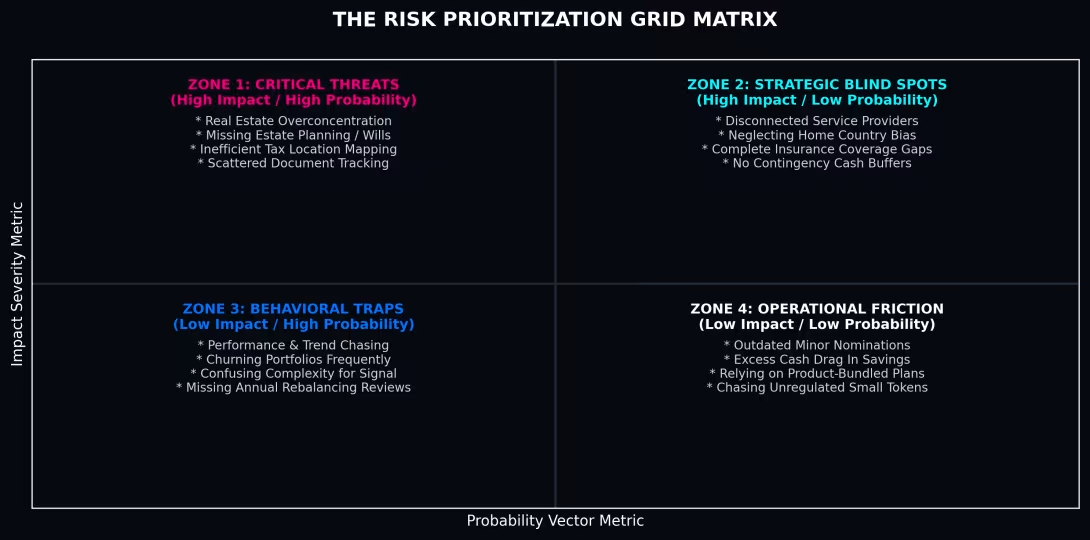
A common vulnerability among property-rich investors, successful corporate promoters, and family business owners is becoming asset-rich but liquidity-poor. Maintaining an exceptional net worth on a spreadsheet can create a false sense of security if the underlying capital is locked in illiquid, multi-year vehicles.
When an unexpected personal emergency, corporate downturn, or high-value investment opportunity arises, a complete lack of liquid cash creates significant financial strain. Without structured liquidity buckets, families are often forced to take out expensive short-term loans, clear assets at deep discounts, or liquidate high-performing equity portfolios right during a major market correction. True balance sheet insulation requires keeping a dedicated portion of your net worth in highly liquid, low-volatility channels to handle immediate cash needs smoothly.
Mistake #8: No Emergency or Contingency Planning
A pervasive behavioral blind spot is assuming that formal emergency planning is a basic discipline meant only for middle-income households. This assumption leaves affluent families exposed to sudden, unmanaged macro disruptions. Major economic events—such as sudden business downturns, changes in global trade policies, lengthy legal disputes, or black swan market crashes—can catch even wealthy households off guard if they lack structural cash cushions.
A professional risk management framework establishes dedicated, unhedged contingency reserves. These liquidity layers are designed to fund your family's baseline lifestyle expenses for extended periods during prolonged macro disruptions, protecting your core investment engines from being disrupted by forced, premature liquidations.
Mistake #9: Inadequate or Improper Insurance Protection
Many affluent professionals carry severe insurance gaps, holding either insufficient coverage limits or inefficient, product-bundled policies that combine insurance with low-yield investments. Relying on inadequate protection means your core equity capital remains directly exposed to unexpected personal risks.
Securing a complex balance sheet requires separating your insurance protection from your investment strategy, utilizing dedicated, high-value risk shields:
- Super-Top-Up Health Insurance: Establishing high-limit private healthcare shields to insulate your liquid capital from long-term medical cost inflation.
- Pure Term Insurance: Maintaining substantial, low-cost term protection to secure your family's lifestyle continuity and back outstanding debt liabilities.
- Personal Accident & Disability Covers: Protecting your household's future earnings against major lifestyle or career disruptions.
- Key Person & Professional Liability Insurance: Guarding corporate promoters, business owners, and active specialists against commercial liabilities and operational claims.
Mistake #10: Poor Documentation and Scattered Records
As families accumulate wealth across multiple financial platforms over their careers, their documentation often becomes scattered and fragmented. Portfolios frequently end up split across disconnected mutual fund registries, old bank deposit folios, physical property deeds, unlisted equity certificates, and forgotten insurance accounts.
This lack of organization introduces a silent risk to your estate. If an unexpected crisis hits, your surviving family members can face immense stress executing frantic searches across disconnected institutions simply to identify the family's true asset base. Building a resilient legacy requires organizing and maintaining a centralized, secure Personal Wealth Inventory that documents every single asset tranche alongside clear verification keys.
Mistake #11: Outdated or Missing Asset Nominations
A major operational point of failure across the Indian financial landscape is maintaining outdated or incomplete asset nominations across active accounts. Investors frequently set up nominations decades earlier when opening an account, then fail to update them following major life transitions like marriage, the birth of children, or the passing of an original nominee.
Leaving asset nominations incomplete creates immense administrative friction during an estate transition. It can cause immediate account freezes and force surviving family members to navigate the public court system to secure legal titles. Ensuring every single bank account, demat folio, mutual fund investment, and insurance wrapper features clear, aligned, and regularly updated nomination profiles is an essential requirement for smooth capital transmission.
Mistake #12: The Absolute Absence of Estate Planning
The most severe threat to multi-generational wealth preservation is a total failure to engage in formal Estate Planning. Many affluent individuals delay this process under the false assumption that estate planning is either an exclusive tool reserved for billionaire dynasties or something that can be handled later in life.
Dying intestate—without a legally valid, uncompromised Will—means your intentions are completely erased from the legal system. Your accumulated wealth is thrust into a rigid, public distribution grid governed strictly by statutory personal succession laws. This path forces your surviving heirs to spend years pursuing expensive Succession Certificates or Letters of Administration, exposing your family's balance sheet to public scrutiny and creating fertile ground for multi-generational legal battles that can tear apart family harmony.
Mistake #13: Unstructured Inheritance Planning
Even when an investor drafts a basic Will, passing multi-crore asset pools in a single, unstructured step can introduce significant challenges if your heirs are unprepared to manage that scale of capital. Passing substantial wealth directly to minor children, young adults, or family members who lack financial literacy can quickly lead to mismanaged capital, exposure to predatory financial actors, or emotional stress.
Securing an intergenerational transition requires a structured approach to inheritance. This strategy focuses on preparing your heirs through ongoing financial education, establishing clear governance rules, and implementing staggered wealth distribution timelines, ensuring your family legacy serves as a lasting foundation for purpose-driven growth.
Mistake #14: Ignoring Holistic Family Governance
Empirical wealth data reveals a sobering trend: the vast majority of substantial family fortunes disappear within three generations. This loss rarely stems from poor investment returns or market volatility; it is driven primarily by a breakdown in family communication, misaligned expectations, and a complete absence of formal Family Governance.
When a household lacks a shared decision-making framework, asset growth can give way to internal conflict once the primary wealth creator passes. Protecting your legacy requires looking past simple account management to establish a formal Family Constitution. Leading regular family meetings and defining clear wealth education parameters helps align your family's values across generations, transforming your financial capital into a resilient, shared legacy.
Mistake #15: Operating Without a Retirement Income Strategy
Affluent investors and corporate executives often spend their entire careers focused exclusively on the wealth accumulation phase, developing deep habits around saving and investing. However, transitioning from accumulation to cash flow extraction requires a complete shift in strategy. Many families encounter significant financial stress by attempting to enter retirement without a formal Retirement Income Strategy.
Managing a distribution portfolio requires a thorough understanding of cash flow matching, tax-efficient extraction routing, and Sequence of Returns Risk (the hazard of a major market drop hitting right when you begin your lifestyle withdrawals). Failing to build a structured income engine can force you to redeem equity units at depressed valuations during a correction, permanently shrinking your core portfolio. A resilient plan builds dedicated cash buffers and systematic withdrawal models to ensure steady lifestyle funding through all market phases.
Mistake #16: Falling Into Home Country Bias
An underlying vulnerability inside many domestic portfolios is an extreme concentration in Home Country Bias. A successful Indian professional often draws their active salary income locally, keeps their primary and secondary properties inside the country, and allocates their liquid capital exclusively into domestic equity and debt markets.
Keeping 100% of your career and investment capital tied to a single economic region exposures your entire balance sheet to localized regulatory adjustments, single-country valuation cycles, and currency purchasing power drops. Shifting a disciplined portion of your wealth into international indices and global tech sectors provides an important macroeconomic hedge, protecting your global purchasing power and aligning your capital with your family's future international spending needs.
Mistake #17: Chasing Performance and Trend Cycles
The classic behavioral error in wealth management is chasing historical returns—increasing your exposure to specific asset classes or trendy sectors only after a massive market rally. This behavior is usually driven by emotional recency bias and media hype, leading individual market participants to buy into overvalued sectors at macro cyclical peaks.
Conversely, these same investors frequently panic and exit their core strategies during standard market corrections, locking in short-term losses and missing out on the subsequent economic recovery. This emotional cycle of buying high and selling low severely damages your compounding momentum. Managing this risk requires replacing emotional, return-chasing behavior with an automated, rule-based rebalancing framework that enforces discipline across full economic horizons.
Mistake #18: Confusing Structural Complexity with Sophistication
Affluent investors are frequently presented with highly complex financial structures, bespoke international contracts, multi-layered derivative paths, and alternative fractional products under the pretense of premium sophistication. It is critical to recognize that adding layers of structural complexity rarely translates into higher risk-adjusted portfolio returns.
In reality, excessive complexity often serves to obscure high underlying management costs, hidden transaction fees, illiquidity locks, and structural tax inefficiencies that create a drag on your net returns. A true fiduciary framework values simplicity and clarity over unnecessary noise. An optimized strategy anchors your wealth in transparent, highly liquid, low-cost, and goal-aligned multi-asset allocations that are easy to monitor and adapt over time.
Mistake #19: Shunning a Periodic Review Process
A wealth management plan cannot operate as a static, set-and-forget spreadsheet. Many families experience long-term financial mismatches by failing to implement a disciplined, Periodic Review Process to keep their strategy aligned with their changing lives.
Your financial architecture must evolve alongside your life transitions—including marriages, the birth of children, corporate career shifts, expanding business footprints, regulatory updates, and changes in domestic tax regimes. A strict quarterly or annual review allows you to systematically rebalance your asset exposures, update risk parameters, adjust liquidity buffers, and verify compliance boundaries, ensuring your portfolio remains completely aligned with your long-term goals.
Mistake #20: Lacking a Trusted, Coordinated Advisory Relationship
The final common point of failure for affluent balance sheets is maintaining a fragmented network of disconnected service providers. An investor may work with an independent Chartered Accountant (CA) for tax filings, a corporate lawyer for business structures, a relationship manager at a commercial bank, a separate broker for stock lines, and individual agents for insurance policies.
Operating without a centralized, objective coordinator often results in a highly fragmented strategy. Your CA may optimize a return path without verifying your portfolio's liquidity needs, while your banker routes capital into high-commission products that conflict with your tax planning or estate goals. Managing a complex balance sheet demands a single, coordinated relationship built to align every moving part of your financial life into a unified blueprint.
How a SEBI Registered Investment Adviser Prevents These Mistakes
Navigating the intersections of multi-asset allocation, complex tax compliance, holding bucket adjustments, and estate continuity completely on your own can quickly turn into an exhausting second job. That is precisely why partnering with a fee-only, SEBI Registered Investment Adviser (RIA) is so vital. A true fiduciary adviser looks past short-term transaction volumes or product distribution sales pitches. Their focus is completely on your long-term success.
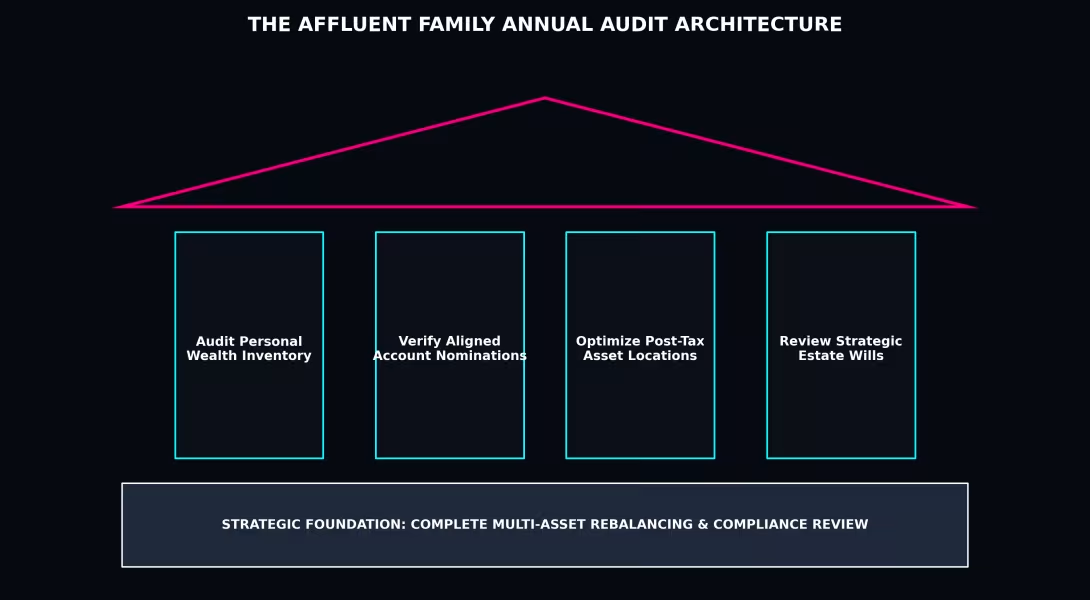
A professional RIA serves as an objective risk manager for your total balance sheet, delivering unbiased advice designed to protect your capital from avoidable structural errors. Your adviser helps you build an accurate personal wealth inventory, align account nominations, implement rule-based rebalancing frameworks, optimize your net post-tax returns, and host clear family wealth discussions. This comprehensive relationship establishes strong guardrails around your capital, helping you make informed decisions across full market cycles.
The Cost of Inaction: The Hidden Multiplier of Delay
When analyzing wealth management vulnerabilities, it is critical to recognize that the most destructive financial errors are rarely the result of making a wrong decision. Far more wealth is lost through inaction—the choice to continually delay necessary protective steps despite understanding their long-term importance.
Affluent professionals often spend years putting off drafting a valid Will, updating outdated bank nominations, organizing scattered records, or setting up dedicated contingency reserves, distracting themselves with the daily demands of their careers or businesses. This delay represents a significant risk. Leaving your structural vulnerabilities unaddressed means you are operating your global capital base without clear legal or financial guardrails. True timeline control requires replacing procrastination with proactive execution, ensuring your protective frameworks are fully established long before they are needed.
"Wealth is not preserved by exceptional investment returns alone. It is preserved through thoughtful planning, disciplined execution, proper governance, and avoiding the mistakes that silently erode financial success over time."
The Wealth Together Partnership
At Wealth Together, our relationship model is completely decoupled from conflict-laden sales commissions or hidden distribution networks. Having successfully navigated this exact corporate transition ourselves, we understand the unique pressures facing high-end technology professionals and modern families. Our mission is to serve as an objective, trusted sounding board—helping you eliminate structural vulnerabilities, optimize your net after-tax cash flows, manage real-world sequence of returns risks, and ensure that your portfolio operates within a highly coordinated financial architecture built to preserve your family's wealth and autonomy for generations.
We invite you to explore our custom Get Started Roadmap to understand our transparent, fee-only advisory onboarding process, or seamlessly utilize our floating portal block to secure your personalized, uncompromised wealth discovery session today.
Skip commission-driven sales pitches and align your capital with a pure fee-only fiduciary adviser.