For high-earning technology executives, medical specialists, corporate promoters, and affluent families in India, accessing financial commentary has never been easier. The explosion of digital media channels, public stock tip groups, messaging platform alerts, and unregulated financial influencers has created a continuous stream of market ideas. Yet, this abundance of data highlights a critical challenge for wealth preservation: when financial recommendations are available everywhere, identifying personalized, conflict-free guidance becomes a complex engineering problem.
Most retail market participants evaluate investment suggestions based on short-term past performance metrics or engaging presentation styles. This approach ignores the underlying structural risks of unvouched guidance. A professional fiduciary framework treats wealth management as an integrated risk-mitigation discipline. True portfolio insulation requires separating generalized financial education from personalized asset allocation, analyzing hidden commission conflicts, enforcing absolute suitability benchmarks, and establishing clear audit trails. Managing these boundaries carefully ensures your core capital is protected from unnecessary operational and compliance failures.
The Fiduciary Axiom: Financial Context vs. Louder Market Voices
The value of financial counsel lies entirely in verified, legally binding accountability. A portfolio idea generated outside a regulated framework carries a severe structural flaw: it lacks a mandatory suitability assessment matched to your specific tax brackets, cash flow timelines, and liability horizons. When an investor acts on unvouched, high-turnover recommendations, they are exposing their household balance sheet to unmanaged volatility. A high-performing investment product cannot compensate for a broken planning foundation.
The Rise of Investment Advice Everywhere
The modern financial ecosystem has experienced a massive shift in how investment ideas are distributed. Individual investors are continuously exposed to portfolio recommendations across mainstream social networks, dedicated financial media profiles, streaming video channels, and private messaging groups. This open access has successfully lowered entry barriers for retail market participants, but it has simultaneously introduced unprecedented operational risks for affluent portfolios.
Never before has financial commentary been so accessible, yet never before has it been so difficult to verify whether a specific transaction is appropriate for your unique balance sheet. The ease of publishing unverified strategies has created an environment where loud, speculative recommendations routinely overshadow disciplined risk management, turning what looks like free information into a significant source of capital erosion.
Information vs. Advice: Understanding the Crucial Difference
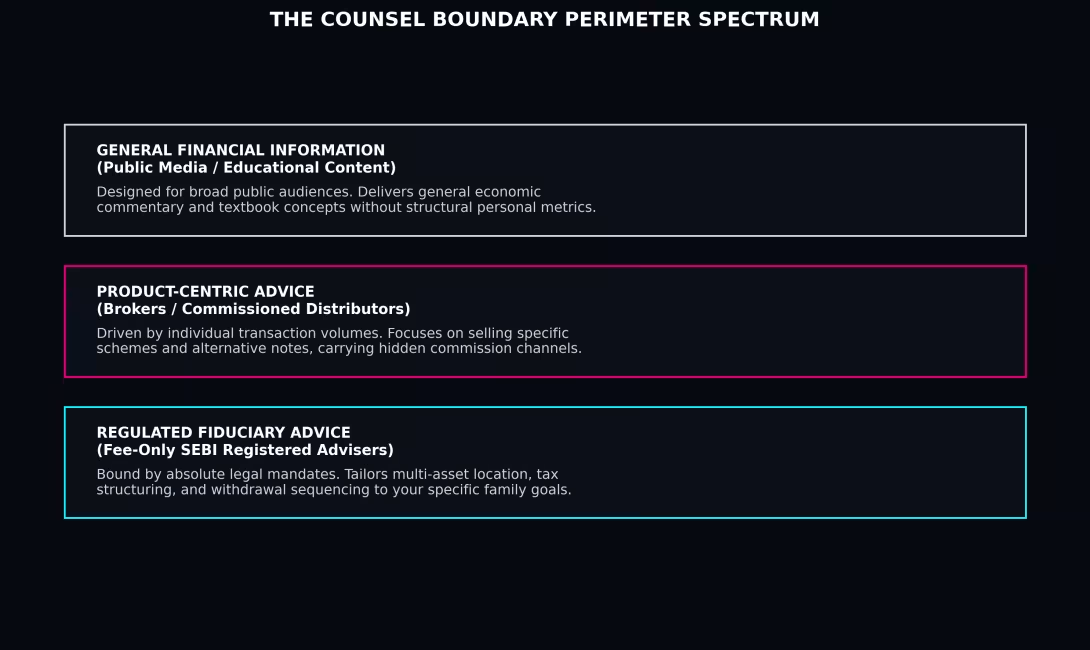
Protecting your compounding capital requires enforcing a strict boundary between generalized Financial Education and personalized Investment Advice. Financial education includes macro market updates, broad economic discussions, textbook asset class explanations, and historical performance charts. This data is purely informational, lacks a specific target, and carries no legal obligation regarding personal outcomes.
Personalized investment advice, by contrast, is a regulated engineering process. It requires executing formal risk profiling, determining precise asset location metrics, building tailored multi-asset allocation strategies, and providing specific, documented transaction instructions. Content creators and financial commentators operate as publishers; they are not fiduciaries. True investment advice can only be delivered by a regulated professional who holds a mandatory legal obligation to put your financial interests ahead of all product distribution channels.
The Hidden Cost of Poor Advice
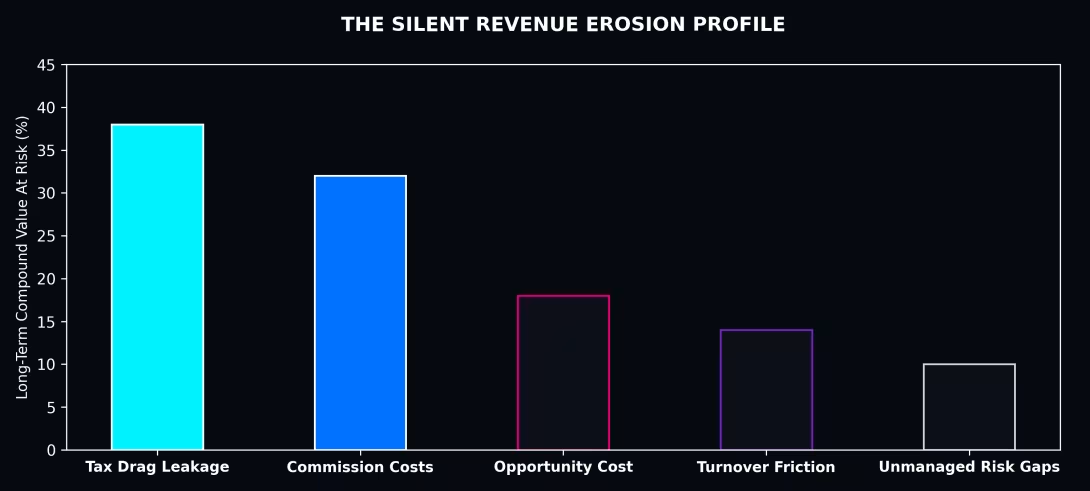
Many individual investors evaluate the risk of unvouched recommendations solely by tracking visible capital losses when a speculative stock tip falls. This narrow focus ignores the compounding, structural costs that poor guidance introduces to a mature balance sheet. The real drag of uncoordinated advice manifests across parallel operational areas:
- Structural Tax Leakage: High-turnover recommendations trigger short-term capital gains taxes and unnecessary slab liabilities, significantly lowering your net post-tax returns.
- Severe Concentration Risks: Chasing hot sector ideas concentrates family wealth into a few high-volatility tranches, leaving your capital exposed to single-industry disruptions.
- Irreversible Opportunity Costs: Stagnating inside high-commission regular mutual fund tracks or poorly managed setups causes your capital to lag behind low-cost, direct indexing alternatives.
- Behavioral Portfolio Damage: Reacting to short-term digital market hype leads to frequent strategy switches, locking in transaction frictions and disrupting your long-term compounding timeline.
Understanding the Regulatory Landscape
Navigating the domestic wealth management landscape requires understanding the separate roles, incentives, and legal obligations governing different financial participants. The ecosystem is split into distinct operational perimeters:
| Ecosystem Participant | Primary Revenue / Compensation Model | Legal & Regulatory Status | Fiduciary Binding Mandate |
|---|---|---|---|
| Financial Educators / Media Creators | Ad Revenue, Platform Sponsorships, Subscriptions | Unregulated / Public Commentators | None |
| Mutual Fund Distributors (MFDs) | Embedded commissions paid by asset companies | Regulated via AMFI guidelines | None (Distribution Standard) |
| Insurance Agents / Wealth Brokers | Upfront product commission tranches | Regulated via IRDAI / Exchange rules | None (Sales Mandate) |
| SEBI Registered Investment Advisers | Direct Client Fees Only (Pure Fee-Only) | SEBI (Investment Advisers) Regulations | Absolute Fiduciary Obligation |
The Finfluencer Phenomenon and Unregistered Advice
The rapid expansion of financial influencers stems from their relatable communication styles, easily digestible content blocks, and strong social proof. For many retail investors, following a popular online portfolio seems like a simple shortcut to financial success. However, deploying serious capital based on digital video trends introduces major blind spots to your balance sheet.
Online recommendations are naturally generic and designed for broad audience reach. They operate with total portfolio blindness, ignoring your personal liabilities, cash flow requirements, and existing asset concentrations. When an unregistered entity issues stock tips or portfolio allocations without conducting proper risk profiling or executing signed suitability matrices, they are bypassing essential investor safety checks. If a highly promoted strategy suffers a severe correction, the individual investor is left holding the losses alone, exposed to an environment that lacks formal regulatory oversight or legal accountability.
The Problem with Unregistered Investment Advice
Operating without formal regulatory protection leaves an affluent family balance sheet highly vulnerable. Unregistered networks function outside the boundary of compliance protocols, meaning they omit essential risk profiling and suitability verification entirely. Without signed audit trails, ongoing rebalancing reviews, or documented investment rationales, investors cannot track deviations or monitor strategic risks over time. This absence of oversight creates an environment where if an unsuitable macro allocation fails, there is no structural recourse available to the consumer, turning unregulated counsel into an expensive trial of self-directed damage control.
The Mis-Selling Trap and Complex Alternative Structuring
True asset insulation requires recognizing that Mis-Selling occurs whenever an investment product is selected because it maximizes the revenue of the distributor rather than the financial safety of the investor. This conflict of interest is especially visible when affluent families are targeted with high-commission insurance-led investment structures, unsuitable Portfolio Management Services (PMS), or complex Alternative Investment Funds (AIFs) masquerading as unbiased wealth planning.
Consider Structured Products—such as capital protection notes or market-linked debentures—frequently presented to HNIs as advanced financial options. These exotic strategies often bundle complex derivative overlays with high underlying fee structures, opaque valuation models, and long lock-in constraints that limit your liquidity. If an investor cannot easily explain how an investment generates its returns and handles its downside risks, they do not fully understand the product's underlying structural volatility.
Why Suitability Matters More Than Product Selection
The foundation of institutional capital preservation is the concept of Suitability. In a professional financial architecture, an investment product cannot be evaluated in isolation. The exact same financial instrument can serve as an appropriate, stabilizing tool for Investor A, while acting as a highly destructive, destabilizing risk for Investor B.
A rigorous suitability analysis determines whether a transaction should be executed by reviewing your entire household balance sheet. Your adviser must evaluate your time horizons, target liquidity needs, current cash flows, individual tax brackets, existing real estate or corporate liabilities, and overall risk tolerance. Prioritizing suitability over simple product picking ensures your capital remains aligned with your long-term family goals through changing economic cycles.
Red Flags Investors Should Watch For
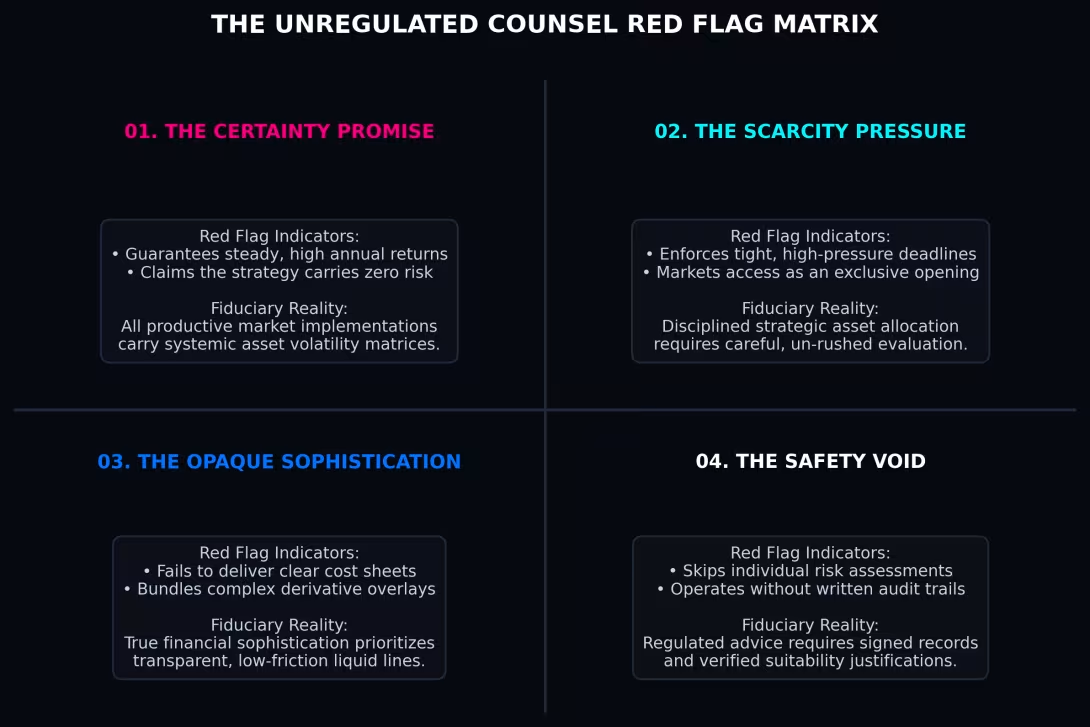
Protecting your assets from predatory sales practices requires maintaining a strict, objective checklist. If a wealth manager or investment promoter exhibits any of the following behavior, it represents a direct threat to your capital:
- Guarantees high annualized returns while claiming the strategy carries zero market risk.
- Uses high-pressure selling tactics, marketing opportunities as limited-time or exclusive openings.
- Claims access to private, secret algorithms or unverified multi-bagger stock tip networks.
- Fails to deliver formal, written documentation detailing the transaction's complete cost structures.
- Attempts to execute asset sales without conducting a thorough individual risk profile or signed suitability assessment.
The Due Diligence Framework: Ten Steps to Safer Execution
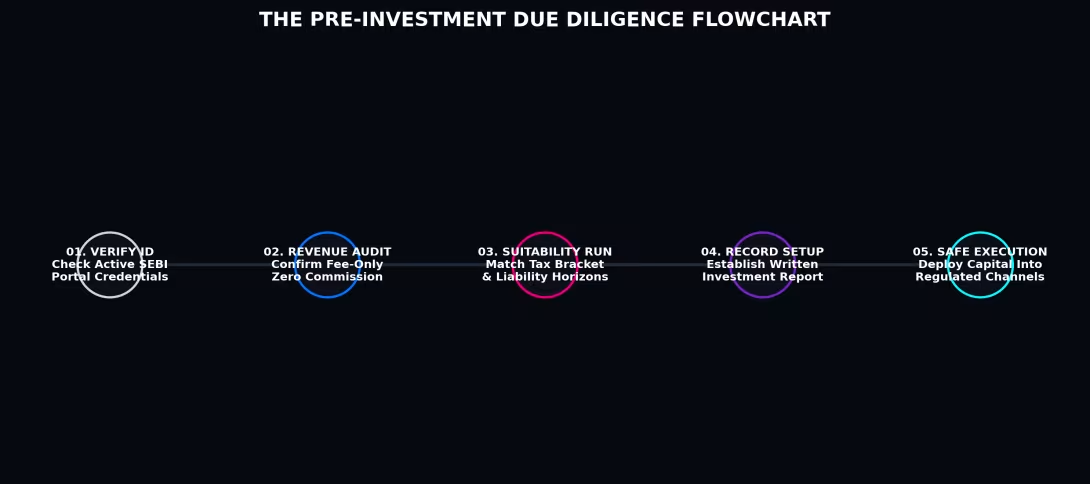
Before deploying capital into any investment channel, affluent families must systematically execute a strict due diligence process to protect their balance sheet from structural failures:
- Verify SEBI Registration: Insist on validating the provider's active regulatory license directly on the official SEBI portal database.
- Audit Compensation Methods: Demand absolute clarity on how the adviser is paid, ensuring they do not accept hidden product commissions or trailing distribution incentives.
- Uncover Conflicts of Interest: Request a formal, written statement confirming whether the firm receives back-end incentives from corporate product providers.
- Analyze Downside Risks: Move past optimistic return charts to evaluate worst-case drawdown scenarios and maximum capital volatility metrics.
- Review Compliance Audit Trails: Ensure every portfolio recommendation is backed by a signed risk profile and an explicit suitability analysis report.
- Verify Liquidity and Exit Paths: Review the exact lock-in timelines and check for early exit penalties before transferring any capital.
- Map Post-Tax Efficiency: Model your expected net returns after accounting for current capital gains rules and your individual income tax slab.
- Assess Historical Records: Evaluate past performance records using verified, audited long-term benchmarks rather than selective snapshot windows.
- Examine Documentation Quality: Reject informal chat room tip streams; demand institutional-grade investment rationale reports.
- Eliminate Sales Pressure: Maintain control over your execution timeline; never sign agreements under rushed or urgent conditions.
The Psychology of Poor Financial Decisions
It is a notable paradox that highly intelligent, successful professionals with decades of analytical experience frequently fall victim to unvouched financial recommendations. This vulnerability is driven by deep behavioral biases that distort logical risk management.
When markets experience strong momentum, individual investors are often driven by an emotional Fear Of Missing Out (FOMO) and basic greed, leading them to abandon disciplined asset allocation templates. This behavior is reinforced by Social Proof and Authority Bias—assuming a strategy must be safe simply because it has significant online traction or is promoted by a visible media figure. Recognizing these psychological traps helps you remain anchored to a rule-based, objective financial blueprint.
Hidden Risks Beyond Direct Investment Losses
When an unvouched financial recommendation goes wrong, direct capital loss is often just the initial impact. Uncoordinated advice introduces parallel vulnerabilities that can cause ongoing damage to your family estate:
- Compounding Tax Leakage: High-frequency asset churning triggers unnecessary short-term capital gains outlays that disrupt your compounding momentum.
- Severe Liquidity Constraints: Getting locked into opaque alternative products leaves you asset-rich but cash-poor during personal emergencies.
- Unmanaged Concentration Gaps: Over-allocating to a single trending sector leaves your household balance sheet exposed to localized economic shocks.
- Estate Continuity Blockades: Operating without aligned asset nominations or clear documentation lines creates immediate account freezes during life transitions.
Case Studies: The Real Impact of Unsuitable Advice
Analyzing hypothetical financial scenarios highlights how a single uncoordinated recommendation can introduce ongoing stress to an affluent household balance sheet:
- The Retiree Liquidity Freeze: A senior executive approaching retirement is advised to shift their baseline safety capital out of low-risk fixed income into an opaque, high-commission Alternative Investment Fund (AIF) promoting outsized yields. When a market slowdown triggers a multi-year liquidity freeze within the fund, the family's regular cash flows are disrupted, forcing them to liquidate core equity holdings at depressed valuations to meet ongoing lifestyle expenses.
- The Professional Insurance Drag: A high-earning technology specialist is persuaded to allocate significant capital into complex, product-bundled insurance policies marketed as premium wealth management. Over a five-year cycle, the strategy generates low returns that fail to clear the hurdle rate of inflation, while locking their principal behind high exit charges that complicate portfolio rebalancing.
- The HNI Concentrated Bet: A successful promoter allocates a large portion of their liquid capital into a single, high-conviction startup venture following unregulated social media advice. When the sector faces unexpected regulatory tightening, the business experiences a severe valuation drop, causing a permanent capital loss that delays the family's long-term estate planning goals.
Product-Centric Sales vs. Holistic Financial Planning
A product-centric sales approach treats wealth management as a series of disconnected transactions, focused entirely on pitching individual schemes, selling complex alternative notes, or moving capital into high-commission products. This model operates with a complete blind spot regarding how those individual components impact your broader financial structure.
A planning-centric fiduciary strategy treats your balance sheet as a single, highly coordinated architecture. Before analyzing individual investment vehicles, your adviser must build a deep understanding of your household liabilities, cash flow requirements, current tax brackets, existing asset concentrations, insurance protections, and cross-generational succession goals. This integrated approach ensures every transaction serves a clear purpose within a unified long-term strategy.
Why Comprehensive Documentation Matters
Good wealth management decisions rely on explicit, verifiable written documentation. A professional advisory relationship does not operate through casual text messages, informal chat rooms, or unrecorded verbal agreements. Every single portfolio recommendation must be backed by a clear, accessible audit trail.
Maintaining comprehensive written documentation—including formal investment rationale reports, signed risk profiles, structured suitability disclosures, and transparent fee agreements—protects your family estate from operational mistakes. This disciplined record-keeping ensures that if your household strategy needs to be reviewed or adapted during a major life transition, your executors hold clear, verifiable blueprints to manage your capital safely.
Investor Protection Mechanisms and Compliance Guardrails
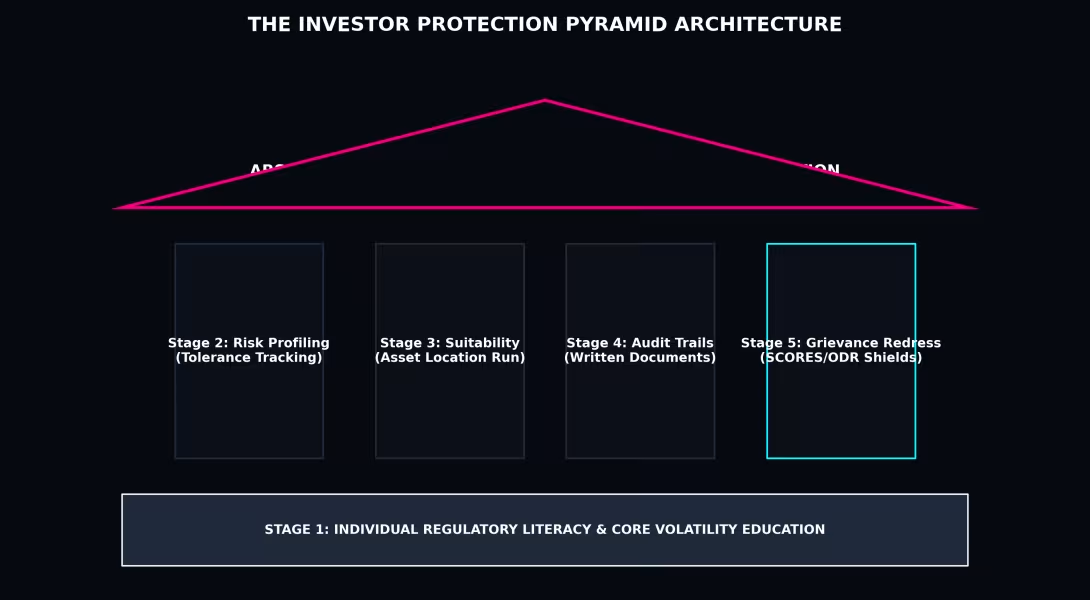
A core advantage of partnering with a SEBI-regulated professional is gaining direct access to robust institutional investor protection frameworks. The Securities and Exchange Board of India has established strict compliance structures designed to guarantee absolute data transparency and manage adviser conflicts:
- The SEBI SCORES System: A centralized, regulated online grievance redressal platform that allows investors to file formal complaints against regulated entities, enforcing mandatory resolution timelines.
- The Online Dispute Resolution (ODR) Architecture: A modern, digital arbitration framework designed to resolve financial disputes transparently, completely bypassing expensive and lengthy court procedures.
- Mandatory Fiduciary Compliance: Regulated advisers are subject to strict record-keeping rules, regular institutional compliance audits, and clear conflict-of-interest disclosures, providing an important layer of safety for your household capital.
What Happens When Nobody Is Accountable?
To understand the true value of a regulated financial framework, contrast how your capital base is protected across separate operational environments when a market disruption occurs:
- Scenario A (The Unregulated Channel): An investor deploys capital based on an unvouched online stock tip or chat room recommendation. If the strategy faces a severe correction, there is no formal record of advice, no individual suitability analysis, no ongoing risk monitoring, and a total absence of legal accountability. The investor is left navigating the capital disruption completely alone.
- Scenario B (The Regulated Fiduciary Track): The investor executes transactions within a SEBI-compliant framework. Every recommendation is backed by an explicit investment rationale report, an individual risk assessment, and a signed suitability analysis. The strategy is subject to regular professional reviews and backed by institutional grievance redressal networks, ensuring your family assets remain completely protected by formal compliance guardrails.
The Real Cost of Free Advice
The ultimate reality of wealth management is that unvouched, "free" financial advice is rarely free. When an investor relies on recommendations that do not charge a visible, upfront service fee, the true cost of that guidance simply manifests through hidden channels—including high embedded product commissions, unnecessary portfolio turnover drag, improper tax location mapping, and exposure to unmanaged market volatility.
The long-term cost of poor advice consistently exceeds the transparent fee of a professional, fee-only fiduciary relationship. Reclaiming complete control over your financial lifecycle requires replacing transaction-driven distribution models with an independent, fee-only SEBI Registered Investment Adviser to align your capital allocation cleanly with your family's long-term prosperity.
Building a Safer Decision-Making Framework
To transition from high-risk, uncoordinated execution to a highly secure wealth preservation framework, affluent households must systematically adopt a disciplined, multi-step decision tree:
First, prioritize personal financial education to understand core market mechanics, while completely tuning out short-term speculative hype. Second, verify the active SEBI registration and compensation structures of your service providers to eliminate commission-driven conflicts of interest. Third, enforce an absolute suitability check before executing any transaction, ensuring the asset perfectly matches your specific tax bracket, time horizon, and cash flow needs. Fourth, insist on building a clear, comprehensive written audit trail for every single portfolio decision. Finally, implement a disciplined annual review process to keep your global strategy completely aligned with your changing lifestyle goals.
The Wealth Together Partnership
At Wealth Together, our relationship model is completely decoupled from conflict-laden sales commissions or hidden product distribution networks. Having successfully navigated this exact corporate transition ourselves, we understand the unique pressures facing high-end technology professionals, promoters, and modern families. Our mission is to serve as an objective, trusted sounding board—helping you define an uncompromised asset location strategy, eliminate structural tax leakages, manage sequence of returns risks, and ensure your global assets operate within a highly secure financial architecture built to preserve your family's autonomy for generations.
We invite you to explore our custom Get Started Roadmap to understand our transparent, fee-only advisory onboarding process, or seamlessly utilize our floating portal block to secure your personalized, uncompromised wealth preservation discovery session today.
Skip commission-driven sales pitches and align your capital with a pure fee-only fiduciary adviser.