In the landscape of modern personal finance, a dangerous reductionism has taken hold. For many individual market participants, the concept of "financial planning" has been hollowed out to mean nothing more than setting up standard Systematic Investment Plans (SIPs) in active mutual funds and casually tracking equity returns. This is a critical misconception.
An isolated investment strategy is not a financial plan; it is merely a single component within a complex, interconnected machine. True, holistic financial planning is a comprehensive engineering discipline. It demands a unified architecture that seamlessly balances wealth accumulation with aggressive risk insulation, structural tax optimization, dynamic liabilities matching, and the absolute verification of clean generational asset transmission. Wealth creation does not automatically equate to long-term financial well-being; a family commanding a ₹2 Crore equity portfolio can remain deeply vulnerable if their balance sheet lacks structural liquidity reserves, valid testamentary documents, and conflict-free risk guardrails.
The Holistic Well-Being Framework
Just as an enterprise system architecture requires defensive redundancy, your household balance sheet demands an uncompromised defensive perimeter. Before a single rupee is deployed into volatile equity markets, a true fiduciary framework establishes an emergency liquidity matrix tailored to your specific fixed burn-rate, conducts rigorous insurance adequacy mapping to neutralize downside catastrophes, and balances your overall asset-to-liability ratios.
Before Investing: Constructing the Personal Financial Balance Sheet
Sustained wealth accumulation cannot occur in a vacuum. Before designing an asset allocation engine, you must map your current financial reality by establishing a comprehensive Personal Financial Balance Sheet. This exercise requires aggregating all active assets—including liquid cash buffers, direct equity tranches, mutual fund holdings, and statutory retirement accounts like the Employees' Provident Fund (EPF) and Public Provident Fund (PPF)—and contrasting them directly against existing short-term or long-term liabilities, such as residential home loans, commercial lines, or high-interest credit obligations. Understanding this initial asset-to-liability cross-section ensures you construct your growth tranches on a stable foundation.
The Emergency Liquidity Matrix: Protecting the Compounding Engine
An emergency corpus does not exist merely to cover unexpected household bills; its strategic purpose is to safeguard your long-term compounding assets from forced, premature liquidations during market corrections. When an economic shock or sudden career transition occurs, an unbuffered portfolio forces the investor to sell equities at deeply depressed valuations, permanently destroying the momentum of compounding. To prevent this operational friction, a structured liquidity matrix isolates capital into dedicated time horizons based on your income volatility:
| Household Income Profile | Recommended Emergency Buffer | Target Deployment Instruments | Core Strategic Purview |
|---|---|---|---|
| Salaried Technology Executives | 6 to 12 Months of Fixed Overheads | Liquid Mutual Funds, High-Yield Savings Ledger | Insulates the family balance sheet from corporate restructurings and labor market shifts. |
| Self-Employed / Promoters | 12 to 24 Months of Fixed Overheads | Arbitrage Direct Plans, Treasury Bills | Dampens the impact of variable business cash flows and seasonal revenue drawdowns. |
| Single-Income Households | Elevated Conservative Buffer (12M+) | Overnight Funds, Ultra-Short Debt Tracks | Provides an enhanced safety margin to protect against single-point-of-failure risk. |
Insurance Architecture: Pure Risk Subtraction vs. Yield Traps
An essential rule of wealth protection states that insurance is purchased to transfer risks you cannot afford to carry, not to generate investment returns. Retail portfolios are frequently cluttered with expensive, commission-heavy traditional insurance products—such as endowment schemes or Unit Linked Insurance Plans (ULIPs)—that combine insurance with subpar investment components, resulting in expensive under-insurance.
An institutional wealth architecture relies on pure risk subtraction via unbundled, low-cost instruments. This strategy requires securing high-sum-assured term life insurance to shield dependents, standalone personal health insurance with independent super top-up policies to bypass the traps of employer-only coverage, and dedicated personal accident and critical illness policies to handle long-term disability risks. This clean separation ensures your wealth-building loops operate independently from your insurance protection lines.
Deconstructing the Risk Appetite Illusion
One of the greatest hazards in wealth management is incorrect behavioral profiling. When the public markets are expanding, almost all investors consider themselves naturally aggressive. However, true risk tolerance is an algorithmic cross-section of your objective financial capability and your psychological capacity to endure drawdown loops without panic-selling.
Through institutional risk profiling, we map out your exact financial constraints against clear timeline goals. This ensures that short-term market volatility never compromises your long-term wealth stability, allowing you to systematically organize your capital allocations based on the exact priority and duration of your real-world household targets.
Goal-Based Tiering: Linking Investments to Life Milestones
An unanchored investment strategy easily devolves into speculative return-chasing. To maintain structural discipline, your capital allocations must be guided by a clear goal-based architecture where your milestones dictate your choice of investments, rather than letting market products dictate your milestones. Portfolios achieve maximum alignment when cash requirements are divided into distinct priority categories:
- Essential Milestones (Non-Negotiable): This category covers baseline retirement income streams, primary family health buffers, and core educational funding. These allocations require highly secure, tax-aware compounding setups with automated rebalancing tracking.
- Important Milestones (Flexible Timelines): This tier includes major property acquisitions, business funding tranches, or targeted legacy goals. These can be adjusted dynamically based on prevailing equity market valuations.
- Lifestyle and Aspirational Milestones (Discretionary): This tier covers premium international travel, luxury expenditures, and leisure outflows. These are funded by harvesting alpha surpluses generated during equity market expansions.
Constructing independent liquidity reserves completely insulated from market volatility to shield your family from macroeconomic disruptions, while avoiding toxic, high-cost traditional insurance policies that bundle insurance with subpar investment components.
Deploying structural capital loops cleanly into highly cost-efficient avenues. For an exhaustive mathematical analysis of the immense drag hidden distribution fees inflict on your primary compounding path, explore our deep-dive report on The Regular Mutual Fund Cost Trap.
Modern Tax Regime Optimization: Navigating the New Framework
Tax mitigation is a direct multiplier of your net portfolio yield. There is a widespread, inaccurate consensus across the retail market that the modern, simplified tax regime is completely devoid of strategic planning opportunities or legal deductions. This view misses the tactical optimizations built right into the compliance code.
By structuring capital vectors intelligently, serious investors can extract significant extra income using advanced legal mechanisms within the new regime. Utilizing corporate components, deploying structured National Pension Scheme (NPS) corporate allocations under Section 80CCD(2), and executing tactical, year-end capital gains harvesting protocols allow you to completely strip away unnecessary revenue leakage, safely keeping more of your hard-earned wealth compounding inside your own ledger.
The Hidden Cost of Inaction: The 10-Year Retirement Penalty Math
In an era continuously disrupted by rapid AI advancements, structural labor market shifts, and unpredictable geopolitical volatility, delaying retirement planning is a critical risk. Younger professionals frequently treat retirement as a distant, abstract event that can be addressed down the road. However, because compounding math operates exponentially, time is your ultimate leverage asset.
Let's look at a rigorous mathematical simulation. Suppose your goal is to build a target corpus of ₹10 Crores by the age of 60, assuming an uncompromised long-term market baseline return of 12% per annum:
| Planning Starting Age | Time Horizon Remaining | Target Corpus Goal | Required Monthly SIP Investment | The Lifetime Delay Penalty |
|---|---|---|---|---|
| Age 30 (Immediate Action) | 30 Years | ₹10 Crores | ₹28,610 / month | Baseline |
| Age 40 (10-Year Delay) | 20 Years | ₹10 Crores | ₹1,00,090 / month | 3.5x Monthly Capital Drag |
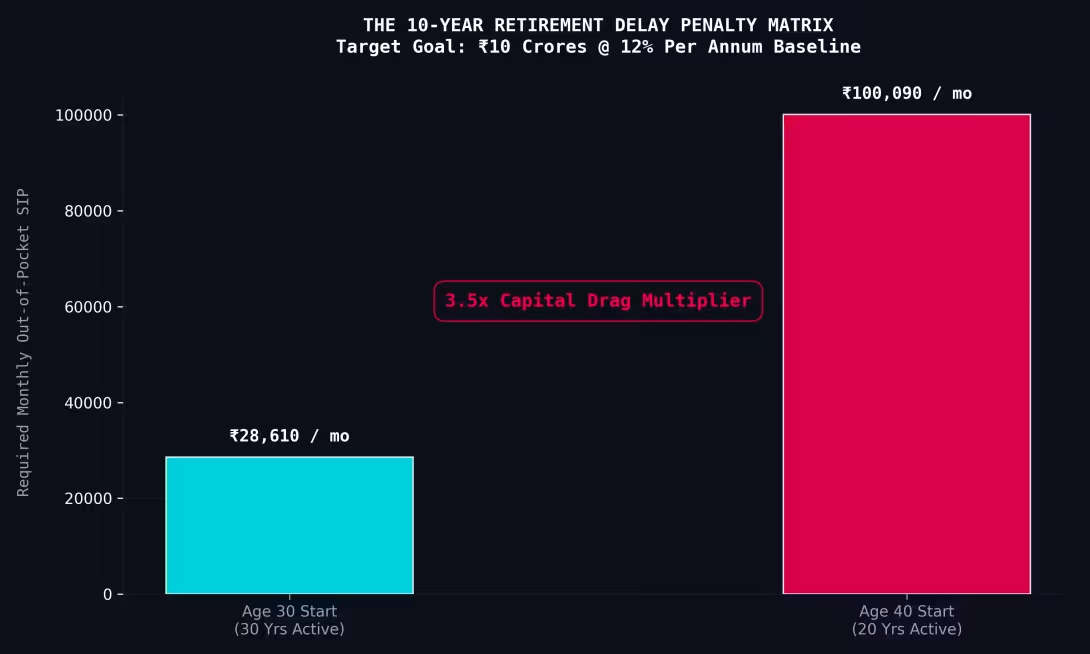
The mathematical reality is stark. Waiting a single decade completely alters the math, forcing you to deploy nearly 3.5 times more capital every single month to hit the exact same wealth target. Commencing your strategy early doesn't just reduce your required savings rate—it completely preserves your ability to relax and enjoy your current life experiences without being forced into an extreme, high-stress savings mode. Modern financial freedom is not about stopping work completely; it is about securing the flexibility to transition into advisory roles, consulting tracks, or passion projects with total peace of mind.
Democratizing Estate Planning: Wills, Trusts, and Capital Preservation
If retirement planning is frequently delayed, estate planning is almost completely ignored. A prevailing cultural myth assumes that Wills and private family Trusts are exclusive legal structures reserved solely for ultra-wealthy dynasties. In reality, every single working adult holding real estate, equity portfolios, or corporate insurance coverage needs immediate estate architecture.
A critical point that many families overlook is the legal difference between a Nomination and a Legal Will. Under Indian regulatory guidelines, a nominee acts merely as an administrative trustee—a temporary custodian authorized to collect insurance proceeds or mutual fund units. They are legally bound to hand those assets over to your legitimate legal heirs as dictated by your valid Will or succession laws. Failing to formalize a registered Will leaves your family exposed to severe administrative friction, frozen accounts, and prolonged asset delivery delays. Setting up clear testamentary documentation removes these risks, ensuring your wealth transfers smoothly according to your true intentions.
The Lifelong Philosophy of Wealth and Autonomy
The ultimate purpose of building wealth is not to endlessly accumulate assets on a digital spreadsheet. Money is simply an instrument to buy back complete sovereignty over your daily schedule, protect your physical health, and secure precious time with your loved ones.
COMPREHENSIVE AUTONOMY — Securing true lifestyle independence requires aligning your capital loops with your personal values. To explore a real-world case study on how this systematic framework looks when put into action, read our cornerstone blueprint detailing our founder's journey: Achieving Financial Independence at 35: From IT Engineering to SEBI RIA.
Financial Planning Mistakes That Cannot Be Fixed by Higher Returns
The single most dangerous misconception in the retail market is the belief that superior fund selection or aggressive asset performance can compensate for a structurally broken financial plan. Investors frequently obsess over optimizing their returns from 12% to 15%, while leaving massive, unchecked vulnerabilities across their broader financial life.
In the real world, a major financial crisis will easily overwhelm market alpha. Consider the systemic structural mistakes that no level of investment performance can ever fix:
- Operating Without a Independent Health Insurance Shield: Relying exclusively on corporate group cover means that if a health issue triggers a career transition, your protection evaporates instantly. A sudden medical emergency can quickly drain a portfolio if you are forced to liquidate long-term assets to cover healthcare bills.
- Lacking a Dedicated Emergency Liquidity Buffer: Forcing a portfolio to fund short-term household emergencies during a market downturn locks in capital losses and stops your compounding momentum right when it matters most.
- Relying on Asset Nominations Without a Valid Will: Allowing your investments to compound into millions without clear testamentary documents guarantees that your estate faces prolonged probate delays and administrative blockades.
- Carrying Outdated or High-Cost Consumption Debt: Allowing toxic, un-optimized consumer liabilities or credit balances to compound against your income creates an automatic drag that easily outpaces your equity market gains.
- Keeping the Family Isolated from Wealth Awareness: Failing to maintain an open financial dialogue with your spouse and dependents means that if an unexpected life event occurs, your family lacks the operational knowledge required to access, manage, and protect the wealth you worked for.
"A 15% return portfolio cannot compensate for a broken financial plan. True financial independence is achieved by establishing defensive guardrails around your capital, ensuring your wealth can withstand real-world disruptions across full market cycles."
The True Role of a SEBI Registered Investment Adviser
Navigating this multi-variable financial machine completely on your own can quickly turn into an exhausting second job. That is precisely why partnering with a fee-only, SEBI Registered Investment Adviser (RIA) is so vital. A true fiduciary adviser looks past short-term transaction volumes or sales pitches. Their focus is completely on your long-term success.
At Wealth Together, our relationship model is completely decoupled from conflict-laden sales commissions or hidden distribution networks. Having successfully navigated this exact corporate transition ourselves, we understand the unique pressures facing high-end technology professionals and modern families. Our mission is to serve as an objective, trusted sounding board—delivering algorithmically sound advice paired with dedicated, empathetic handholding to guide you through every major financial decision.
We invite you to explore our custom Get Started Roadmap to understand our transparent, fee-only advisory onboarding process, or seamlessly utilize our floating portal block to secure your personalized, uncompromised lifetime wealth discovery session today.
Skip commission-driven sales pitches and align your capital with a pure fee-only fiduciary adviser.